

Published on June 19, 2026 | Updated on June 19, 2026 | 9 min read
BIAN Explained: The Banking Industry Reference Model
What BIAN is, its service-domain landscape for banking, why a shared reference model reduces integration cost, and how it complements TOGAF and ArchiMate — a clear TOFU primer.
Looking for an enterprise architecture software platform? Use our EA tool evaluation guide and run the EA maturity assessment.
Key takeaways
- How to translate strategy into architecture priorities and delivery increments.
- How to align business, data, application, and technology decisions.
- How to sustain execution discipline with measurable architecture governance.
Strategy-to-execution alignment
Enterprise architecture creates leverage when strategic priorities are translated into capability-level outcomes and delivery sequencing.
This requires a shared language between executives, architecture leaders, and delivery organizations.
- Define measurable capability outcomes tied to strategic goals
- Map cross-domain dependencies before portfolio commitment
- Review architecture assumptions at each roadmap increment
What BIAN is
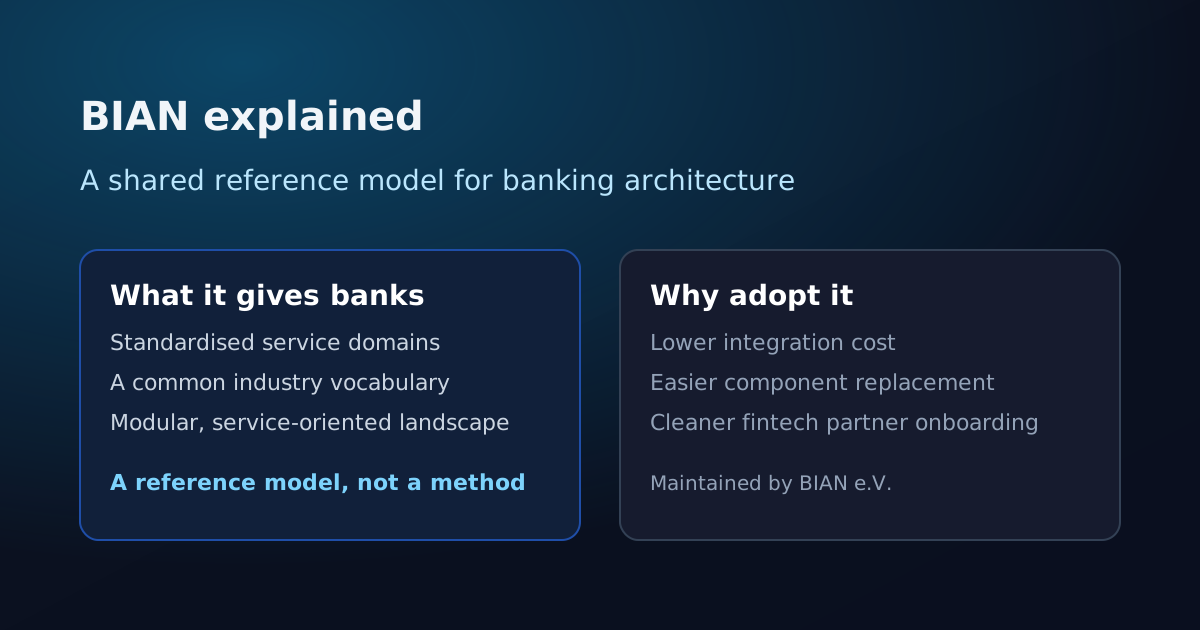
BIAN — the Banking Industry Architecture Network — is a not-for-profit association of banks, technology vendors, system integrators and academics that maintains a shared reference model for banking architecture. Its purpose is to give the whole industry a common language for what a bank does, so that systems from different vendors can fit together with less custom integration.
The model's centrepiece is a service landscape: a structured catalogue of standardised banking capabilities. Rather than each bank inventing its own map of capabilities, BIAN offers an industry-agreed one. This primer paraphrases BIAN's core ideas; the authoritative source is the BIAN organisation's own published standard.
The service landscape and service domains
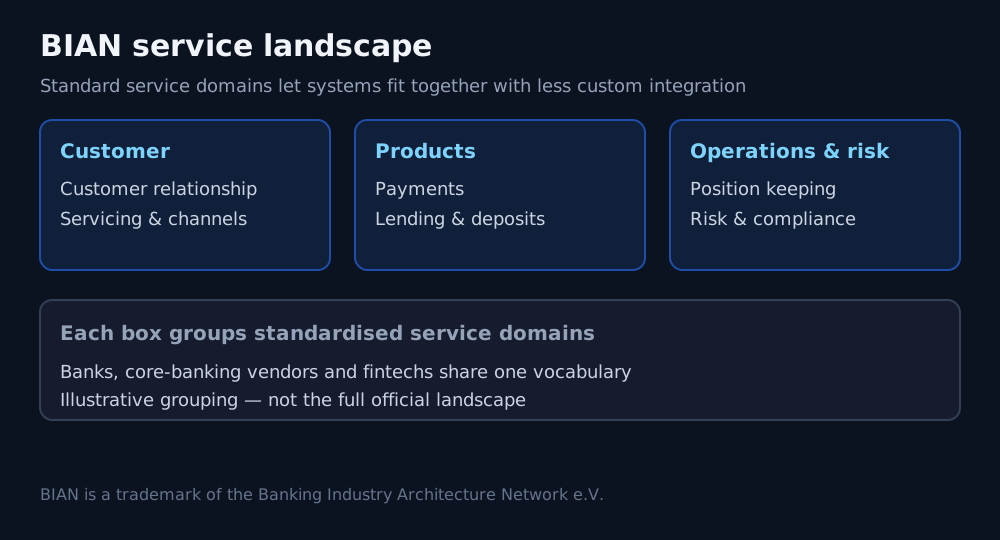
At the heart of BIAN are service domains — discrete, standardised units of banking capability, each with a clear boundary and responsibility. Examples in spirit include capabilities around payments, customer relationship management, lending, and position keeping. The service landscape groups these domains into business areas and domains so that the whole of a bank can be mapped at a glance.
The value of describing a bank this way is modularity. When capabilities are defined as standard service domains, you can reason about replacing one component without unravelling the rest, and you can compare what you have against what the market offers. That is the opposite of a monolith where everything is entangled.
- Service domains: standardised units of banking capability
- Business areas and domains: how those units are grouped
- A common vocabulary shared across banks, vendors and integrators
- A basis for modular, service-oriented landscapes rather than monoliths
A clear introduction to BIAN, the Banking Industry Architecture Network: what the reference model is, its service landscape, and how it fits with TOGAF.
How BIAN fits with TOGAF and ArchiMate
BIAN is not a competitor to TOGAF or ArchiMate; it operates at a different level. TOGAF is a method for running an architecture effort. ArchiMate is a notation for modelling it. BIAN provides the banking-specific content — a ready-made capability map — that those general tools can carry.
A practical pattern is to use a TOGAF-style cycle to structure the work, model the architecture in ArchiMate, and adopt BIAN service domains as the capability vocabulary so the model speaks the industry's language. You get method, notation and domain content working together rather than reinventing each.
Putting BIAN to work with Archilu
For a bank, the pragmatic path is to use BIAN as the capability backbone of the architecture: map your real systems and processes to standard service domains, then use that map to plan modernisation, partner integration and component replacement. You do not need to model every domain at once — start with the areas under active change.
Archilu supports a BIAN-aligned practice by holding the business capabilities, applications, data and technology in one connected model, so you can attach systems to service domains and trace dependencies and impact across them. For regulated finance this also helps with the documentation and traceability that DORA and CSSF expectations demand. To find your starting point, Archilu's free EA maturity assessment scores ten dimensions and returns a prioritised plan in about ten minutes, and the linked guides on enterprise architecture for banks and EA tooling for the financial sector turn the model into concrete next steps. BIAN is a trademark of the Banking Industry Architecture Network e.V.
Execution alignment KPIs
These indicators show whether architecture is improving strategic execution quality.
- Capability outcome attainment vs roadmap target
- Strategic initiative delay caused by architecture dependencies
- Architecture debt trend on critical value streams
- Portfolio re-prioritization speed after risk change
Common mistakes
Strategic architecture work fails when it is disconnected from delivery sequencing and budget decisions.
- Publishing target states without execution ownership
- No dependency mapping across initiatives
- No cadence for architecture refresh based on outcomes
- No explicit link between architecture debt and portfolio risk
Practical checklist
Use this sequence to connect strategy to execution outcomes.
- Translate strategic goals into capability-level outcomes
- Map dependencies across business, app, data, and tech domains
- Define architecture decision checkpoints in roadmap cadence
- Track progress with measurable delivery and risk indicators
A clear introduction to BIAN, the Banking Industry Architecture Network: what the reference model is, its service landscape, and how it fits with TOGAF.
FAQ
What is BIAN in simple terms?
BIAN — the Banking Industry Architecture Network — is a not-for-profit association of banks, technology vendors and integrators that maintains a standard reference model for banking architecture. Its core deliverable is a service landscape: a catalogue of standardised banking capabilities, called service domains, that gives the whole industry a common vocabulary for what a bank does and how its systems should be structured. It is a reference model, not a method or a product.
Why would a bank adopt BIAN?
The main driver is integration and interoperability. When a bank, its core-banking vendor and its fintech partners all describe capabilities using the same BIAN service domains, integrating systems and replacing components becomes far less costly and ambiguous. BIAN also makes it easier to compare in-house capabilities against the market and to plan a modular, service-oriented landscape rather than a monolith.
How does BIAN relate to TOGAF?
They operate at different levels and are complementary. TOGAF is a general method for running any architecture effort. BIAN is a banking-specific reference model — a ready-made, industry-standard map of capabilities you can plug into that method. A bank typically uses TOGAF (or a similar approach) to structure the work and BIAN to provide the domain vocabulary, instead of inventing its own capability map from scratch.
How do we keep architecture aligned with strategy over time?
Run quarterly roadmap refresh using business outcomes, risk signals, and execution data.
Who should own strategy-to-architecture translation?
Enterprise architecture leadership with shared accountability from business and delivery leaders.
Strategic links
Compare enterprise architecture platforms
Related articles
IT Cost and Supplier Risk: One Map for Money and DORA
Cost and ICT third-party risk are usually managed in separate spreadsheets. Mapping applications to suppliers and cost in one model lets you see concentration, license exposure and rationalisation candidates at once — and produce the evidence DORA-minded reviews expect.
NIS2 and Enterprise Architecture: Mapping the Systems and Dependencies Risk Management Touches
NIS2 broadens the entities covered and raises the bar on cyber risk management, supply-chain security and incident handling. Each of those expectations rests on one prior question: do you actually know your systems and how they depend on each other? An EA map is the natural place to hold that — honestly, as evidence, not as a compliance badge.
CSSF and Enterprise Architecture: One Map for ICT, Outsourcing and Resilience Documentation
Banks, PFS, investment firms and fund actors supervised by the CSSF carry recurring documentation expectations around ICT, outsourcing and operational resilience. Each rests on a prior question: can you actually show your capabilities, applications, data flows and the third parties behind them? An EA repository is the natural place to hold that — honestly, as evidence, not as a compliance badge.