

Published on June 19, 2026 | Updated on June 19, 2026 | 9 min read
ArchiMate Explained: Layers, Elements and How to Use It
What ArchiMate is, its three core layers, the active/behaviour/passive structure, and the difference between a modelling language and a method — a clear TOFU primer.
Looking for an enterprise architecture software platform? Use our EA tool evaluation guide and run the EA maturity assessment.
Key takeaways
- How to translate strategy into architecture priorities and delivery increments.
- How to align business, data, application, and technology decisions.
- How to sustain execution discipline with measurable architecture governance.
Strategy-to-execution alignment
Enterprise architecture creates leverage when strategic priorities are translated into capability-level outcomes and delivery sequencing.
This requires a shared language between executives, architecture leaders, and delivery organizations.
- Define measurable capability outcomes tied to strategic goals
- Map cross-domain dependencies before portfolio commitment
- Review architecture assumptions at each roadmap increment
What ArchiMate is
ArchiMate is a modelling language for enterprise architecture, maintained by The Open Group. Its job is narrow and valuable: to give architects a standard, vendor-neutral notation for describing and visualising architecture, so that a diagram means the same thing to everyone who reads it, regardless of the tool that drew it.
That standardisation is the point. Without a shared language, architecture diagrams drift into personal conventions — boxes and arrows whose meaning lives only in the author's head. ArchiMate fixes the vocabulary so the model is communicable and durable. This primer paraphrases the core ideas; the authoritative definition is The Open Group's ArchiMate specification.
The three core layers
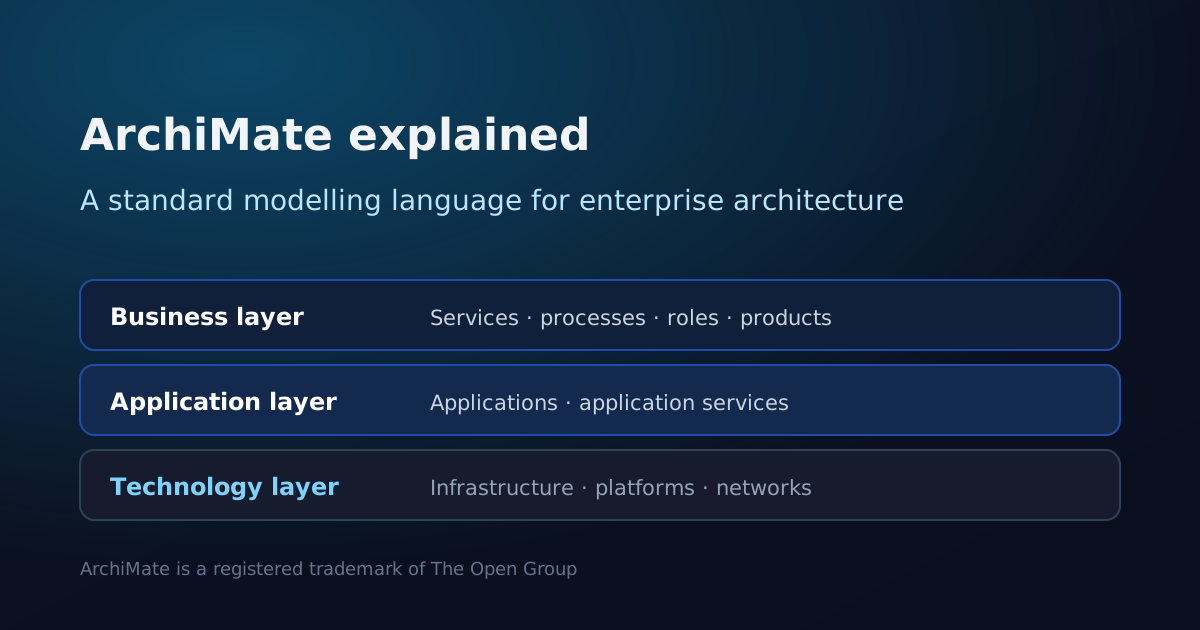
ArchiMate organises a model into layers. The three core ones are the business layer (services, processes, roles and the products customers see), the application layer (the applications and application services that support the business), and the technology layer (the infrastructure, platforms and networks beneath).
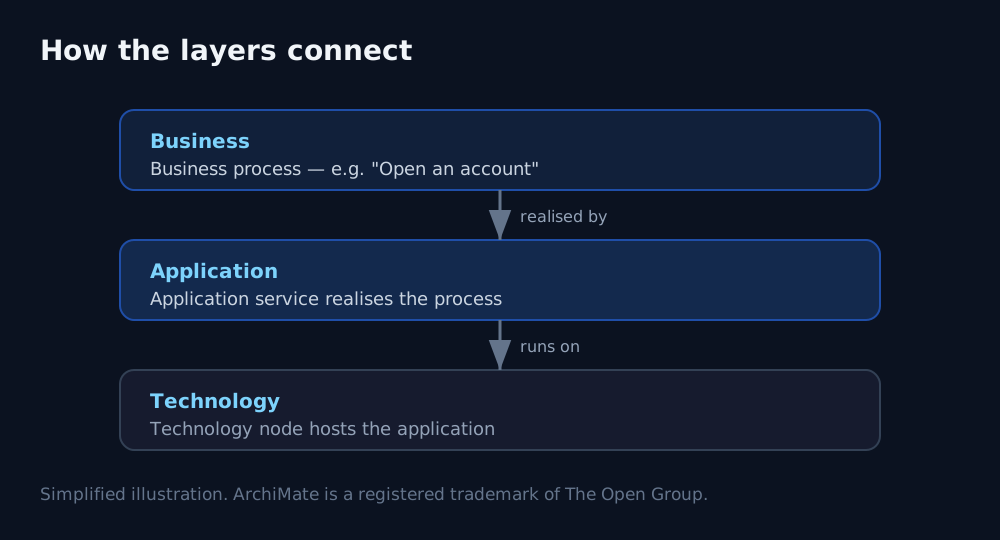
The power is in the connections across layers: a business process is realised by an application service, which is provided by an application, which runs on a technology node. Following that chain lets you trace, for example, which infrastructure ultimately supports a customer-facing service — the kind of question that is painful to answer from disconnected diagrams.
- Business layer: services, processes, roles, products
- Application layer: applications and the services they expose
- Technology layer: infrastructure, platforms, networks
- Cross-layer relationships: how each layer realises the one above
Active, behaviour and passive structure
Within each layer, ArchiMate distinguishes three kinds of element. Active structure elements are the things that perform behaviour (an application component, a business role). Behaviour elements are what they do (a process, an application function, a service). Passive structure elements are what behaviour acts upon (a data object, a business object).
This active / behaviour / passive distinction is one of the most useful ideas in the language. It keeps models consistent — you describe who does what to what — and makes diagrams comparable across teams, because everyone classifies elements the same way.
A plain-language introduction to ArchiMate: what the modelling language is, its layers and core concepts, and how it complements TOGAF in practice.
Language versus method
A frequent confusion is treating ArchiMate and TOGAF as competitors. They are not. ArchiMate is a language — it tells you how to draw and describe the architecture. TOGAF is a method — it tells you how to run the architecture effort. Both are maintained by The Open Group and are designed to work together.
In practice, teams often use the TOGAF ADM to structure a piece of architecture work and ArchiMate to model the artefacts that work produces. You can also use ArchiMate without TOGAF, or vice versa; they are complementary, not coupled.
Using ArchiMate well with Archilu
The pragmatic way to adopt ArchiMate is to start with a small, useful subset — business services and processes, the applications behind them, the technology underneath — and let the model grow with the questions you actually need to answer. Standardising the notation early pays off immediately in clarity.
Archilu supports an ArchiMate-aligned practice by holding the business, application and technology layers as one connected, queryable model rather than a set of static drawings. Because the layers and their relationships are real objects, you can trace dependencies and impact instead of redrawing diagrams by hand. Start from where you are: Archilu's free EA maturity assessment scores ten dimensions and returns a prioritised plan in about ten minutes, and the linked ArchiMate tool and TOGAF guides turn the language into concrete next steps. ArchiMate is a registered trademark of The Open Group.
Execution alignment KPIs
These indicators show whether architecture is improving strategic execution quality.
- Capability outcome attainment vs roadmap target
- Strategic initiative delay caused by architecture dependencies
- Architecture debt trend on critical value streams
- Portfolio re-prioritization speed after risk change
Common mistakes
Strategic architecture work fails when it is disconnected from delivery sequencing and budget decisions.
- Publishing target states without execution ownership
- No dependency mapping across initiatives
- No cadence for architecture refresh based on outcomes
- No explicit link between architecture debt and portfolio risk
Practical checklist
Use this sequence to connect strategy to execution outcomes.
- Translate strategic goals into capability-level outcomes
- Map dependencies across business, app, data, and tech domains
- Define architecture decision checkpoints in roadmap cadence
- Track progress with measurable delivery and risk indicators
A plain-language introduction to ArchiMate: what the modelling language is, its layers and core concepts, and how it complements TOGAF in practice.
FAQ
What is ArchiMate in simple terms?
ArchiMate is a modelling language for enterprise architecture, maintained by The Open Group. It gives architects a standard, vendor-neutral notation to describe and visualise architecture — the business, application and technology layers and the relationships between them — so that diagrams mean the same thing across teams and tools. It is a language, not a method or a product.
What is the difference between ArchiMate and TOGAF?
TOGAF is a method: how you run an architecture effort, including the ADM cycle. ArchiMate is a language: how you draw and describe the architecture in a precise, standard notation. They are complementary and both maintained by The Open Group — teams commonly use the TOGAF ADM to structure the work and ArchiMate to model the artefacts it produces.
Do I need to learn every ArchiMate element to use it?
No. ArchiMate is layered and rich, but most teams start with a small, useful subset — business services and processes, applications and their interfaces, and the technology beneath — and grow from there. The benefit comes early: a shared notation removes the ambiguity of ad-hoc boxes and arrows. Depth can be added as the practice matures.
How do we keep architecture aligned with strategy over time?
Run quarterly roadmap refresh using business outcomes, risk signals, and execution data.
Who should own strategy-to-architecture translation?
Enterprise architecture leadership with shared accountability from business and delivery leaders.
Strategic links
Compare enterprise architecture platforms
Related articles
IT Cost and Supplier Risk: One Map for Money and DORA
Cost and ICT third-party risk are usually managed in separate spreadsheets. Mapping applications to suppliers and cost in one model lets you see concentration, license exposure and rationalisation candidates at once — and produce the evidence DORA-minded reviews expect.
NIS2 and Enterprise Architecture: Mapping the Systems and Dependencies Risk Management Touches
NIS2 broadens the entities covered and raises the bar on cyber risk management, supply-chain security and incident handling. Each of those expectations rests on one prior question: do you actually know your systems and how they depend on each other? An EA map is the natural place to hold that — honestly, as evidence, not as a compliance badge.
CSSF and Enterprise Architecture: One Map for ICT, Outsourcing and Resilience Documentation
Banks, PFS, investment firms and fund actors supervised by the CSSF carry recurring documentation expectations around ICT, outsourcing and operational resilience. Each rests on a prior question: can you actually show your capabilities, applications, data flows and the third parties behind them? An EA repository is the natural place to hold that — honestly, as evidence, not as a compliance badge.