

Published on June 19, 2026 | Updated on June 19, 2026 | 9 min read
TOGAF Explained: The ADM, Domains and How to Use It
What TOGAF is, the ADM phases, the four domains and the difference between the framework and a certification — a TOFU primer for teams adopting EA.
Looking for an enterprise architecture software platform? Use our EA tool evaluation guide and run the EA maturity assessment.
Key takeaways
- How to translate strategy into architecture priorities and delivery increments.
- How to align business, data, application, and technology decisions.
- How to sustain execution discipline with measurable architecture governance.
Strategy-to-execution alignment
Enterprise architecture creates leverage when strategic priorities are translated into capability-level outcomes and delivery sequencing.
This requires a shared language between executives, architecture leaders, and delivery organizations.
- Define measurable capability outcomes tied to strategic goals
- Map cross-domain dependencies before portfolio commitment
- Review architecture assumptions at each roadmap increment
What TOGAF is — and what it is not
TOGAF is an enterprise architecture framework maintained by The Open Group, a vendor-neutral standards body. In plain terms, it is a shared method and vocabulary that lets an organisation plan, design, govern and evolve its architecture in a consistent way, rather than reinventing the approach for every project.
It helps to say what TOGAF is not. It is not a software product, not a certification you must hold to begin, and not a rigid recipe. It is a body of guidance — most visibly a process called the ADM — that teams adapt to their context. The rest of this primer paraphrases the core ideas; the authoritative source is The Open Group's own standard.
The ADM: a cycle, not a checklist
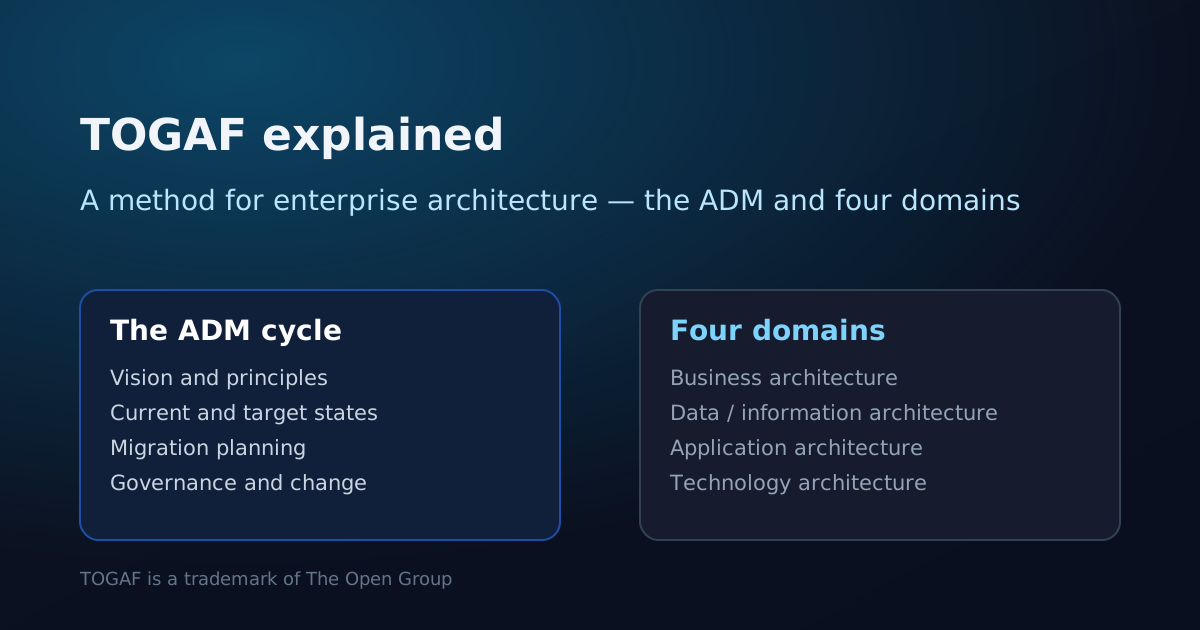
The heart of TOGAF is the Architecture Development Method, or ADM — a cyclical process for moving from strategy to delivered change and back again. It is deliberately iterative: you revisit phases as you learn, rather than marching once through a linear plan.
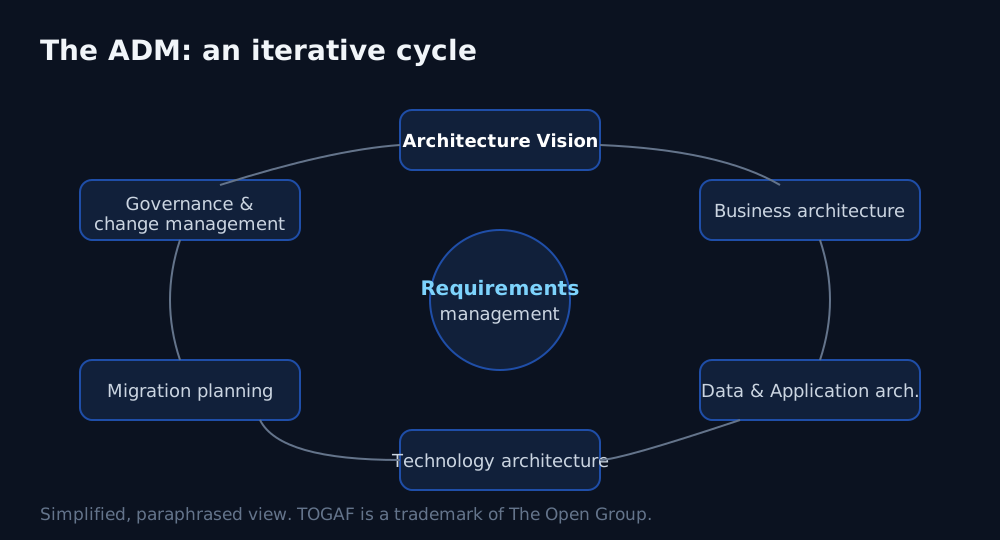
At a high level the ADM runs from a preliminary set-up, through an architecture vision, into the architecture domains, then into opportunities, migration planning, governance and change management. The diagram on this page sketches the cycle. The value is less in the exact phase names and more in the discipline: agree the vision, describe current and target states, plan the move, govern the implementation, and feed lessons back in.
- Preliminary and Architecture Vision: scope, principles and the case for change
- Business, Data, Application and Technology architectures: current and target states
- Opportunities, Solutions and Migration Planning: how to get there
- Implementation Governance and Change Management: keep it on track and current
The four architecture domains
TOGAF organises architecture into four interrelated domains. The business architecture describes capabilities, processes and organisation. The data (or information) architecture describes the data the business relies on. The application architecture describes the applications and how they support processes. The technology architecture describes the infrastructure and platforms underneath.
The domains are not silos; their value is in the links between them — which capability a process supports, which applications hold which data, which technology a given application runs on. Keeping those relationships explicit is what lets you reason about change instead of guessing at its blast radius.
A clear, plain-language introduction to TOGAF: what the framework is, the ADM cycle, the four architecture domains, and how to apply it pragmatically.
Framework versus certification
A common confusion: using TOGAF and being TOGAF-certified are different things. The framework is freely usable to structure your practice. Certification, offered by The Open Group, validates an individual's knowledge of the standard and can help with consistency and credibility — but you do not need every architect certified to start applying the ADM and the domains.
Be wary of any tool that claims to make you "TOGAF-compliant" as if that were a binary stamp. What tools can honestly do is support a TOGAF-aligned practice: hold the artefacts, structure the phases, and keep the model current.
How to apply TOGAF pragmatically with Archilu
Most organisations get value from TOGAF by adopting it selectively: use the ADM to structure a real piece of work, use the four domains to organise the model, and use a shared vocabulary so business and IT discuss the same thing. You do not need to implement every artefact the standard describes on day one.
Archilu supports a TOGAF-aligned practice without claiming any certification: it holds the business, application, data and technology layers in one connected model, supports the review and governance steps the ADM calls for, and keeps everything current so the architecture stays a living asset rather than a document. To see where to start, Archilu's free EA maturity assessment scores ten dimensions and returns a prioritised plan in about ten minutes, and the linked TOGAF tool guide and ADM checklist turn the method into concrete next steps. TOGAF is a trademark of The Open Group.
Execution alignment KPIs
These indicators show whether architecture is improving strategic execution quality.
- Capability outcome attainment vs roadmap target
- Strategic initiative delay caused by architecture dependencies
- Architecture debt trend on critical value streams
- Portfolio re-prioritization speed after risk change
Common mistakes
Strategic architecture work fails when it is disconnected from delivery sequencing and budget decisions.
- Publishing target states without execution ownership
- No dependency mapping across initiatives
- No cadence for architecture refresh based on outcomes
- No explicit link between architecture debt and portfolio risk
A clear, plain-language introduction to TOGAF: what the framework is, the ADM cycle, the four architecture domains, and how to apply it pragmatically.
FAQ
What is TOGAF in simple terms?
TOGAF is an enterprise architecture framework maintained by The Open Group. It gives organisations a common method and vocabulary for planning, designing and governing their architecture. Its best-known component is the Architecture Development Method (ADM), a cyclical process for moving from business strategy to implemented change. It is a framework, not a product.
Do I need TOGAF certification to use TOGAF?
No. The framework is freely usable to structure your practice; certification, offered by The Open Group, validates individual knowledge of it. Many teams apply TOGAF concepts pragmatically — the ADM, the domains, a shared vocabulary — without every architect being certified. Certification can help with consistency and credibility, but it is separate from simply using the framework.
How does TOGAF relate to ArchiMate?
They are complementary and both maintained by The Open Group. TOGAF is the method — how you run an architecture effort. ArchiMate is a modelling language — how you draw and describe the architecture in a standard, unambiguous notation. Teams often use the TOGAF ADM to structure the work and ArchiMate to model the artefacts the method produces.
How do we keep architecture aligned with strategy over time?
Run quarterly roadmap refresh using business outcomes, risk signals, and execution data.
Who should own strategy-to-architecture translation?
Enterprise architecture leadership with shared accountability from business and delivery leaders.
Strategic links
Compare enterprise architecture platforms
Related articles
IT Cost and Supplier Risk: One Map for Money and DORA
Cost and ICT third-party risk are usually managed in separate spreadsheets. Mapping applications to suppliers and cost in one model lets you see concentration, license exposure and rationalisation candidates at once — and produce the evidence DORA-minded reviews expect.
NIS2 and Enterprise Architecture: Mapping the Systems and Dependencies Risk Management Touches
NIS2 broadens the entities covered and raises the bar on cyber risk management, supply-chain security and incident handling. Each of those expectations rests on one prior question: do you actually know your systems and how they depend on each other? An EA map is the natural place to hold that — honestly, as evidence, not as a compliance badge.
CSSF and Enterprise Architecture: One Map for ICT, Outsourcing and Resilience Documentation
Banks, PFS, investment firms and fund actors supervised by the CSSF carry recurring documentation expectations around ICT, outsourcing and operational resilience. Each rests on a prior question: can you actually show your capabilities, applications, data flows and the third parties behind them? An EA repository is the natural place to hold that — honestly, as evidence, not as a compliance badge.