

Published on June 19, 2026 | Updated on June 19, 2026 | 9 min read
FEAF Explained: The US Federal Enterprise Architecture
What FEAF is, the reference models it uses, why it was built for government coordination, and how its ideas transfer to any large, federated organisation — a clear TOFU primer.
Looking for an enterprise architecture software platform? Use our EA tool evaluation guide and run the EA maturity assessment.
Key takeaways
- How to translate strategy into architecture priorities and delivery increments.
- How to align business, data, application, and technology decisions.
- How to sustain execution discipline with measurable architecture governance.
Strategy-to-execution alignment
Enterprise architecture creates leverage when strategic priorities are translated into capability-level outcomes and delivery sequencing.
This requires a shared language between executives, architecture leaders, and delivery organizations.
- Define measurable capability outcomes tied to strategic goals
- Map cross-domain dependencies before portfolio commitment
- Review architecture assumptions at each roadmap increment
What FEAF is and why it exists
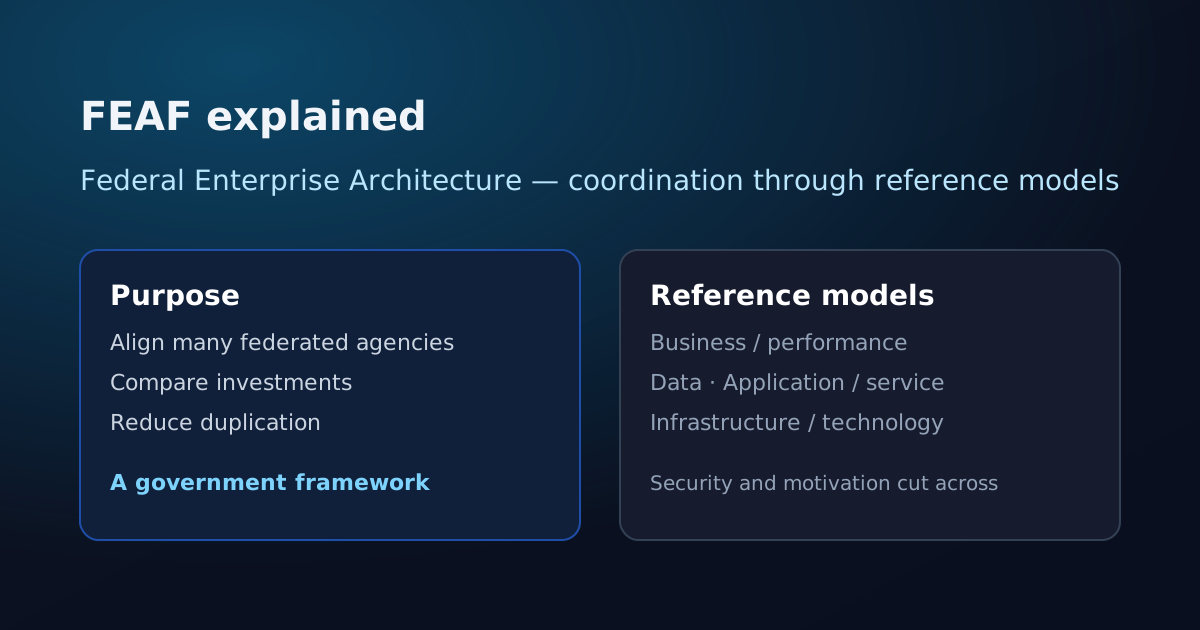
FEAF — the Federal Enterprise Architecture Framework — is the enterprise architecture framework developed by the United States federal government for its own agencies. Its reason for existing is coordination: the federal government is a vast, federated collection of departments, each with its own systems and budgets, and FEAF was built to give them a common way to describe and compare their architectures.
The animating problem is duplication and fragmentation. Without a shared structure, two agencies might fund near-identical capabilities, or be unable to share data because nothing maps cleanly between them. FEAF addresses this with common reference models and a consistent classification. This primer paraphrases the framework's intent; the authoritative source is the US government's own published guidance.
The reference models at its core
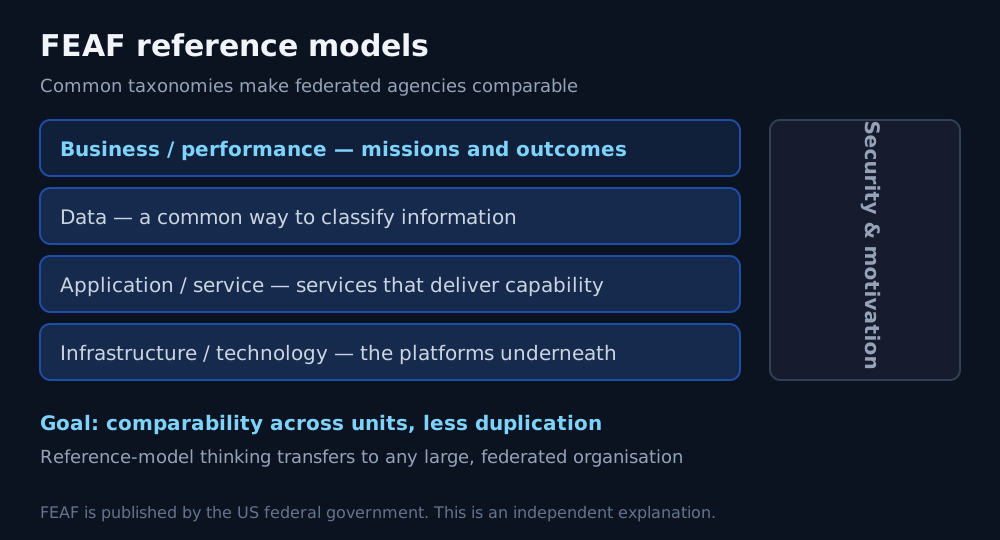
FEAF's most distinctive feature is its set of reference models — standardised taxonomies that let very different agencies describe their work in comparable terms. Across its versions the framework has organised these around business or performance, data, application or service, and infrastructure or technology, with motivation and security cutting across.
The point of a reference model is comparability. If every agency classifies its capabilities and data the same way, an oversight body can see overlaps, gaps and opportunities to consolidate. That is the mechanism by which FEAF turns thirty separate architectures into one analysable portfolio.
- Business / performance: missions, outcomes and how they are measured
- Data: a common way to describe and classify information
- Application / service: the services and systems that deliver capability
- Infrastructure / technology: the platforms underneath
- Security and motivation: concerns that cut across the others
Designed for a federated organisation
FEAF is best understood as a framework for governing many semi-autonomous units toward shared goals. Each agency keeps its own architecture, but a common layer makes the whole comparable and steerable. That federated design is what distinguishes it from frameworks aimed primarily at a single enterprise.
This is why its ideas travel beyond government. A large bank with independent business lines, a holding company with many subsidiaries, or a public administration with multiple directorates all face the same problem FEAF was built to solve: coordinating distinct units without forcing them into one rigid system.
A clear introduction to FEAF, the US Federal Enterprise Architecture Framework: what it is, its reference models, when it applies, and how it compares to TOGAF.
How FEAF compares to TOGAF and ArchiMate
TOGAF is the general-purpose, industry-neutral method most enterprises reach for; ArchiMate is the notation for modelling the artefacts. FEAF overlaps with both in concepts but differs in purpose: it is a government framework optimised for cross-agency comparison through reference models, not a universal method.
In practice the frameworks are not mutually exclusive. An organisation can use TOGAF's ADM to run the work, ArchiMate to model it, and borrow FEAF-style reference models to make units comparable. The reference-model idea is the most portable part of FEAF.
Applying FEAF ideas with Archilu
For most organisations the value of FEAF is not in adopting the federal framework literally — it is government-specific — but in stealing its best idea: a common classification that makes independent units comparable. Start by agreeing a shared reference model for capabilities and data, then describe each unit against it.
Archilu supports this kind of federated, reference-model practice by holding the business, application, data and technology layers of every unit in one connected model, so overlaps and gaps become visible instead of hidden in separate documents. To see where to begin, Archilu's free EA maturity assessment scores ten dimensions and returns a prioritised plan in about ten minutes. FEAF is published by the United States federal government; this article is an independent explanation.
Execution alignment KPIs
These indicators show whether architecture is improving strategic execution quality.
- Capability outcome attainment vs roadmap target
- Strategic initiative delay caused by architecture dependencies
- Architecture debt trend on critical value streams
- Portfolio re-prioritization speed after risk change
Common mistakes
Strategic architecture work fails when it is disconnected from delivery sequencing and budget decisions.
- Publishing target states without execution ownership
- No dependency mapping across initiatives
- No cadence for architecture refresh based on outcomes
- No explicit link between architecture debt and portfolio risk
Practical checklist
Use this sequence to connect strategy to execution outcomes.
- Translate strategic goals into capability-level outcomes
- Map dependencies across business, app, data, and tech domains
- Define architecture decision checkpoints in roadmap cadence
- Track progress with measurable delivery and risk indicators
A clear introduction to FEAF, the US Federal Enterprise Architecture Framework: what it is, its reference models, when it applies, and how it compares to TOGAF.
FAQ
What is FEAF in simple terms?
FEAF stands for the Federal Enterprise Architecture Framework, developed by the United States federal government to help its agencies plan, describe and coordinate their architectures in a consistent way. Its purpose is cross-agency alignment: a common structure and set of reference models so that separate departments can compare investments, avoid duplication and share services. It was designed for the public sector, but its underlying ideas apply to any large, federated organisation.
How does FEAF differ from TOGAF?
TOGAF is a general-purpose, vendor-neutral framework maintained by The Open Group and used worldwide across industries. FEAF is a government framework with a specific mission: coordinating US federal agencies. FEAF leans heavily on standardised reference models to make agencies comparable, whereas TOGAF centres on the ADM process. They share many architecture concepts; the difference is scope and intent rather than fundamentals.
Is FEAF relevant outside the US government?
The framework itself is specific to US federal agencies, so most private organisations would not adopt it wholesale. But its core ideas — common reference models, a consistent classification of business, data, application and infrastructure, and a focus on reducing duplication across units — are valuable to any large group of semi-autonomous divisions. Many enterprises borrow the reference-model thinking without adopting FEAF by name.
How do we keep architecture aligned with strategy over time?
Run quarterly roadmap refresh using business outcomes, risk signals, and execution data.
Who should own strategy-to-architecture translation?
Enterprise architecture leadership with shared accountability from business and delivery leaders.
Strategic links
Compare enterprise architecture platforms
Related articles
IT Cost and Supplier Risk: One Map for Money and DORA
Cost and ICT third-party risk are usually managed in separate spreadsheets. Mapping applications to suppliers and cost in one model lets you see concentration, license exposure and rationalisation candidates at once — and produce the evidence DORA-minded reviews expect.
NIS2 and Enterprise Architecture: Mapping the Systems and Dependencies Risk Management Touches
NIS2 broadens the entities covered and raises the bar on cyber risk management, supply-chain security and incident handling. Each of those expectations rests on one prior question: do you actually know your systems and how they depend on each other? An EA map is the natural place to hold that — honestly, as evidence, not as a compliance badge.
CSSF and Enterprise Architecture: One Map for ICT, Outsourcing and Resilience Documentation
Banks, PFS, investment firms and fund actors supervised by the CSSF carry recurring documentation expectations around ICT, outsourcing and operational resilience. Each rests on a prior question: can you actually show your capabilities, applications, data flows and the third parties behind them? An EA repository is the natural place to hold that — honestly, as evidence, not as a compliance badge.