


Published on June 19, 2026 | Updated on June 19, 2026 | 9 min read
Zachman Framework Explained: The 6x6 Classification Schema
What the Zachman Framework is, why it is an ontology rather than a method, its six interrogatives and six perspectives, and how it complements TOGAF — a clear TOFU primer.
Looking for an enterprise architecture software platform? Use our EA tool evaluation guide and run the EA maturity assessment.
Key takeaways
- How to translate strategy into architecture priorities and delivery increments.
- How to align business, data, application, and technology decisions.
- How to sustain execution discipline with measurable architecture governance.
Strategy-to-execution alignment
Enterprise architecture creates leverage when strategic priorities are translated into capability-level outcomes and delivery sequencing.
This requires a shared language between executives, architecture leaders, and delivery organizations.
- Define measurable capability outcomes tied to strategic goals
- Map cross-domain dependencies before portfolio commitment
- Review architecture assumptions at each roadmap increment
What the Zachman Framework is
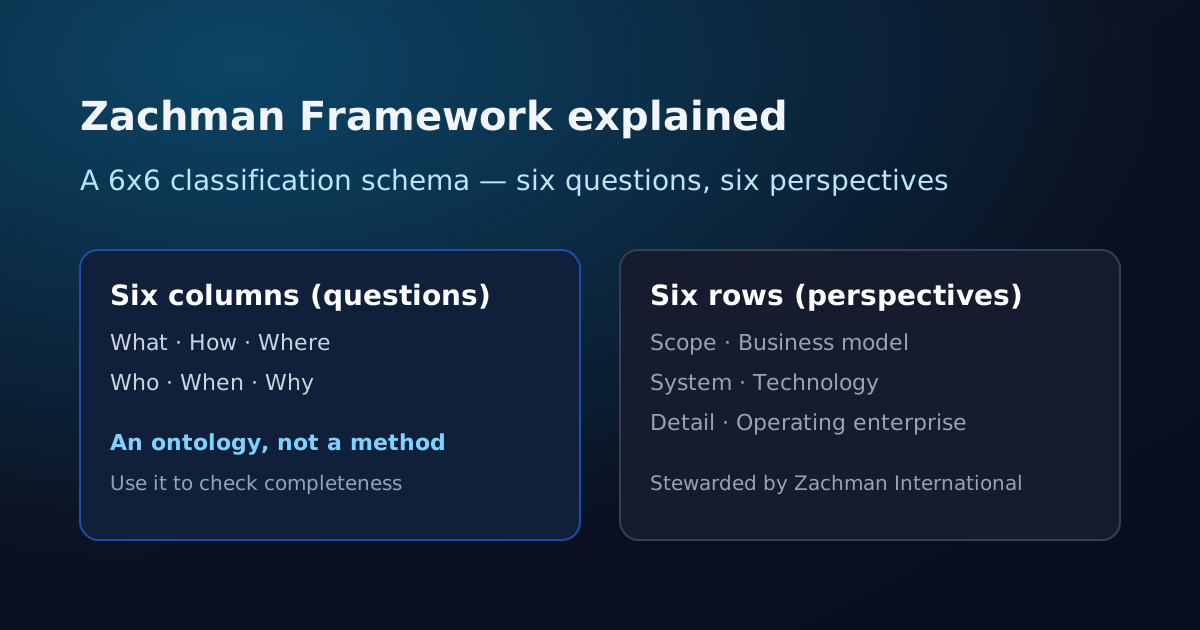
The Zachman Framework is a classification schema for the artefacts of enterprise architecture. It was originated by John Zachman in the 1980s and is stewarded today by Zachman International. In plain terms, it is a way to organise everything you might describe about an enterprise so that nothing important is missed and nothing is described twice in the wrong place.
The crucial point — and the one most often misunderstood — is that Zachman is an ontology, not a methodology. It tells you what kinds of descriptions exist and where each belongs in a structured grid. It does not tell you the process for producing them. This primer paraphrases the framework's core ideas; the authoritative source is Zachman International's own definition.
Six columns: the fundamental questions
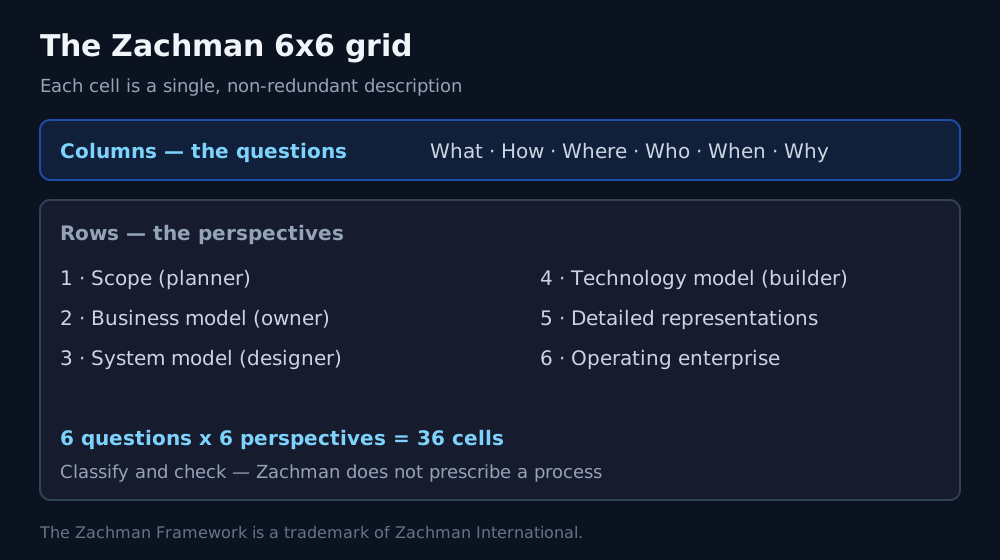
The columns of the Zachman grid are the six interrogatives that fully describe any complex thing: What, How, Where, Who, When and Why. Applied to an enterprise, they map to data, function, network, people, time and motivation respectively.
The discipline of the columns is that they are independent. The 'What' of the business (its data and things) is a different kind of description from the 'Why' (its goals and motivation). Keeping them separate is what stops architecture artefacts from blurring into one another.
- What — data and the things the enterprise manages
- How — functions and processes
- Where — locations and networks
- Who — people, roles and responsibilities
- When — timing, events and schedules
- Why — goals, strategy and motivation
Six rows: stakeholder perspectives
The rows represent perspectives — the different audiences who need a view of the enterprise. They run from the most abstract to the most concrete: the executive scope (the planner's view), the business model (the owner's view), the system model (the designer's view), the technology model (the builder's view), the detailed representations (the subcontractor's view) and finally the operating enterprise itself.
Each row is a legitimate, complete view in its own right, aimed at a real stakeholder. The value of the framework is that a cell — the intersection of one question and one perspective — is a single, primitive, non-redundant model. Thirty-six cells in total describe the enterprise without overlap.
A plain-language introduction to the Zachman Framework: what the 6x6 classification schema is, its rows and columns, and how it relates to TOGAF.
How Zachman relates to TOGAF and ArchiMate
Because Zachman classifies rather than prescribes, it sits comfortably alongside method-based frameworks. TOGAF gives you the ADM — a process to run the work. ArchiMate gives you a notation to draw the artefacts. Zachman gives you a grid to check that the set of artefacts is complete and correctly placed.
In practice, teams use them together: run a TOGAF-style cycle, model the results in ArchiMate, and use the Zachman grid as a completeness check to confirm every question and every perspective has been addressed. They answer different questions, so they do not compete.
Using Zachman pragmatically with Archilu
Few organisations populate all thirty-six cells at once, and they should not try to. The pragmatic adoption is to use the grid as a thinking and review tool — pick the cells that matter for a given decision, and let the framework expose the gaps you have been ignoring, such as an undocumented motivation column or a missing 'Where'.
Archilu supports a Zachman-aligned practice by holding the business, application, data and technology descriptions as one connected, queryable model rather than scattered documents. Because the elements and their relationships are real objects, you can see where coverage is thin and where perspectives disagree. To find your starting point, Archilu's free EA maturity assessment scores ten dimensions and returns a prioritised plan in about ten minutes. The Zachman Framework is a trademark of Zachman International.
Execution alignment KPIs
These indicators show whether architecture is improving strategic execution quality.
- Capability outcome attainment vs roadmap target
- Strategic initiative delay caused by architecture dependencies
- Architecture debt trend on critical value streams
- Portfolio re-prioritization speed after risk change
Common mistakes
Strategic architecture work fails when it is disconnected from delivery sequencing and budget decisions.
- Publishing target states without execution ownership
- No dependency mapping across initiatives
- No cadence for architecture refresh based on outcomes
- No explicit link between architecture debt and portfolio risk
Practical checklist
Use this sequence to connect strategy to execution outcomes.
- Translate strategic goals into capability-level outcomes
- Map dependencies across business, app, data, and tech domains
- Define architecture decision checkpoints in roadmap cadence
- Track progress with measurable delivery and risk indicators
A plain-language introduction to the Zachman Framework: what the 6x6 classification schema is, its rows and columns, and how it relates to TOGAF.
FAQ
What is the Zachman Framework in simple terms?
The Zachman Framework is a classification schema for enterprise architecture, created by John Zachman and stewarded by Zachman International. It is a 6x6 grid: six columns ask the fundamental questions What, How, Where, Who, When and Why, while six rows represent the perspectives of different stakeholders, from the executive scope down to the operating enterprise. Each cell holds a distinct, non-redundant kind of description. It is an ontology — a way to organise artefacts — not a step-by-step method.
Is the Zachman Framework a methodology like TOGAF?
No, and this is the most common confusion. Zachman is a structure: it tells you what kinds of descriptions exist and where each belongs, but not the process for producing them. TOGAF, by contrast, is a method — the ADM gives you a sequence of phases. The two are complementary: many teams use Zachman to classify and check the completeness of their artefacts and TOGAF to run the work that produces them.
When is the Zachman Framework most useful?
It is most useful as a completeness and communication checklist. By forcing every cell to be considered, it reveals gaps — for example a strong technology view but no documented motivation (the Why column). It is also valuable for aligning stakeholders, because each row maps to a real audience. Smaller teams often adopt a subset rather than populating all thirty-six cells at once.
How do we keep architecture aligned with strategy over time?
Run quarterly roadmap refresh using business outcomes, risk signals, and execution data.
Who should own strategy-to-architecture translation?
Enterprise architecture leadership with shared accountability from business and delivery leaders.
Strategic links
Compare enterprise architecture platforms
Related articles
IT Cost and Supplier Risk: One Map for Money and DORA
Cost and ICT third-party risk are usually managed in separate spreadsheets. Mapping applications to suppliers and cost in one model lets you see concentration, license exposure and rationalisation candidates at once — and produce the evidence DORA-minded reviews expect.
NIS2 and Enterprise Architecture: Mapping the Systems and Dependencies Risk Management Touches
NIS2 broadens the entities covered and raises the bar on cyber risk management, supply-chain security and incident handling. Each of those expectations rests on one prior question: do you actually know your systems and how they depend on each other? An EA map is the natural place to hold that — honestly, as evidence, not as a compliance badge.
CSSF and Enterprise Architecture: One Map for ICT, Outsourcing and Resilience Documentation
Banks, PFS, investment firms and fund actors supervised by the CSSF carry recurring documentation expectations around ICT, outsourcing and operational resilience. Each rests on a prior question: can you actually show your capabilities, applications, data flows and the third parties behind them? An EA repository is the natural place to hold that — honestly, as evidence, not as a compliance badge.