


Published on March 14, 2026 · Updated on March 14, 2026
What's enterprise architecture? The secret blueprint that keeps giants like Amazon and Netflix from collapsing
Imagine the scene.
Netflix suffers a major outage.
A corrupted database brings their entire platform to its knees.
Millions of users can no longer watch their movies.
Trust begins to crumble.
The financial losses are massive.
Most companies would simply patch the bug.
Netflix made a radically different decision:
they redesigned their entire architecture.
They migrated to the cloud, adopted microservices, and built a platform capable of surviving failures.
Today:
- more than 300 million subscribers
- billions of hours streamed
- constant deployments with no interruption
The question is simple:
How can a company scale to this level without collapsing?
The answer can be summed up in two words:
Enterprise Architecture.
A discipline that often remains invisible, yet is essential for transforming technological chaos into a perfectly orchestrated machine.
If your company is growing — or if you simply want to understand how digital giants stay standing — this article will reveal the master blueprint behind modern tech empires.
The Company as a Rapidly Growing City
To understand Enterprise Architecture, imagine a city.
A city experiencing explosive growth.
Houses are being built everywhere.
Roads become congested.
Water and electricity networks become difficult to maintain.
Without urban planning, the city quickly becomes chaos:
- isolated neighborhoods
- incompatible infrastructure
- growth that becomes impossible
Now translate that to a modern company.
A large organization typically has:
- hundreds of teams
- thousands of applications
- millions of lines of code
- data flowing everywhere
Without a global plan, the information system becomes an uncontrollable pile of systems.
That’s exactly what happened to Amazon in the early 2000s.
Their website relied on a massive software monolith.
Every modification risked breaking the entire system.
The solution?
Amazon decomposed their system into independent microservices.
Each service handles a specific function:
- payments
- catalog
- recommendations
- delivery
The result:
Amazon can now handle massive traffic spikes like Black Friday without their system breaking.
Behind this transformation lies a critical role:
the Enterprise Architect.
The urban planner of the company.
The Enterprise Architect: The Urban Planner of the Digital World
An Enterprise Architect usually does not write application code.
Their role is far more strategic.
They design the global blueprint of the information system.
They answer fundamental questions such as:
- How does technology support business strategy?
- How do applications communicate with each other?
- Where does the data live?
- How can the company evolve in 5 or 10 years?
Their goal is simple:
prevent complexity from exploding.
Without this role, even the best developers can build brilliant systems that become impossible to maintain at scale.
What Is Enterprise Architecture, Really?
Enterprise Architecture (EA) is the discipline that organizes and structures:
- business strategy
- business processes
- applications
- data
- technologies
so they function together in a coherent way.
In other words:
it is the blueprint of the digital enterprise.
Why is this so critical?
In large organizations, it’s common to find:
- thousands of applications
- dozens of different technologies
- duplicated data everywhere
Without a global architecture:
- IT costs explode
- projects slow down
- innovation becomes difficult
Enterprise Architecture acts like a central nervous system that keeps everything aligned.
The Four Fundamental Layers of Enterprise Architecture
Enterprise Architecture can be visualized as a pyramid composed of four layers.
Each layer supports the next.
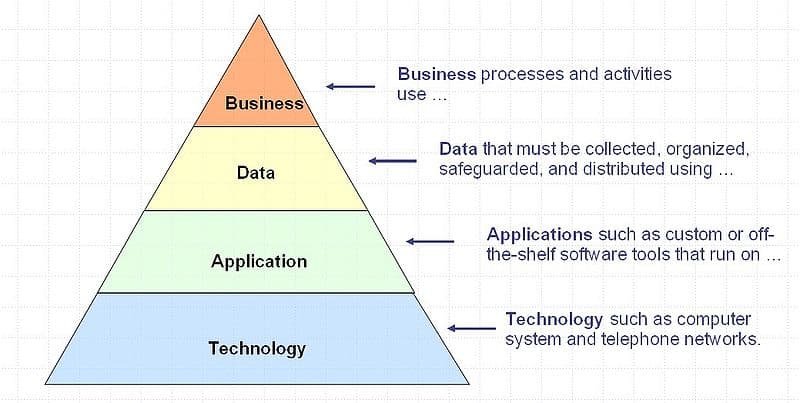
Custom diagram: four-layer Enterprise Architecture operating model.
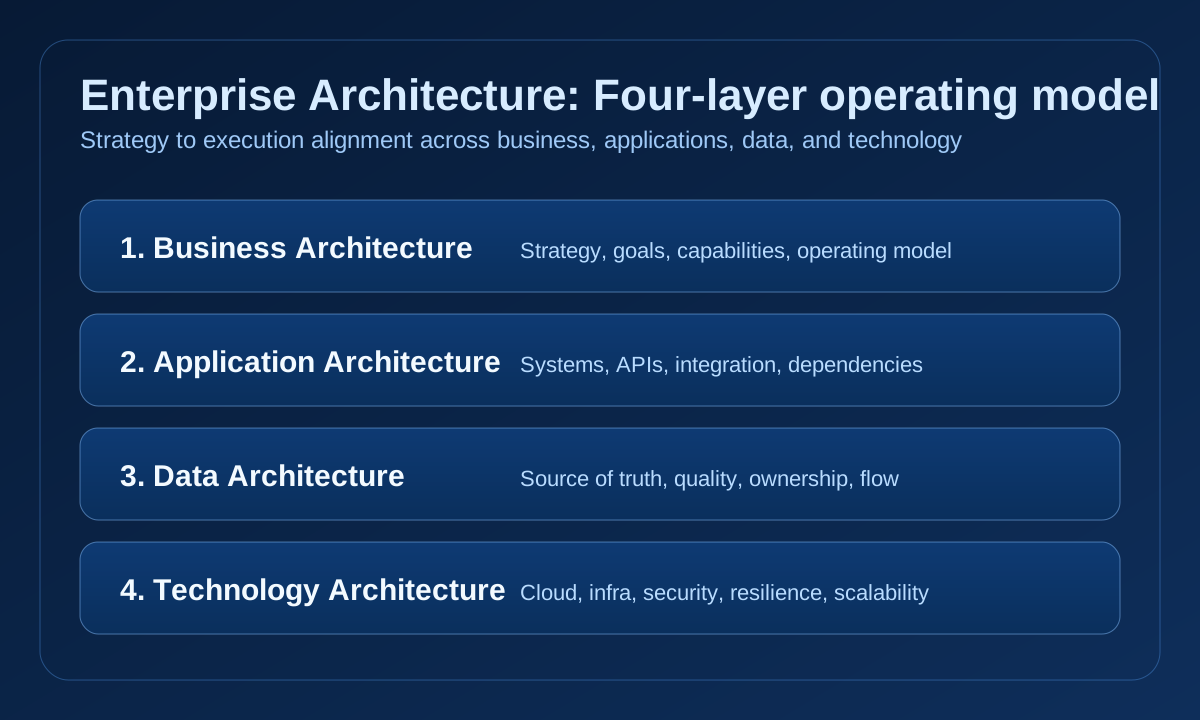
1. Business Architecture — The “Why”
Everything starts with the business.
This layer defines:
- strategy
- business goals
- business capabilities
- processes
At Netflix, the objective is clear:
deliver a seamless, global, personalized streaming experience.
This vision influences every technological decision.
Technology must always serve strategy — never the other way around.
2. Application Architecture — The “What”
This layer describes the systems that support the business.
For example:
- CRM systems
- ERP systems
- mobile applications
- e-commerce platforms
- payment systems
Architects must answer critical questions:
- How many applications should exist?
- How do they communicate?
- Should APIs be used?
- What dependencies exist?
Amazon solved this problem by enforcing a famous rule:
all communication between systems must go through standardized APIs.
3. Data Architecture — The Heart of Knowledge
Data has become one of the most strategic assets of modern companies.
Data Architecture defines:
- where data is stored
- what the source of truth is
- how data flows between systems
- who owns the data
Netflix, for example, uses:
- Amazon S3
- DynamoDB
- massive data pipelines
to guarantee consistency and availability.
Without strong data architecture, companies end up with multiple versions of the truth.
And decision-making becomes risky.
4. Technology Architecture — The Foundations
This layer concerns the technical infrastructure:
- cloud platforms
- servers
- networks
- databases
- security
- integration platforms
Netflix made a major strategic choice:
migrating entirely to AWS.
Between 2008 and 2016, they transformed their architecture to become fully cloud-native.
Today their platform can:
- deploy thousands of servers automatically
- absorb massive traffic spikes
- continue running even if certain components fail
Who Actually Builds This Architecture?
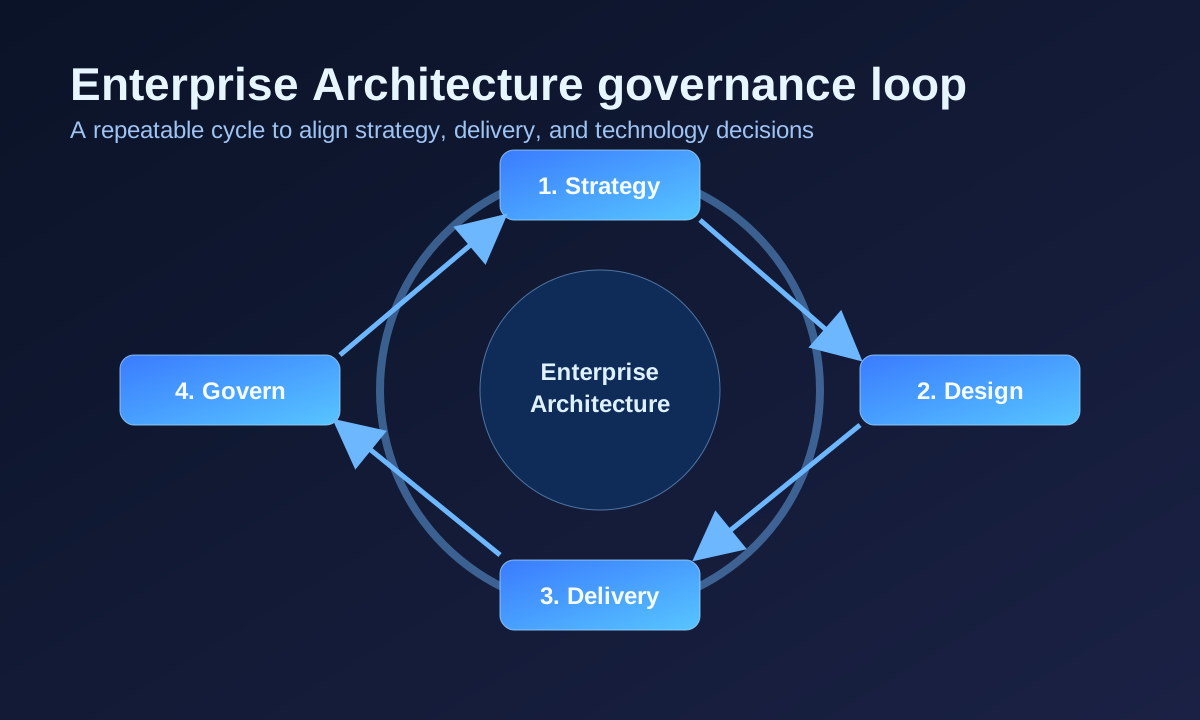
Let’s return to the construction site analogy.
The Promoter (CEO / Business)
defines the vision.
The Enterprise Architect
designs the master blueprint.
Specialized architects
(Solution Architects, Data Architects, Cloud Architects)
design specific parts of the system.
Engineers and developers
build the applications.
Without coordination between these roles, the system quickly becomes unmanageable.
Why Enterprise Architecture Can Save Billions
Without Enterprise Architecture:
- IT costs explode
- technical debt becomes massive
- projects fail
- systems become impossible to evolve
With a strong architecture:
- companies innovate faster
- systems become scalable
- technologies can change without breaking everything
This is precisely what allowed Amazon and Netflix to evolve:
from fragile startups
into platforms serving hundreds of millions of users worldwide.
The Golden Rule of Great Architects
Experienced architects often repeat this sentence:
“We don’t build systems for today.
We build systems that can change tomorrow.”
A good architecture is not only stable.
It is adaptable.
Conclusion: The Invisible Weapon of Companies That Last
Enterprise Architecture is not a luxury reserved for tech giants.
It is an essential discipline for any organization that wants to:
- grow
- innovate
- last
It transforms complexity into structure.
It aligns technology with strategy.
And most importantly, it prevents companies from collapsing under their own weight.
FAQ
What is enterprise architecture in simple terms?
It is the operating blueprint that aligns strategy, applications, data, and technology so the company can scale safely.
Why is enterprise architecture critical for growth?
It prevents system sprawl, reduces risk, and keeps technology decisions aligned with business priorities.
When should an organization formalize enterprise architecture?
As soon as multiple teams, platforms, and transformation programs start creating conflicting decisions.
Compare enterprise architecture platforms
Need help structuring your Enterprise Architecture and aligning strategy, data architecture, and technology architecture?