

Published on March 18, 2026 | Updated on March 18, 2026 | 10 min read
Enterprise Architecture for Banks: Frameworks, BIAN, and Modern Banking Architecture
BIAN provides modular service domains and standard APIs for modern banking architecture.
Looking for an enterprise architecture software platform? Use our EA tool evaluation guide and run the EA maturity assessment.
Key takeaways
- In banking, architecture maturity is measured by resilience and regulatory traceability under change pressure.
- How to translate strategy into architecture priorities and delivery increments.
- How to align business, data, application, and technology decisions.
Table of contents
- Introduction
- Why Enterprise Architecture Is Critical for Banks
- Without a structured architecture approach, banks often experience:
- Enterprise Architecture Alignment
- The BIAN Framework
- The BIAN Service Landscape
- Service Domains in Practice
- The BIAN Architecture Model
- Business Areas
- Business Areas Context
- Business Domains
- Service Domains
- BIAN and Microservices
- Semantic APIs and Open Banking
- BIAN and TOGAF
- Benefits of Using BIAN in Banking
- Reduced IT Complexity
- Faster Digital Transformation
- Improved Interoperability
- Lower Integration Costs
- Better Alignment with Business Capabilities
- Enterprise Architecture in Modern Banking
- Conclusion
Introduction
Banks operate some of the most complex IT environments in any industry. They must support millions of transactions, strict regulatory requirements, legacy core banking systems, and increasingly digital customer experiences.
To manage this complexity, financial institutions rely heavily on Enterprise Architecture (EA) frameworks specifically adapted to the banking industry.
One of the most important of these frameworks is BIAN (Banking Industry Architecture Network), which provides a standardized architectural model designed for banks.
This article explains how enterprise architecture works in banking and why frameworks such as BIAN are critical for modern financial institutions.
Why Enterprise Architecture Is Critical for Banks
Banking IT environments are typically characterized by:
- decades of legacy systems
- highly regulated processes
- complex integration between systems
- increasing demand for digital banking services
Without a structured architecture approach, banks often experience:
- fragmented application landscapes
- duplicated capabilities
- high integration costs
- slow innovation cycles
Enterprise Architecture Alignment
Enterprise architecture helps banks create a coherent technology strategy aligned with business goals and regulatory requirements.
EA provides a structured way to design the banking ecosystem across multiple layers, including business processes, data, applications, and technology infrastructure.
The BIAN Framework
The Banking Industry Architecture Network (BIAN) is one of the most widely recognized architecture frameworks specifically designed for the banking industry.
BIAN is a global, non-profit initiative that brings together banks, technology providers, and service firms to define a standard architectural framework for banking interoperability.
The goal of BIAN is to create a common language and architecture model for banking services, enabling banks to reduce integration complexity and modernize their systems.
BIAN was established in 2008 and is now supported by many banks, software vendors, and system integrators worldwide.
The BIAN Service Landscape
One of the key elements of BIAN is the Service Landscape, which structures banking operations into modular building blocks.
BIAN decomposes banking activities into Service Domains, each representing a specific business capability such as:
- Customer management
- Payments
- Loan processing
- Account management
- Risk and compliance
Service Domains in Practice
Each Service Domain represents a bounded functional capability and can be implemented as a reusable service or microservice within the bank’s architecture.
This modular approach allows banks to design composable banking architectures where services can evolve independently.
The BIAN Architecture Model
The BIAN framework organizes banking architecture into several conceptual layers.
Business Areas
The highest level groups banking activities into broad functional areas.
Examples include:
- sales and service
- operations and execution
- risk and compliance
- reference data
Business Areas Context
These areas represent the major domains of banking activity.
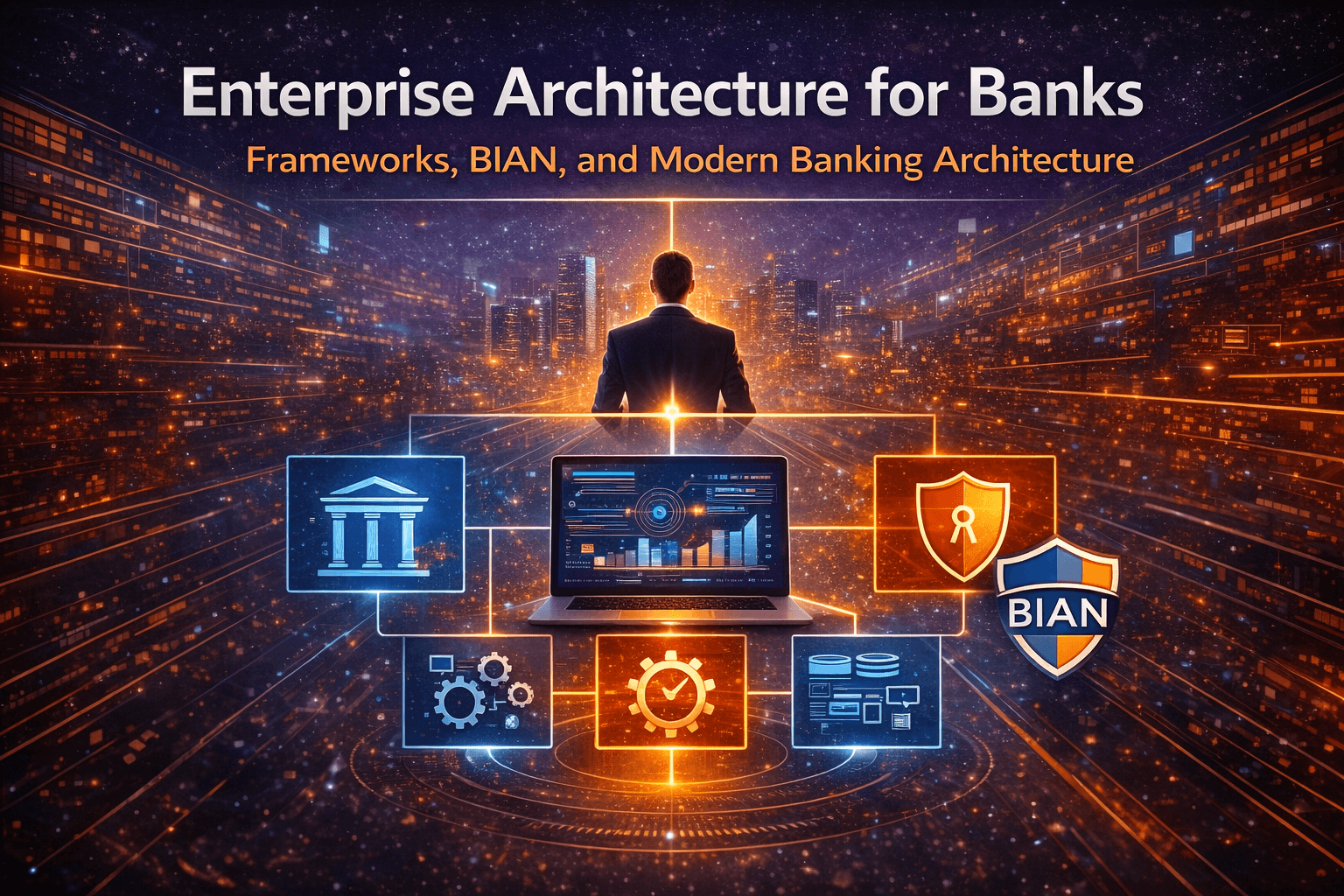
How enterprise architecture and BIAN help banks modernize legacy systems and reduce integration complexity.
Business Domains
Each business area contains several business domains, which represent clusters of related capabilities.
These domains correspond to recognizable banking functions such as:
- lending
- payments
- customer onboarding
- product management
Service Domains
The lowest level of the architecture consists of Service Domains.
These are the fundamental building blocks of BIAN.
Each Service Domain defines a specific banking capability with well-defined responsibilities and interfaces.
This structure allows banks to build modular and interoperable banking systems.
BIAN and Microservices
One of the reasons BIAN has gained popularity is that its architecture aligns well with modern microservices architectures.
Each BIAN Service Domain can be implemented as a microservice, enabling:
- independent deployment
- scalable banking services
- API-based integration
- faster innovation cycles
Semantic APIs and Open Banking
BIAN also defines standardized semantic APIs, which simplify communication between services and systems.
This makes BIAN particularly well suited for open banking and digital banking platforms.
BIAN and TOGAF
BIAN does not replace general enterprise architecture frameworks such as TOGAF.
Instead, the two frameworks are complementary.
TOGAF provides a general enterprise architecture methodology.
BIAN provides a banking-specific reference architecture.
The two frameworks can be used together to guide architecture development in financial institutions.
In practice:
- TOGAF defines how to develop architecture
- BIAN defines what the banking architecture should look like
Benefits of Using BIAN in Banking
Banks adopting the BIAN framework can achieve several benefits.
Reduced IT Complexity
Standardized service domains simplify the architecture landscape.
Faster Digital Transformation
Reusable architecture components accelerate innovation.
Improved Interoperability
BIAN creates a common language for banking services.
Lower Integration Costs
Standard APIs reduce integration challenges.
Better Alignment with Business Capabilities
Service domains directly map to banking business capabilities.
Enterprise Architecture in Modern Banking
Together, these approaches allow banks to transition from legacy monolithic systems toward modular, digital banking platforms.
- Enterprise Architecture frameworks (TOGAF, Zachman)
- Industry architecture frameworks (BIAN)
- Cloud-native architectures
- API platforms
- Microservices architectures
Conclusion
Enterprise architecture plays a critical role in the modernization of banking systems.
Frameworks like BIAN provide a standardized reference architecture that helps banks structure their services, reduce complexity, and accelerate digital transformation.
By combining general enterprise architecture frameworks like TOGAF with industry-specific frameworks like BIAN, banks can design architectures that are both strategically aligned and operationally scalable.
In a world of open banking, APIs, and digital ecosystems, enterprise architecture is no longer optional — it is a core capability for modern banks.
How enterprise architecture and BIAN help banks modernize legacy systems and reduce integration complexity.
FAQ
What is BIAN?
BIAN (Banking Industry Architecture Network) is a banking-specific architecture framework that provides standardized service domains and semantic APIs.
Does BIAN replace TOGAF?
No. TOGAF defines how architecture is developed, while BIAN provides a banking-specific reference architecture.
Why is enterprise architecture critical for banks?
It helps banks handle legacy systems, regulation, and digital transformation while reducing fragmentation, duplication, and integration costs.
Strategic links
Compare enterprise architecture platforms
Related articles
IT Cost and Supplier Risk: One Map for Money and DORA
Cost and ICT third-party risk are usually managed in separate spreadsheets. Mapping applications to suppliers and cost in one model lets you see concentration, license exposure and rationalisation candidates at once — and produce the evidence DORA-minded reviews expect.
NIS2 and Enterprise Architecture: Mapping the Systems and Dependencies Risk Management Touches
NIS2 broadens the entities covered and raises the bar on cyber risk management, supply-chain security and incident handling. Each of those expectations rests on one prior question: do you actually know your systems and how they depend on each other? An EA map is the natural place to hold that — honestly, as evidence, not as a compliance badge.
CSSF and Enterprise Architecture: One Map for ICT, Outsourcing and Resilience Documentation
Banks, PFS, investment firms and fund actors supervised by the CSSF carry recurring documentation expectations around ICT, outsourcing and operational resilience. Each rests on a prior question: can you actually show your capabilities, applications, data flows and the third parties behind them? An EA repository is the natural place to hold that — honestly, as evidence, not as a compliance badge.