

Published on June 22, 2026 | Updated on June 22, 2026 | 10 min read
NIS2 and Enterprise Architecture: Mapping the Systems and Dependencies Risk Management Touches
NIS2 broadens the entities covered and raises the bar on cyber risk management, supply-chain security and incident handling. Each of those expectations rests on one prior question: do you actually know your systems and how they depend on each other? An EA map is the natural place to hold that — honestly, as evidence, not as a compliance badge.
Looking for an enterprise architecture software platform? Use our EA tool evaluation guide and run the EA maturity assessment.
Key takeaways
- Why every NIS2 expectation — risk management, supply-chain security, incident handling — rests on first knowing your systems and their dependencies.
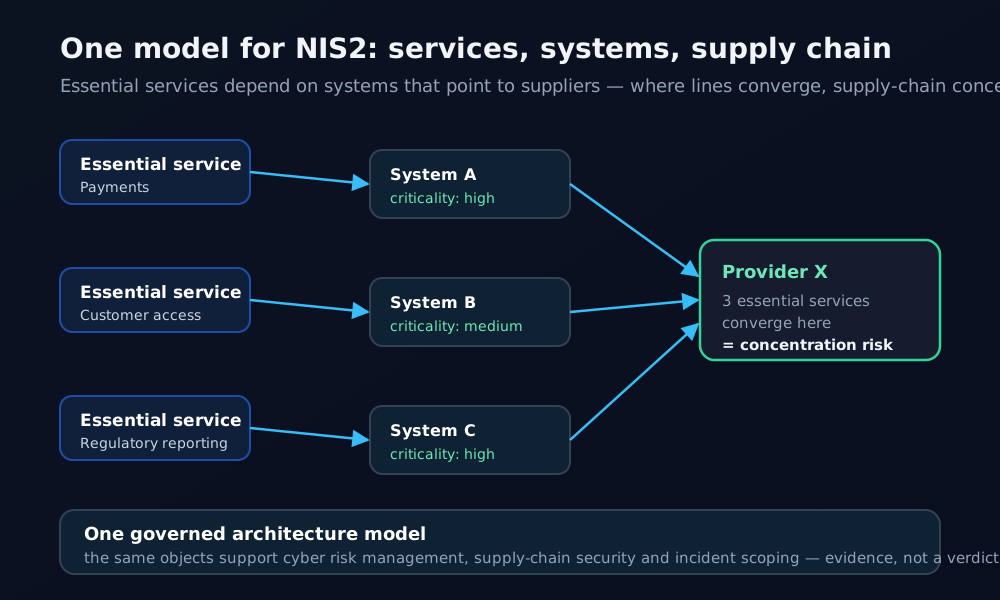
- How an EA map traces essential services to the systems and third parties behind them, so supply-chain exposure and concentration become visible.
- How a living dependency map speeds up incident scoping — honestly, as a documentation aid, not a NIS2 certification or control library.
Table of contents
- What NIS2 actually asks of essential and important entities
- Every NIS2 expectation rests on a prior question: do you know your systems?
- Mapping systems and dependencies for cyber risk management
- Supply-chain and ICT third-party relationships, made visible
- Incident handling: scoping the blast radius from a living map
- Why a sovereign, EU-hostable repository fits this specifically
What NIS2 actually asks of essential and important entities
NIS2 widened the net. Where its predecessor reached a relatively narrow set of operators, NIS2 brings a much larger population of essential and important entities into scope — across sectors such as energy, transport, banking and financial market infrastructure, health, digital infrastructure, public administration and more. If you are a regulated financial or critical-entity organisation in the EU, the realistic starting assumption is that some part of NIS2 touches you, and the precise determination is one to confirm with qualified counsel.
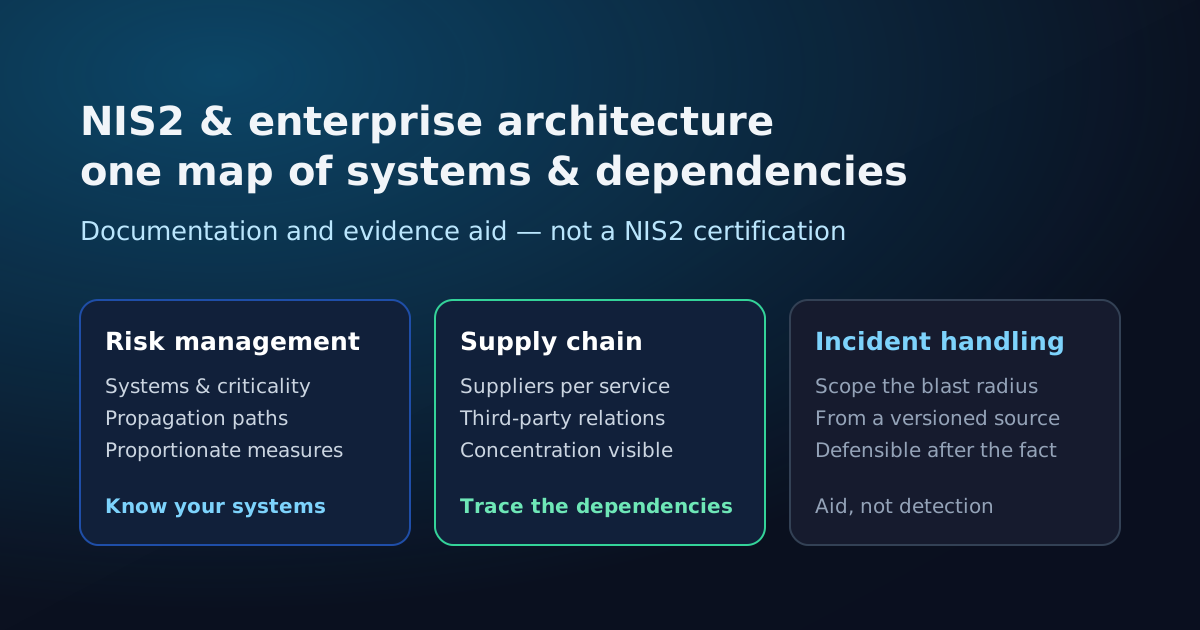
Underneath the legal text, the substance is recognisable: take appropriate and proportionate technical, operational and organisational measures to manage the risks to your network and information systems; secure your supply chain; handle incidents, including reporting significant ones within defined timelines; and be able to demonstrate that you do all of this. This article is a preparation and documentation aid, not legal advice. What it shows is where enterprise architecture gives those measures a backbone — because almost every one of them presupposes that you can actually see your systems and how they connect.
Every NIS2 expectation rests on a prior question: do you know your systems?
Risk management, supply-chain security and incident handling all sound like separate workstreams. They share a hidden prerequisite. You cannot assess the risk to a system you have not inventoried. You cannot secure a supply chain whose providers you cannot trace to the services they support. You cannot scope an incident if you do not know what the affected component depends on. The prior question — do you know your systems and their dependencies — sits underneath the whole regime.
For most organisations that knowledge exists, but scattered: a CMDB that drifted, network diagrams in a wiki, supplier lists in finance, criticality assessments in a slide deck from last year. None of it joins up, and the join is exactly what NIS2 conversations need. An enterprise architecture repository is, at heart, the place where those threads become one connected model — systems, the business services they support, the dependencies between them, and the third parties behind them.
- Risk management presupposes a real inventory of network and information systems
- Supply-chain security presupposes you can trace services to their providers
- Incident handling presupposes you know what an affected component depends on
- The common prerequisite is a connected, current view — not four disconnected lists
Mapping systems and dependencies for cyber risk management
The core NIS2 risk-management expectation is to identify and treat the risks to your network and information systems with measures proportionate to the exposure. Proportionality needs a denominator: which systems support which essential services, how critical each is, and what would be affected if one failed. A flat asset list cannot tell you that; a dependency model can.
In an EA repository each system carries attributes that make it analysable — owner, criticality, hosting, the technology it runs on — and points to the business services it supports and the systems it depends on. With that in place you can ask the questions risk management really turns on: if this component is compromised, which essential services degrade? Where does a single weakness propagate furthest? The honest caveat applies as always — the model is only as good as the data you put in it, and risk treatment decisions stay with your security and risk functions. The repository gives them sight, not a verdict.
- System register with owner, criticality, hosting and technology footprint
- Each system linked to the business services it supports
- Dependencies mapped so you can follow propagation paths
- A queryable model that makes proportionality assessable, not guessed
NIS2 expects essential and important entities to manage cyber risk and handle incidents across their systems and supply chain. An EA repository maps those systems, dependencies and ICT relationships so the documentation is faster to assemble — it is a documentation aid, not a NIS2 certification.
Supply-chain and ICT third-party relationships, made visible
Supply-chain security is one of the places NIS2 most clearly raised the bar. Entities are expected to take into account the security of their supply chain, including the relationships with direct suppliers and service providers, and the quality of those parties' security practices. You cannot manage an exposure you cannot see, and supplier exposure is precisely the kind that accretes invisibly: each individual dependency on a provider looked reasonable when it was made.
A mapped model turns that invisible accretion into something you can count. Link each application to the suppliers and service providers behind it, then trace each essential service down to those third parties. The clusters appear: the provider sitting behind a disproportionate share of what matters, the dependency you would not have chosen deliberately but inherited. This is also exactly the analysis that overlaps with DORA's ICT third-party and concentration-risk work — one model, two regulatory conversations. To be clear about the boundary: the repository surfaces and documents the relationships; the security evaluation of any supplier, and the contractual posture around it, remain yours.
Incident handling: scoping the blast radius from a living map
When something breaks, speed of comprehension matters as much as speed of response. NIS2's incident-handling and reporting expectations assume you can quickly understand what an incident affects and communicate it within defined timelines. The slowest part of that is often not the technical fix but the scoping — working out, under pressure, which services are touched and what they depend on.
A current architecture model collapses that step. Trace the affected component upward to the business and essential services it supports, and downward to the systems and suppliers it relies on, and the blast radius is on screen rather than in someone's head. The same model makes the post-incident account defensible: you can show, from a versioned source, what was in scope and why. We are precise about the limit — an EA repository supports incident handling by providing the dependency context; it does not detect incidents or perform response. Detection, containment and recovery live in your security operations, and the architecture model feeds them rather than replaces them.
- Trace the affected component to the essential services it supports
- Trace it down to the systems and suppliers it depends on
- Scope the blast radius from a model, not from memory under pressure
- Show, from a versioned source, what was in scope — defensible after the fact
Why a sovereign, EU-hostable repository fits this specifically
Three properties of ArchiLU matter more in a NIS2 context than almost anywhere else. It can be hosted in the EU or on-premise, so the sensitive map of which systems support which essential services — close to a blueprint of where you are most vulnerable — does not leave a boundary you control. It is available natively in French and English, which matters when the same model has to serve a French-speaking security committee and an English-language audit or authority exchange. And it is licensed for unlimited users, so the risk, security and architecture people who all need to read the same dependency map are not gated by a seat count; the commercial detail lives on the pricing page rather than here.
The honest boundary, restated because it matters: ArchiLU is an enterprise architecture repository that produces documentation and evidence and makes it easier to assemble. It is not a NIS2 certification, not a control library, and we are transparent about certifications we do not yet hold. What it gives a regulated EU institution is a sovereign, multilingual, connected model of its systems and dependencies — the groundwork NIS2, DORA and the EU AI Act conversations all rest on. For the fastest read on where your own practice stands across portfolio, governance and risk dimensions, the free EA Maturity Assessment scores ten dimensions and returns a prioritised plan in about ten minutes.
NIS2 expects essential and important entities to manage cyber risk and handle incidents across their systems and supply chain. An EA repository maps those systems, dependencies and ICT relationships so the documentation is faster to assemble — it is a documentation aid, not a NIS2 certification.
FAQ
Does an EA repository make my organization NIS2 compliant?
No, and we will not pretend otherwise. ArchiLU is an enterprise architecture repository, not a NIS2 certification and not a control library. NIS2 compliance is a legal and supervisory determination made against your organisational, technical and procedural cyber-risk measures — by your competent authority, not by any software. What an EA repository offers is the underlying map: which systems you run, how they depend on each other, and which third parties sit behind them. That makes the documentation and evidence faster to assemble and keep current, which is an aid to your risk and security work — not a substitute for it.
How does mapping the architecture help with NIS2 supply-chain security?
NIS2 expects essential and important entities to account for the security of their supply chain, including the relationships with direct suppliers and service providers. You cannot manage that exposure if you cannot see it. An EA model links each application to the suppliers and service providers it depends on, so you can follow a critical service down to the third parties behind it — and spot where many critical services lean on the same provider. The repository organises and connects that picture; the security assessment of any given supplier remains your work and your counsel's.
What does an architecture map give me for NIS2 incident handling?
When an incident hits, the first questions are which services are affected, what they depend on, and who needs to know. A current dependency map answers those faster than a scramble through scattered diagrams: trace the affected component up to the business services it supports and down to the systems and suppliers it relies on. That same connected view is what makes a post-incident write-up defensible — you can show the blast radius from a model rather than reconstruct it from memory. It supports incident handling; it does not perform detection or response, which live in your security tooling and processes.
We are covered by both NIS2 and DORA — is the architecture work duplicated?
Largely no, and that is the point. NIS2 and DORA ask overlapping prior questions: know your systems, know your ICT dependencies, know your third parties, be able to evidence how you manage the resulting risk. One living architecture model answers the shared groundwork once, then feeds both conversations. The regimes differ in scope and specifics — DORA is financial-sector operational resilience, NIS2 covers a broader set of essential and important entities — so the legal mapping is distinct. But the inventory and dependency backbone is common, which is exactly why a single EA repository is efficient rather than redundant.
Strategic links
Compare enterprise architecture platforms
Related articles
IT Cost and Supplier Risk: One Map for Money and DORA
Cost and ICT third-party risk are usually managed in separate spreadsheets. Mapping applications to suppliers and cost in one model lets you see concentration, license exposure and rationalisation candidates at once — and produce the evidence DORA-minded reviews expect.
CSSF and Enterprise Architecture: One Map for ICT, Outsourcing and Resilience Documentation
Banks, PFS, investment firms and fund actors supervised by the CSSF carry recurring documentation expectations around ICT, outsourcing and operational resilience. Each rests on a prior question: can you actually show your capabilities, applications, data flows and the third parties behind them? An EA repository is the natural place to hold that — honestly, as evidence, not as a compliance badge.
From Spreadsheet to Living Model: The ICT Third-Party and Outsourcing Register as Enterprise Architecture
An ICT third-party and outsourcing register is only useful if it is current and queryable — yet most live in a spreadsheet that drifts from reality the day it is finished. Turn the register into a living architecture model: map each critical or important function to the applications and third parties, including the sub-outsourcing chains, behind it, and register, dependencies and concentration stay reconciled. Honestly: an EA repository connects the data and makes the evidence easier to assemble — the register's legal completeness stays yours.