

Published on June 19, 2026 | Updated on June 19, 2026 | 12 min read
Application Portfolio Management & Rationalization Guide
What APM and rationalization really involve — inventory, the TIME model, cost/health/risk signals, technical debt, decommissioning, TCO and governance — with concrete sector examples.
Looking for an enterprise architecture software platform? Use our EA tool evaluation guide and run the EA maturity assessment.
Key takeaways
- How to design governance that accelerates delivery instead of blocking it.
- How to define decision rights and exception workflows that teams can use.
- How to measure governance quality with concrete portfolio indicators.
Table of contents
- Governance operating model
- What application portfolio management actually is
- The application portfolio: from a list to a decision asset
- Application rationalization: the discipline, not the spreadsheet
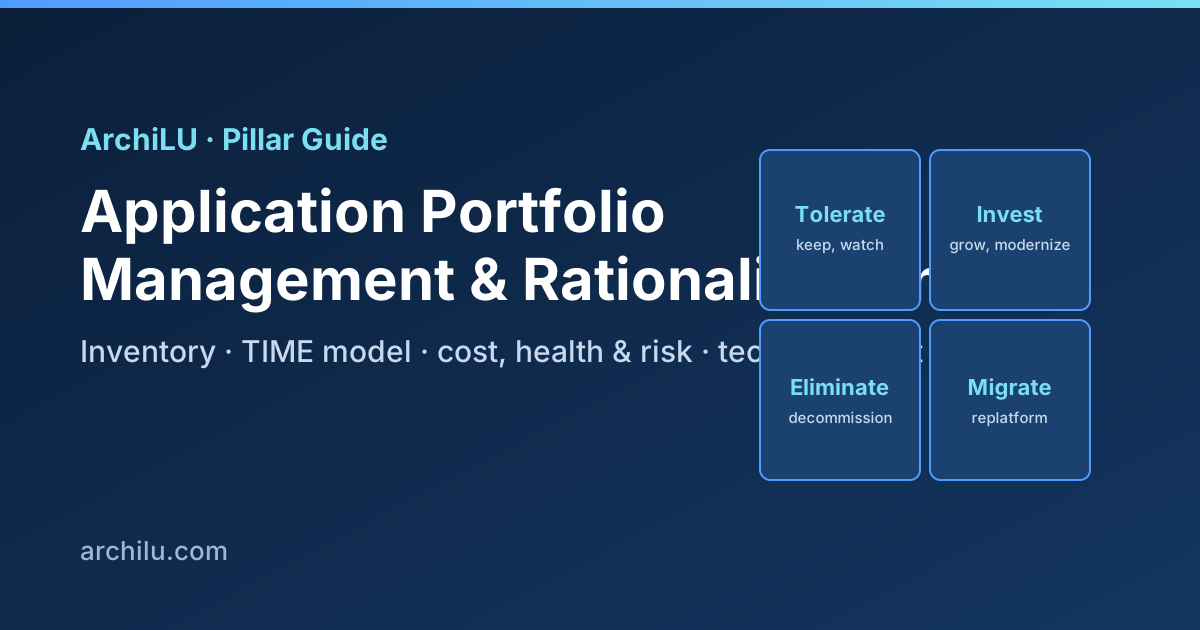
- The TIME model: Tolerate, Invest, Migrate, Eliminate
- Cost, health and risk: the signals that move a decision
- Technical debt and the cost of waiting
- Decommissioning and total cost of ownership
- Governance: making rationalization stick
- Governance KPIs
- Common mistakes
- Practical checklist
Governance operating model
Governance should be designed as a service that improves decision quality and speed, not as a review ritual.
A mature model combines clear decision rights, risk-tiered review depth, and transparent outcome tracking.
- Create risk tiers with explicit approval authorities
- Standardize decision records with rationale and trade-offs
- Track exceptions with expiration dates and remediation plans
What application portfolio management actually is
Most organizations do not lack applications — they lack an honest, shared view of them. Spreadsheets diverge, owners change, and nobody can say with confidence which systems still earn their keep. Application portfolio management (APM) fixes that by maintaining one trusted inventory and treating your applications the way a fund manager treats holdings: as a portfolio to be measured, compared and rebalanced.
Concretely, APM means knowing, for every application, who owns it, which supplier provides it, where it sits in its lifecycle, what it costs to run, how healthy it is, and what depends on it. That inventory is the foundation; rationalization is what you do with it. Archilu builds this layer directly on your architecture model, so the inventory is not a static list but a living view connected to capabilities, suppliers and technologies.
The application portfolio: from a list to a decision asset
A list of applications answers "what do we have?". A portfolio answers "what should we do about it?". The difference is the decision signals you attach to each entry — and the consistency with which you collect them.
Without that structure, every renewal, audit or transformation re-opens the same archaeology. With it, a CIO can walk into a steering committee and show, at a glance, where money and risk concentrate. The signals below are what turn the inventory into a decision asset.
- Ownership and accountability: a named business and IT owner per application
- Supplier exposure: which vendors you depend on, and how concentrated that dependency is
- Technology footprint: the stack behind each app, and which versions are aging or unsupported
- Lifecycle stage: from pilot to active to sunset
- Dependencies: what calls what, so nothing is decommissioned blind
Application rationalization: the discipline, not the spreadsheet
Rationalization is the recurring decision of which applications to keep, change or retire. It is not a one-off cleanup project; it is a cadence. The goal is to reduce redundancy, cut avoidable cost and shrink risk without breaking the business that runs on those systems.
The classic trap is to rationalize on cost alone. An expensive application that underpins a regulated process is not a candidate for elimination just because it shows up red in finance. Equally, a cheap app can be the riskiest thing you own if it runs on unsupported technology and nobody remembers how it works. Good rationalization weighs value, fitness, cost and risk together — which is exactly what the TIME model structures.
The TIME model: Tolerate, Invest, Migrate, Eliminate
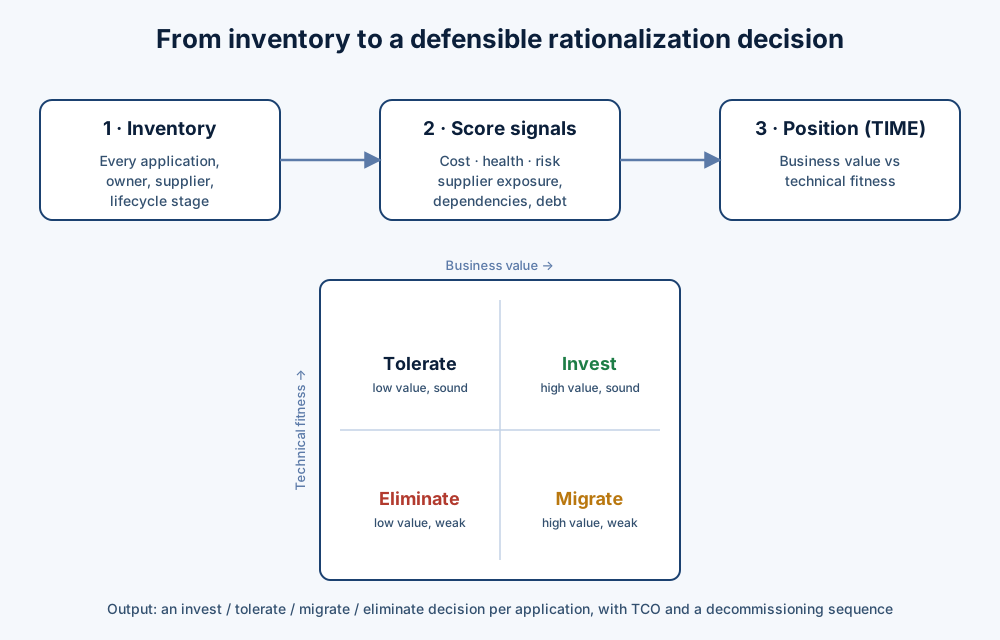
The TIME model (popularized by Gartner) positions each application on two axes: business value and technical fitness. The quadrant it lands in suggests a default action. It is deliberately simple, because its job is to start a structured conversation, not to replace judgment.
Use it as a first pass across the whole portfolio, then debate the borderline cases. The diagram on this page shows the four quadrants and the path from inventory to a positioned decision.
- Tolerate — low value but technically sound: keep it, but stop investing and watch it
- Invest — high value and sound: protect and modernize it; this is where new spend belongs
- Migrate — high value but technically weak: replatform or replace before it becomes a liability
- Eliminate — low value and weak: decommission it and recover the cost and risk
A practical pillar guide to application portfolio management and rationalization: the TIME model, cost/health/risk signals, technical debt, TCO and governance.
Cost, health and risk: the signals that move a decision
TIME tells you the shape of the decision; the underlying signals tell you how confident to be. Three families of signal matter most. Cost covers licence, hosting, support and the internal effort to keep an application alive. Health covers functional fit, stability, user satisfaction and how current the technology is. Risk covers supplier fragility, single points of failure, compliance exposure and end-of-life components.
In a bank, a payments-adjacent application with a weak supplier and an unsupported runtime is a risk story long before it is a cost story. In a public-sector body, a low-cost legacy form processor that only one retiring developer understands is a continuity risk, not a savings opportunity. The signals are the same; the weighting changes by sector. Archilu surfaces supplier exposure, technology footprint and cost signals against the model so these tradeoffs are visible rather than anecdotal.
Technical debt and the cost of waiting
Technical debt is the accumulated gap between how your applications are built today and how they would need to be built to be safe, supportable and adaptable. It rarely causes a single dramatic failure; it shows up as rising maintenance effort, slower change, growing key-person risk and a security surface you cannot fully see.
The reason debt belongs in a rationalization guide is that it changes the math. An application that looks cheap on a licence line can be expensive once you price the effort to keep it running and the risk of running it unsupported. Making debt explicit — which apps carry it, how much, and what it costs to carry — is what stops it from quietly deciding your roadmap for you.
Decommissioning and total cost of ownership
Deciding to eliminate an application is the easy half. Doing it safely is the engineering. Most failed decommissioning efforts stumble on the same things: hidden dependencies, data retention obligations, and a downstream report nobody knew relied on the system. A dependency map and a phased sequence — turn off the inbound interfaces, archive the data, then retire the app — are what make a shutdown defensible to auditors and to the business.
Underpinning all of it is total cost of ownership. TCO counts licence and hosting, but also implementation, integration upkeep, internal maintenance, support and the risk premium of aging technology. Two applications with an identical licence line can have very different TCO, and that difference is often what tips a decision from tolerate to migrate or eliminate. Model it before you commit: use Archilu's application rationalization calculator to compare candidates and the EA TCO calculator to put real numbers on the run cost.
Governance: making rationalization stick
A one-time rationalization audit decays within a year. New applications arrive, owners move on, and the inventory drifts back toward the spreadsheet it replaced. Governance is what keeps the portfolio honest: a clear owner for the inventory, a regular review cadence, and a rule that no new application enters the estate without a place in the model and a stated lifecycle.
The practical pattern is to connect rationalization to existing rhythms — budget cycles, supplier renewals, transformation milestones — rather than running it as a separate initiative competing for attention. When the application portfolio is the same model your architects, finance and risk teams already use, the decisions hold. Start from where you are: Archilu's free EA maturity assessment scores ten dimensions and returns a prioritized plan, and the buyer's guides and calculators linked above turn the principles here into concrete next steps.
Governance KPIs
A governance model is credible only if it produces faster and better decisions over time.
- Review-to-decision SLA by risk tier
- Exception backlog aging trend
- Rework rate after architecture decision
- Cross-domain dependency risk trend
Common mistakes
Governance fails when it is heavy on control but weak on decision clarity.
- Reviewing low-risk changes with full committee overhead
- No explicit decision rights by risk category
- No expiration date on architecture exceptions
- No measurable quality indicators in governance forums
Practical checklist
This baseline keeps governance useful without creating delivery drag.
- Define risk tiers and matching decision rights
- Create standard review templates and acceptance criteria
- Set SLA for architecture decisions by risk level
- Track exceptions, aging, and closure outcomes monthly
A practical pillar guide to application portfolio management and rationalization: the TIME model, cost/health/risk signals, technical debt, TCO and governance.
FAQ
What is application portfolio management (APM)?
Application portfolio management is the discipline of maintaining a single, trusted inventory of every application and enriching it with decision signals — owner, supplier, lifecycle, cost, health, risk and dependencies — so leadership can decide, application by application, what to invest in, tolerate, migrate or eliminate. It turns a scattered list of systems into a portfolio you can actually steer.
What is the TIME model used for rationalization?
TIME stands for Tolerate, Invest, Migrate, Eliminate. You position each application on two axes — business value and technical fitness — and the quadrant suggests a default action: invest in high-value, technically sound systems; tolerate low-value but sound ones; migrate high-value systems on a weak platform; and eliminate low-value, weak applications. It is a starting point for discussion, not an automatic verdict.
How do you know which applications to decommission?
Decommissioning candidates usually share signals: low or declining business usage, high run cost relative to value, an end-of-life or unsupported technology, a fragile or single-point-of-failure supplier, and functional overlap with another system. The hard part is rarely identifying them — it is untangling dependencies and data retention obligations so the shutdown is safe. A dependency map and a phased sequence are what make it defensible.
Why include TCO in a rationalization decision?
Licence or hosting cost is only part of the picture. Total cost of ownership also captures internal maintenance effort, integration upkeep, support, infrastructure and the risk premium of running unsupported technology. Two applications with the same licence line can have very different TCO once you count the people and the debt behind them, which is exactly what changes a tolerate decision into a migrate or eliminate one.
How do we prove governance value to executives?
Show reduction of decision delays, exception backlog, and high-risk dependencies over time.
Strategic links
Compare enterprise architecture platforms
Related articles
IT Cost and Supplier Risk: One Map for Money and DORA
Cost and ICT third-party risk are usually managed in separate spreadsheets. Mapping applications to suppliers and cost in one model lets you see concentration, license exposure and rationalisation candidates at once — and produce the evidence DORA-minded reviews expect.
NIS2 and Enterprise Architecture: Mapping the Systems and Dependencies Risk Management Touches
NIS2 broadens the entities covered and raises the bar on cyber risk management, supply-chain security and incident handling. Each of those expectations rests on one prior question: do you actually know your systems and how they depend on each other? An EA map is the natural place to hold that — honestly, as evidence, not as a compliance badge.
CSSF and Enterprise Architecture: One Map for ICT, Outsourcing and Resilience Documentation
Banks, PFS, investment firms and fund actors supervised by the CSSF carry recurring documentation expectations around ICT, outsourcing and operational resilience. Each rests on a prior question: can you actually show your capabilities, applications, data flows and the third parties behind them? An EA repository is the natural place to hold that — honestly, as evidence, not as a compliance badge.