

Published on June 19, 2026 | Updated on June 19, 2026 | 10 min read
Application Portfolio Management Tool: A Buyer's Guide
A factual buyer's guide to APM tools — health, cost and rationalization signals, what to evaluate, and where Archilu's portfolio capabilities fit.
Looking for an enterprise architecture software platform? Use our EA tool evaluation guide and run the EA maturity assessment.
Key takeaways
- How to compare platforms on decision outcomes, not feature volume.
- How to reduce adoption risk with a short but rigorous pilot.
- How to link tool selection to governance and transformation cadence.
Operating model deep dive
Enterprise architecture software only creates value when it improves how decisions are made across strategy, portfolio, and delivery.
Before selecting a platform, define who makes which architecture decisions, what evidence is required, and how exceptions are tracked to closure.
- Map decision workflows by role (EA, domain leads, product, security, finance)
- Define minimal evidence pack for each decision type
- Set escalation path when standards and delivery pressure conflict
What an APM tool is for
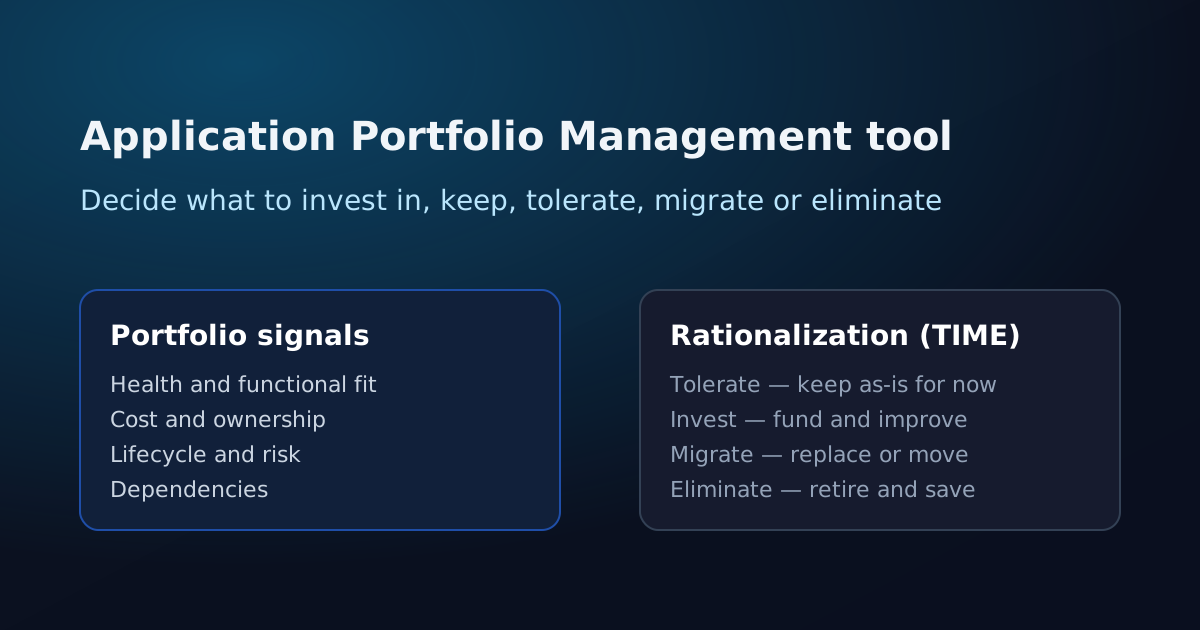
Application portfolio management exists to answer a budget question: of all the applications we run, which deserve more investment, which to keep as-is, and which to retire? An APM tool makes that decision defensible by attaching evidence to every application.
That evidence is the difference between an opinion and a plan. When each application carries a health score, a cost, an owner, a lifecycle stage and its dependencies, rationalization stops being a political argument and becomes a portfolio view leadership can act on.
The decision signals to look for
An inventory alone is not portfolio management. The signals below are what let you prioritize — and a tool that cannot capture them will leave you back in spreadsheets.
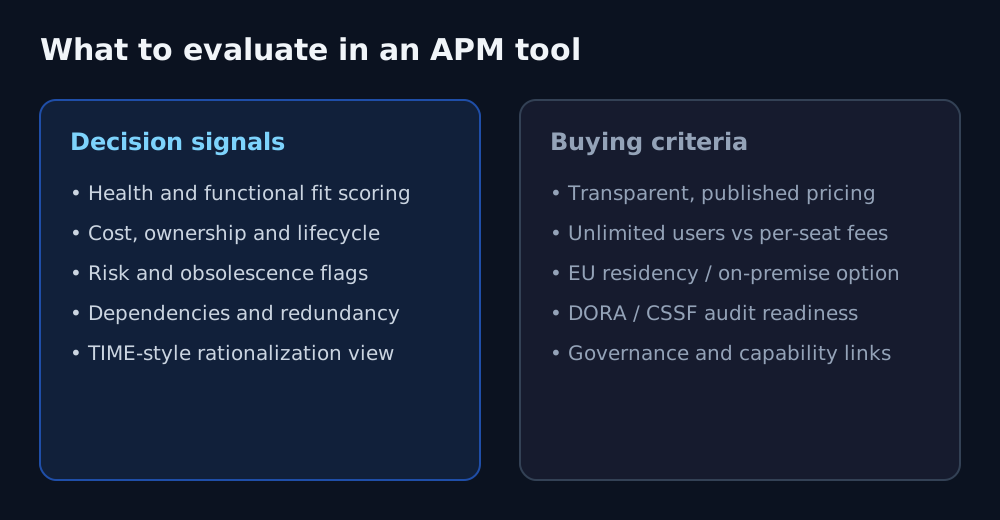
- Health and functional fit: is the application healthy, and does it still fit the need?
- Cost and ownership: run cost and who is accountable
- Lifecycle and risk: obsolescence, end-of-life and concentration risk
- Dependencies and redundancy: overlap with other applications
- Rationalization view: a TIME-style read (tolerate, invest, migrate, eliminate)
Buying criteria beyond the feature list
Two APM tools can score the same dimensions and still differ sharply on total cost and risk. The criteria below often decide the project more than any single feature.
Per-seat licensing discourages the broad input that good portfolio data needs; unlimited users let owners keep cost and fit accurate. Hosting and data residency, regulatory fit, and a link back to business capabilities then shape both adoption and the credibility of your rationalization case.
- User model: unlimited users vs per-seat fees
- Hosting: EU residency or an on-premise option you control
- Regulatory fit: DORA, CSSF and audit-ready documentation
- Links back to business capabilities, not a flat application list
What an application portfolio management (APM) tool does, what to evaluate, and how Archilu scores health, cost and rationalization with EU hosting.
Where Archilu fits
Archilu provides application portfolio management on the same model as its capability and application mapping: each application carries health, cost, ownership, lifecycle and dependency signals, and connects back to the capabilities it supports — so a rationalization decision is traceable, not improvised.
On the buying criteria, Archilu is deliberately different: unlimited users with no per-seat fee, EU or on-premise hosting you control, a posture built for DORA/CSSF-regulated finance, native French alongside English, and an AI assistant plus a free maturity assessment to start faster.
- APM with health, cost, lifecycle and rationalization signals on one model
- Unlimited users with no per-seat fee, so every owner can keep portfolio data accurate
- EU or on-premise hosting, built for DORA/CSSF documentation needs
Be honest about when a heavier suite fits
No single tool wins every context. If you run a very large, multi-domain landscape that needs deep, unified EA plus GRC in one suite, or your procurement mandates a long-standing global vendor with the widest integration marketplace, a heavier platform may suit you better — and we will not pretend otherwise.
Archilu is a focused choice that trades some breadth for EU sovereignty and fast time-to-value. The point is to match the tool to your context, not to the longest feature list.
Decide from your maturity, then buy
Before comparing feature grids, baseline where your architecture practice actually stands. Archilu's free EA Maturity Assessment scores ten dimensions and returns a prioritized action plan in about ten minutes — a concrete way to see which APM profile your organization needs, and a clean first step before a demo.
Metrics that matter
Use KPIs that measure decision quality and adoption, not tool activity volume.
- Decision lead time by workflow
- Adoption rate by role and business domain
- Architecture exception closure rate
- Portfolio decisions supported by evidence
Common mistakes
Most software selection failures are operating model failures before they are tooling failures.
- Comparing feature lists without testing real decision workflows
- Ignoring integration and data model constraints
- No adoption plan by stakeholder group
- No migration strategy for existing repositories
Practical checklist
Run this checklist before committing to a platform contract.
- Define top 5 decision workflows and success metrics
- Run a time-boxed pilot with real portfolio data
- Score adoption risk by role and business domain
- Validate migration and integration effort before selection sign-off
What an application portfolio management (APM) tool does, what to evaluate, and how Archilu scores health, cost and rationalization with EU hosting.
FAQ
What is an application portfolio management tool?
An application portfolio management (APM) tool inventories every application and enriches it with decision signals — health, functional fit, cost, ownership, lifecycle, risk and dependencies — so leadership can decide what to invest in, keep, tolerate, migrate or eliminate. It turns a list of systems into a prioritized rationalization plan.
What should I evaluate when choosing an APM tool?
Look for the decision signals first: health and functional fit scoring, cost and lifecycle, risk and obsolescence flags, dependencies and redundancy, and a rationalization view such as the TIME model. Then weigh the buying criteria — unlimited users vs per-seat fees, EU residency or an on-premise option, DORA/CSSF audit readiness, and links back to business capabilities.
How is APM different from application mapping?
Application mapping builds the connected picture — which apps support which capabilities and how they depend on each other. APM uses that picture to drive decisions: scoring each application on health, cost and risk to plan investment and rationalization. The two are complementary, and the strongest tools do both on one model.
What is the best first KPI after software rollout?
Track decision lead time and stakeholder adoption by role within the first 90 days.
Should procurement drive platform selection alone?
No. Procurement, architecture, and transformation leadership should evaluate together.
Strategic links
Compare enterprise architecture platforms
Related articles
IT Cost and Supplier Risk: One Map for Money and DORA
Cost and ICT third-party risk are usually managed in separate spreadsheets. Mapping applications to suppliers and cost in one model lets you see concentration, license exposure and rationalisation candidates at once — and produce the evidence DORA-minded reviews expect.
NIS2 and Enterprise Architecture: Mapping the Systems and Dependencies Risk Management Touches
NIS2 broadens the entities covered and raises the bar on cyber risk management, supply-chain security and incident handling. Each of those expectations rests on one prior question: do you actually know your systems and how they depend on each other? An EA map is the natural place to hold that — honestly, as evidence, not as a compliance badge.
CSSF and Enterprise Architecture: One Map for ICT, Outsourcing and Resilience Documentation
Banks, PFS, investment firms and fund actors supervised by the CSSF carry recurring documentation expectations around ICT, outsourcing and operational resilience. Each rests on a prior question: can you actually show your capabilities, applications, data flows and the third parties behind them? An EA repository is the natural place to hold that — honestly, as evidence, not as a compliance badge.