

Published on June 21, 2026 | Updated on June 21, 2026 | 10 min read
Your Architecture Map Is the Most Sensitive Asset You'll Expose to AI
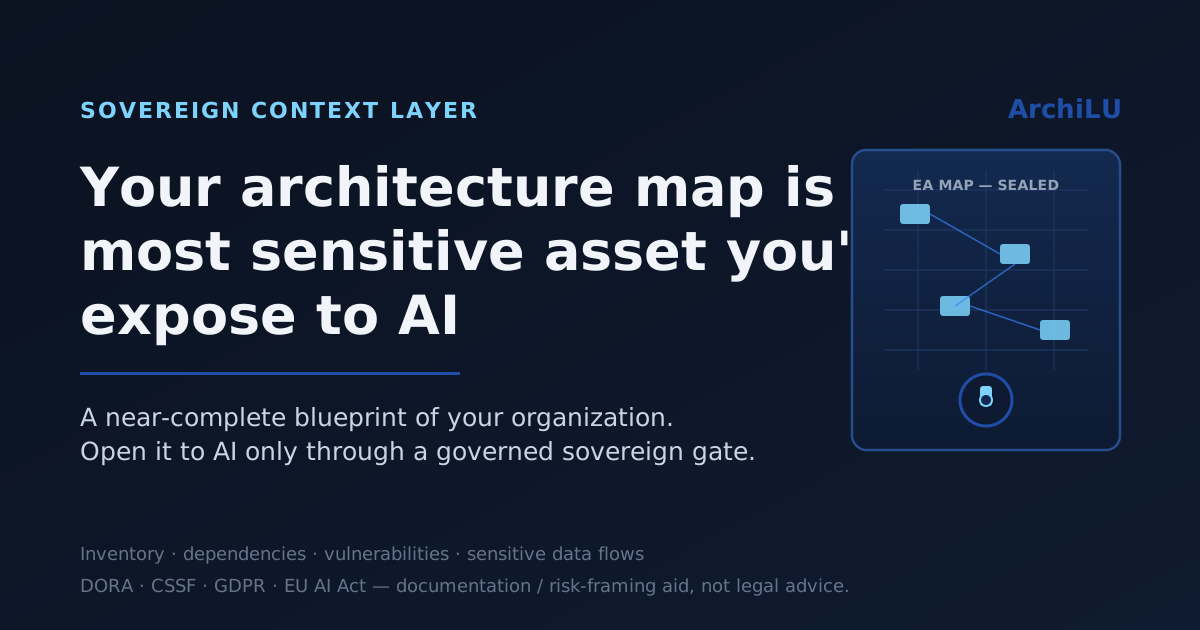
The incumbents' "talk to your architecture" pitch glosses over one fact: an EA map is the single most revealing document an attacker, competitor or auditor could ask for. Here is what it exposes, why US-cloud LLMs make it a regulatory landmine, and how a sovereign context layer lets AI reason on your architecture without you losing control of it.
Looking for an enterprise architecture software platform? Use our EA tool evaluation guide and run the EA maturity assessment.
Key takeaways
- Your EA map is a near-complete blueprint of the org — the highest-sensitivity asset you can hand to an external AI; give context without losing control.
- Why MCP is plumbing — and the governed, sovereign context behind it is the real differentiator.
- How to let AI agents reason on your architecture without sending your SI map to external clouds.
Table of contents
- Sovereign context operating model
- Execution focus for this topic
- The one document you would least want to leak
- What your EA map actually reveals
- Why connecting it to US-cloud LLMs is the landmine
- What the incumbents' pitch quietly assumes
- How to give AI context without leaving the regulatory frame
- The sovereign context layer: AI value without losing control
- An honest disclaimer
- Regulated AI context KPIs
- Common mistakes
- Practical checklist
Sovereign context operating model
An AI agent is only as good as the context it can reach. For a regulated enterprise, that context — the architecture repository — is also one of its most sensitive assets.
The operating model that matters is not "expose the repository over MCP"; it is "govern what context leaves, to whom, and under which residency and audit constraints".
- Decide which object types are queryable, and which are never exposed
- Keep context fresh: reconcile the repository against live sources, not a yearly snapshot
- Make every answer traceable to a governed source the user is entitled to see
Execution focus for this topic
Your EA map is a near-complete blueprint of the org — the highest-sensitivity asset you can hand to an external AI; give context without losing control.
Use this page as a decision support asset: align stakeholders, validate trade-offs, and connect architecture choices to measurable business outcomes.
- Primary query focus: Your Architecture Map Is the Most Sensitive Asset You'll Expose to AI
- Decision scope: strategy, governance, operating model, and execution constraints
- Expected output: clear next actions with ownership and measurable indicators
The one document you would least want to leak
Imagine an attacker could send your organization a single request and receive one document in return. Not your customer list, not a quarter of financials — those hurt, but they are recoverable. The one they would actually ask for is your enterprise architecture map. It is the single artifact that turns scattered facts into a plan: it tells them what you run, what depends on what, what is old and unpatched, where your weak points are, and how regulated data moves between your systems.
That is the asset a growing number of EA tools now invite you to connect to an external AI so people can simply ask it questions. The productivity case is genuine and we are not dismissing it. But before you wire your most revealing document to a general-purpose model, it is worth being precise about what that document actually contains — because the incumbents' « talk to your architecture » pitch tends to skip straight past it.
This article does two things. First, it states plainly what an EA map exposes and why connecting it to US-cloud LLMs is, for a regulated EU institution, the highest-sensitivity exposure most firms will ever make. Then it turns constructive: how to give AI agents real architectural context without leaving the DORA, CSSF, GDPR and EU AI Act frame.
What your EA map actually reveals
An EA repository is not a knowledge base with some diagrams in it. It is close to a complete, structured blueprint of the organization — and its danger is precisely that it correlates things that are merely sensitive in isolation into something that is critical in aggregate.
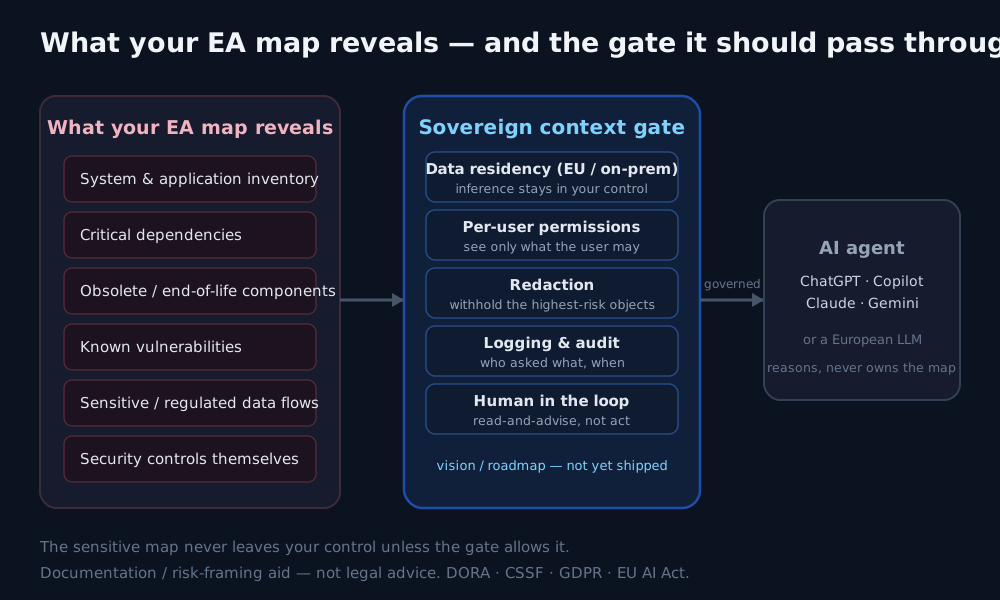
Read the list below as an attacker would. Each line is useful on its own; together they are a map of exactly where to push and what falls over when you do. That aggregation effect is the heart of why this asset sits in a category of its own.
- The full system and application inventory — what you run, including the systems you would rather were not widely known.
- Critical dependencies — which applications and services would take others down if they failed, i.e. where to apply pressure.
- Obsolete and end-of-life components — the unsupported, unpatched technology that is hardest to defend.
- Known vulnerabilities and remediation status — sometimes recorded directly against the affected systems.
- Sensitive and regulated data flows — how personal, financial or supervised data moves between systems and out to third parties.
- Security controls themselves — in some repositories, the very measures meant to protect everything above.
Why connecting it to US-cloud LLMs is the landmine
Connecting that map to a general-purpose assistant — ChatGPT, Microsoft Copilot, Claude, Gemini — is technically the work of an afternoon. The difficulty is not technical. It is that the moment a user asks a question, the prompt and often the retrieved repository content travel to wherever the model runs, where they may be processed, cached or temporarily retained, potentially under a non-EU jurisdiction and potentially under vendor terms you have not read closely.
For a regulated EU institution that lands on several regimes at once. Treated under DORA, a general-purpose AI provider wired into your architecture is an ICT third party that engages concentration risk, exit-strategy and audit-rights obligations. Under GDPR, any personal data in the reachable flows raises lawful-basis and cross-border-transfer questions. Under the EU AI Act, the use case has to be placed in its risk class rather than assumed low-risk because it looks like a chat box. And the CSSF, like other supervisors, expects you to govern and document exactly this kind of dependency.
None of that means « never connect AI to architecture ». It means the default path — point a US-cloud LLM at your most sensitive map and hope the terms are fine — is the exact opposite of what a CISO or DPO can defend to an auditor. The exposure is real and it is the largest most firms will make. The good news is that the value and the risk are separable.
An EA map is a near-complete blueprint of your organization. Why connecting it to external LLMs is your single highest-sensitivity exposure — and how to give AI agents context without leaving the DORA/CSSF/EU AI Act frame.
What the incumbents' pitch quietly assumes
Several established EA vendors now race to own « talk to your architecture » — a chat interface, an MCP connector, a context-engineering story over the repository. The capability is legitimate and the demos are compelling. But almost all of them rest on one unstated assumption: that connecting your EA repository to a general-purpose, mostly US-hosted model is acceptable.
For a lot of organizations it is. For a regulated EU bank, insurer, critical-infrastructure operator or public body, it frequently is not — and « it ran on a US-cloud LLM, terms looked fine in the UI » is not evidence an auditor accepts. Nobody in the EA market has really owned the sovereign, governance-first side of this conversation. That is the gap this article — and our positioning — is about. Not « we do MCP too », but « here is how AI reasons on your architecture without you losing control of it ».
How to give AI context without leaving the regulatory frame
Here is the constructive half. The pattern that keeps the value while removing the exfiltration risk is a governance gate — a sovereign context layer — between the agent and the repository, rather than a direct pipe from a US-cloud model into your map. Each control below maps to a specific concern an auditor or regulator will raise.
None of these is exotic; together they are the difference between an uncontrolled disclosure and a governed, defensible capability. The point is that AI value does not require surrendering the map — it requires putting a gate in front of it.
- Data residency: keep inference and any retained data in the EU or on infrastructure you control, and know exactly where prompts and retrieved content go — no « somewhere in a US region ».
- Permission-awareness: the agent sees only what the requesting user is entitled to see, request by request, so it cannot become a bypass around your access-control model.
- Redaction of sensitive object types: classify your objects and withhold the highest-risk categories — vulnerabilities, controls, single points of failure, regulated data flows — so the agent reasons over a deliberately reduced view.
- Logging and auditability: record who asked what, when, and what was returned, retained and searchable, to the same standard as any access to sensitive data.
- Human in the loop: keep the agent read-and-advise, not act — no autonomous writes or downstream actions on your architecture without a named human owner.
- Sovereign options: EU-hosted or on-premise deployment and European-LLM choices, so the regulatory frame is a deployment property, not an afterthought.
The sovereign context layer: AI value without losing control
Step back and the controls above describe a single thing: a System of Context that sits alongside your Systems of Record, governed for residency, permissions, redaction and audit, that an AI agent can query and that an auditor will accept. That is what we mean by a sovereign context layer — and it is the way we believe a regulated institution gets AI value from its architecture without the sensitive map leaving its control.
We are deliberately honest about status. ArchiLU today offers a connected EA model — capabilities, application portfolio, dependencies — with EU-region or on-premise hosting you control, native French and English, and a free EA Maturity Assessment, built around DORA and CSSF documentation needs. A fully sovereign, data-residency-aware context layer for AI agents — a sovereign, governed MCP over that model — is our conviction and our roadmap, the direction we are building toward. It is not a shipped product, and we will not imply otherwise.
If you take one decision from this piece, let it be this: treat your architecture map as the highest-sensitivity asset it actually is, and require a governance gate before any AI touches it. The « talk to your architecture » feature is worth having — on terms a CISO can defend.
An honest disclaimer
This article is a documentation and risk-framing aid to help your architecture, security and compliance teams structure the conversation and gather evidence — not legal or compliance advice. It does not make you compliant with DORA, NIS2, GDPR, the EU AI Act, CSSF expectations or any other regime. Sovereign hosting, redaction and logging address parts of the risk; compliance is established by your own governance, contracts, records and controls, assessed against your specific regulatory perimeter.
Validate every decision with your own legal, DPO and risk functions, against your specific situation, before connecting any AI to your architecture map. If you want to pressure-test the approach for your context, the maturity assessment and a demo are the fastest way to start a grounded conversation.
Regulated AI context KPIs
Measure whether your context is trustworthy and governed, not how many queries the agent runs.
- Context freshness: median age of architecture objects vs live reality
- Share of answers traceable to a governed, permission-scoped source
- Sensitive object types covered by redaction/residency policy
- Audit coverage: prompts and responses logged and reviewable
Common mistakes
Most MCP-for-EA initiatives fail on context quality and governance long before they fail on the protocol.
- Exposing the full architecture repository to external LLMs without data-residency controls
- Treating MCP as the differentiator instead of the governed context behind it
- Connecting an 18-month-old, hand-maintained repository an agent cannot trust
- No permission-awareness, logging, or redaction of sensitive object types
Practical checklist
Run this before connecting any AI agent to your architecture repository.
- Confirm where prompts and responses go, and whether data stays in your region
- Enforce permission-aware access so the agent only sees what the user may see
- Classify and redact sensitive object types (vulnerabilities, data flows, controls)
- Log prompts and answers for audit, and keep a human in the loop for any change
An EA map is a near-complete blueprint of your organization. Why connecting it to external LLMs is your single highest-sensitivity exposure — and how to give AI agents context without leaving the DORA/CSSF/EU AI Act frame.
FAQ
Why is an EA map more sensitive than other internal data?
Because of what it aggregates. A single document or database leaks one thing. An enterprise architecture map correlates everything: the full system inventory, which applications depend on which, what is obsolete and unpatched, where the known vulnerabilities sit, how regulated and personal data flows between systems, and sometimes the security controls themselves. It is the one artifact that turns a list of facts into a coherent attack plan — which is exactly why it deserves more caution than almost any other asset before you connect it to an external AI.
Isn't "talk to your architecture" a normal feature now? Everyone is shipping it.
The feature is real and useful; the framing is what we push back on. Several EA vendors now market a chat interface or an MCP connector over the repository, and they are right that natural-language access to architecture is valuable. What the pitch tends to gloss over is where the data goes when that conversation runs on a general-purpose US-cloud LLM. For a regulated EU institution, that omission is the whole risk. The right question is not whether you can talk to your architecture, but under whose jurisdiction and governance the conversation happens.
Can we get AI value from our architecture without sending it to US-cloud LLMs?
Yes, and that is the constructive half of this article. The pattern is a sovereign context layer that sits between the agent and the repository: it keeps inference in the EU or on infrastructure you control, enforces per-user permissions, redacts the highest-risk object types, logs every request and keeps a human in the loop. EU-hosted or on-premise deployment and European model options make this achievable. The goal is to let AI reason over your architecture without the sensitive map leaving your control.
Does ArchiLU already offer this sovereign AI connection today?
No, and we will not pretend it does. What we can offer today is a connected EA model — capabilities, application portfolio, dependencies — with EU-region or on-premise hosting you control, native French and English, and a free EA Maturity Assessment, built around DORA and CSSF documentation needs. A fully sovereign, data-residency-aware context layer for AI agents is our conviction and our roadmap, the direction we are building toward, not a shipped product. This article describes where we believe the category should go, honestly labelled as such.
Is this article legal or compliance advice?
No. It is a documentation and risk-framing aid to help architecture, security and compliance teams structure the conversation and gather evidence. It is not legal advice and it does not make you compliant with DORA, NIS2, GDPR, the EU AI Act, CSSF expectations or any other regime. Hosting, redaction or logging choices address parts of the risk; compliance is established by your own governance, contracts, records and controls, assessed against your specific regulatory perimeter. Validate every decision with your legal, DPO and risk functions.
Is MCP enough to make our architecture AI-ready?
No. MCP is the transport; the value is the quality, freshness, governance, and sovereignty of the context it exposes.
Strategic links
Compare enterprise architecture platforms
Related articles
IT Cost and Supplier Risk: One Map for Money and DORA
Cost and ICT third-party risk are usually managed in separate spreadsheets. Mapping applications to suppliers and cost in one model lets you see concentration, license exposure and rationalisation candidates at once — and produce the evidence DORA-minded reviews expect.
NIS2 and Enterprise Architecture: Mapping the Systems and Dependencies Risk Management Touches
NIS2 broadens the entities covered and raises the bar on cyber risk management, supply-chain security and incident handling. Each of those expectations rests on one prior question: do you actually know your systems and how they depend on each other? An EA map is the natural place to hold that — honestly, as evidence, not as a compliance badge.
CSSF and Enterprise Architecture: One Map for ICT, Outsourcing and Resilience Documentation
Banks, PFS, investment firms and fund actors supervised by the CSSF carry recurring documentation expectations around ICT, outsourcing and operational resilience. Each rests on a prior question: can you actually show your capabilities, applications, data flows and the third parties behind them? An EA repository is the natural place to hold that — honestly, as evidence, not as a compliance badge.