

Published on June 21, 2026 | Updated on June 21, 2026 | 9 min read
Should a Regulated Bank Connect AI Agents to Its Architecture?
The EA map is a near-complete blueprint of the bank. Connecting an AI agent to it can accelerate impact analysis and compliance reporting — or quietly leak the blueprint to a US-cloud model. A structured go / no-go framework.
Looking for an enterprise architecture software platform? Use our EA tool evaluation guide and run the EA maturity assessment.
Key takeaways
- Why MCP is plumbing — and the governed, sovereign context behind it is the real differentiator.
- How to let AI agents reason on your architecture without sending your SI map to external clouds.
- How to keep an EA repository fresh enough that an AI agent's answers are actually trustworthy.
Table of contents
- Sovereign context operating model
- The question CIOs and CISOs are actually asking
- The upside — why this is worth the conversation
- The exposure — what the EA map really is
- The regulatory frame: DORA, GDPR, the EU AI Act, CSSF
- How to decide: which questions are safe, which objects must never leave
- The four gates and the sovereign options
- The verdict: yes — but only governed and sovereign
- Regulated AI context KPIs
- Common mistakes
- Practical checklist
Sovereign context operating model
An AI agent is only as good as the context it can reach. For a regulated enterprise, that context — the architecture repository — is also one of its most sensitive assets.
The operating model that matters is not "expose the repository over MCP"; it is "govern what context leaves, to whom, and under which residency and audit constraints".
- Decide which object types are queryable, and which are never exposed
- Keep context fresh: reconcile the repository against live sources, not a yearly snapshot
- Make every answer traceable to a governed source the user is entitled to see
The question CIOs and CISOs are actually asking
The market keeps saying "talk to your architecture." Vendors race to connect Claude, Copilot, ChatGPT or Gemini to the EA repository so an architect can ask questions in plain language. For a regulated bank, that pitch lands differently. The person who has to sign off is not excited by the demo — they are calculating what just left the building.
So the real question is not "is AI useful on our architecture?" It almost certainly is. The question is whether connecting an agent to the EA repository is a defensible decision for a DORA/CSSF-supervised institution, and if so, under what conditions. This is a decision and risk framework, not a recommendation to connect or to abstain. It is a documentation and risk-framing aid — not legal advice, and it does not make you compliant with DORA, GDPR, the EU AI Act or CSSF expectations.
The upside — why this is worth the conversation
If the risk were trivial nobody would push back, and if the value were trivial nobody would push forward. The value is real. An agent reasoning over a living EA model can compress work that today eats weeks of architect time.
Three uses tend to justify the whole conversation. Impact analysis: "if we decommission this core component, what breaks and which critical functions are affected?" — answered against the dependency graph in seconds instead of a fortnight of interviews. Rationalization: surfacing redundant or obsolete applications as candidates for retirement. Compliance reporting: drafting the architecture sections of a DORA register or a CSSF submission from the model rather than from memory. None of this is hypothetical hype; it is the ordinary work the EA repository already holds the answers to.
- Impact analysis on the dependency graph — minutes instead of weeks
- Rationalization: redundant and obsolete applications surfaced as retirement candidates
- Compliance and audit reporting drafted from the model, not from tribal memory
- Faster onboarding: a new architect can interrogate the estate without a guided tour
The exposure — what the EA map really is
Here is the part the demo skips. An EA map is not a tidy diagram; it is a near-complete blueprint of the bank. It holds the full system inventory, the critical dependencies, the obsolete components still in production, the known vulnerabilities, the sensitive data flows, and sometimes the security measures themselves.
Assembled, that is the single most useful document an attacker could obtain — and the single disclosure a supervisor is most likely to question. When you attach EA context to a prompt sent to a general US-cloud LLM, that context leaves your control and crosses a third-country boundary. The agent answered a question; you also exported the blueprint. That is the asymmetry at the heart of this decision.
- Full system inventory and critical dependencies — the bank's nervous system
- Obsolete components and known vulnerabilities — a ready-made attack map
- Sensitive data flows and, sometimes, the security controls themselves
- A near-complete blueprint that, once sent out, you cannot recall
The regulatory frame: DORA, GDPR, the EU AI Act, CSSF
Four regimes shape this decision, and they overlap rather than stack neatly. Treat the summary below as the map for a conversation with your second and third lines of defence, not as a clearance.
DORA brings ICT third-party risk and concentration into scope: a general-purpose LLM provider can become a critical ICT third party, and routing your most sensitive context through one model concentrates risk in a way the regulation expects you to manage. GDPR applies the moment any personal data appears in the context and governs the transfer when inference happens outside the EU. The EU AI Act layers obligations that scale with how the use case is classified. CSSF expectations sit on top for Luxembourg-supervised entities, where outsourcing and ICT-risk circulars set the supervisory tone. None of these say "never"; all of them say "govern it, and be able to evidence the governance."
- DORA — ICT third-party risk and concentration when an external model becomes critical
- GDPR — personal data in context, and EU-to-third-country transfer at inference time
- EU AI Act — obligations scaling with the use case's risk classification
- CSSF — outsourcing and ICT-risk expectations for Luxembourg-supervised entities
A balanced decision and risk framework for CIOs, CISOs and risk leaders weighing whether to connect Claude, Copilot or any AI agent to the bank's EA repository — the upside, the exposure, and the sovereign way to decide.
How to decide: which questions are safe, which objects must never leave
The decision is not "AI or no AI." It is a question-by-question and object-by-object judgment, which is exactly why a flat ban and a blank cheque are both wrong. Split the space into what can be answered safely and what must stay inside the perimeter.
Many questions are low-risk: aggregate counts, capability coverage, ownership lookups, high-level dependency direction. Some are categorically not: anything that returns the live vulnerability list of a critical function, the security controls protecting a system, or a sensitive data flow tied to identifiable people. The discipline is to define those classes once, encode them, and let the gate — not the architect's judgment in the moment — enforce them.
- Generally safe to ask: aggregate inventories, capability coverage, ownership and high-level dependencies
- Never let leave the repository: live vulnerability lists, security controls of critical systems, person-linked data flows
- Decide by object type and sensitivity class, defined once — not improvised per query
- Default to deny for anything touching a critical function until explicitly cleared
The four gates and the sovereign options
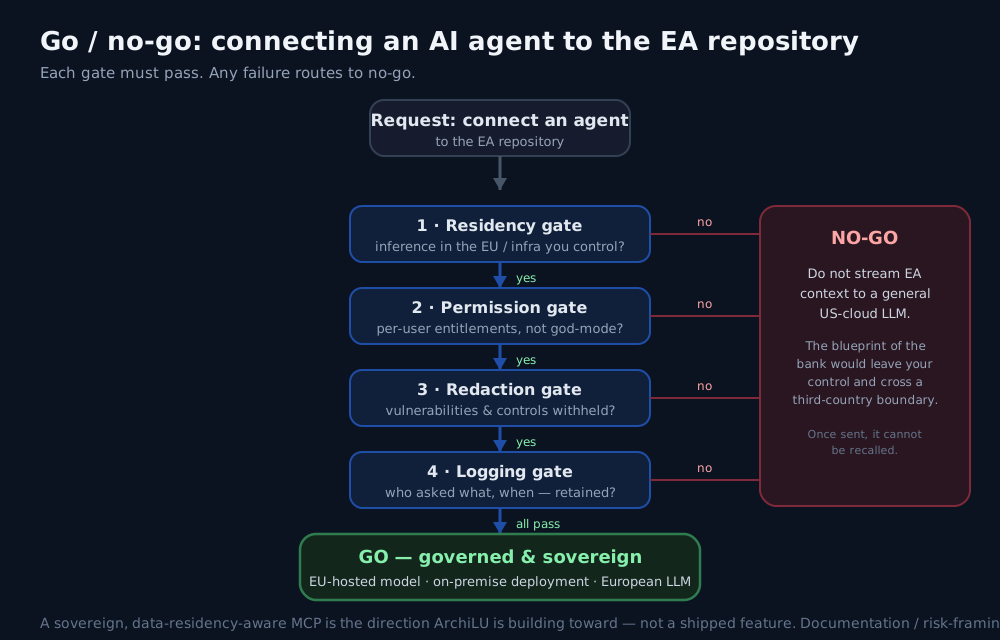
If the institution decides to proceed, four gates turn "connect an agent" into something defensible. Residency: keep inference in the EU or on infrastructure you control, so context does not cross a third-country boundary. Permissions: the agent sees only what the asking user is entitled to see — per-user, not a god-mode service account. Redaction: sensitive object types (vulnerabilities, security controls) are withheld at the boundary even when the rest of the answer flows. Logging: every query is recorded — who asked what, when — so the governance is evidenced, not asserted.
Those gates are only fully achievable with a sovereign delivery model. The options are concrete: an EU-hosted model, a private or on-premise deployment, or a European LLM. This is what we mean by a data-residency-aware MCP — an interface that governs where the data goes, not only who queries. To be honest about our own state: a sovereign MCP server is the direction ArchiLU is building toward, our conviction about how this should work, not a feature you can switch on today. What we do offer today is the governed context underneath it — an EU-region or on-premise EA model you control, native FR/EN, built around DORA/CSSF documentation needs.
- Residency gate — inference in the EU or on infrastructure you control
- Permission gate — per-user entitlements, never a god-mode service account
- Redaction gate — withhold vulnerabilities and security controls at the boundary
- Logging gate — who asked what, when, retained as audit evidence
- Sovereign options — EU-hosted model, on-premise deployment, or a European LLM
The verdict: yes — but only governed and sovereign
Connecting an AI agent to the architecture of a regulated bank is not reckless and it is not inevitable. It is a governed decision. Done with residency, permission, redaction and logging gates over a sovereign delivery model, the high-value uses — impact analysis, rationalization, compliance drafting — become defensible, and you can show your supervisor the governance rather than promise it. Done by pointing a general US-cloud LLM at the live repository, you have exported the blueprint of the bank and you cannot take it back.
Start from where your practice actually stands, not from a vendor demo. ArchiLU's free EA Maturity Assessment scores ten dimensions in about ten minutes and gives a concrete read on whether your context is even governed enough to connect an agent to it responsibly. Remember the disclaimer throughout: this framework helps you document and reason about the risk; it does not constitute legal advice and does not by itself make you compliant with DORA, GDPR, the EU AI Act or CSSF expectations.
Regulated AI context KPIs
Measure whether your context is trustworthy and governed, not how many queries the agent runs.
- Context freshness: median age of architecture objects vs live reality
- Share of answers traceable to a governed, permission-scoped source
- Sensitive object types covered by redaction/residency policy
- Audit coverage: prompts and responses logged and reviewable
Common mistakes
Most MCP-for-EA initiatives fail on context quality and governance long before they fail on the protocol.
- Exposing the full architecture repository to external LLMs without data-residency controls
- Treating MCP as the differentiator instead of the governed context behind it
- Connecting an 18-month-old, hand-maintained repository an agent cannot trust
- No permission-awareness, logging, or redaction of sensitive object types
Practical checklist
Run this before connecting any AI agent to your architecture repository.
- Confirm where prompts and responses go, and whether data stays in your region
- Enforce permission-aware access so the agent only sees what the user may see
- Classify and redact sensitive object types (vulnerabilities, data flows, controls)
- Log prompts and answers for audit, and keep a human in the loop for any change
A balanced decision and risk framework for CIOs, CISOs and risk leaders weighing whether to connect Claude, Copilot or any AI agent to the bank's EA repository — the upside, the exposure, and the sovereign way to decide.
FAQ
Can a regulated bank connect an AI agent to its EA repository at all?
Yes — but only governed and sovereign. The decision is not binary 'AI or no AI'; it is about which questions an agent may ask, which object types may leave the repository, and where inference runs. With residency, permission, redaction and logging gates in place, many high-value uses (impact analysis, rationalization candidates, documentation drafting) become defensible. Without those gates, you are streaming a blueprint of the bank to an external model.
Why is an EA map considered so sensitive?
Because it is a near-complete blueprint of the organization: the full system inventory, critical dependencies, obsolete components, known vulnerabilities, sensitive data flows and sometimes security measures. Individually each item may be mundane; assembled, it is exactly the reconnaissance an attacker would want and exactly the disclosure a supervisor will question. That is why the residency and redaction questions come before the productivity questions.
Which regulations are in scope for this decision?
At minimum DORA (ICT third-party risk and concentration), GDPR (any personal data and EU-to-third-country transfers), the EU AI Act (obligations that scale with the use case's risk classification) and CSSF expectations for Luxembourg-supervised entities. This article frames those regimes so you can structure the conversation with your second and third lines of defence. It is a documentation and risk-framing aid, not legal advice, and it does not by itself make you compliant with any of them.
What is the difference between a US-cloud LLM and a sovereign option here?
With a general US-cloud LLM, your prompts — including whatever EA context you attach — leave your control and cross a third-country boundary, which is precisely what DORA concentration and GDPR transfer reviews scrutinize. A sovereign option keeps inference in the EU or on infrastructure you control: EU-hosted models, a private deployment, or a European LLM. The agent can still be useful; the blueprint simply does not leave your jurisdiction.
Where does ArchiLU fit in this decision?
ArchiLU's role is to be the governed context layer behind that decision: an EU-region or on-premise EA model you control, native French and English, built around DORA/CSSF documentation needs. A sovereign, data-residency-aware MCP — an AI agent reasoning on that context without the map leaving your control — is the direction we are building toward, not a shipped feature today. Treat the gates in this article as the design target, not a product claim.
Is MCP enough to make our architecture AI-ready?
No. MCP is the transport; the value is the quality, freshness, governance, and sovereignty of the context it exposes.
Strategic links
Compare enterprise architecture platforms
Related articles
IT Cost and Supplier Risk: One Map for Money and DORA
Cost and ICT third-party risk are usually managed in separate spreadsheets. Mapping applications to suppliers and cost in one model lets you see concentration, license exposure and rationalisation candidates at once — and produce the evidence DORA-minded reviews expect.
NIS2 and Enterprise Architecture: Mapping the Systems and Dependencies Risk Management Touches
NIS2 broadens the entities covered and raises the bar on cyber risk management, supply-chain security and incident handling. Each of those expectations rests on one prior question: do you actually know your systems and how they depend on each other? An EA map is the natural place to hold that — honestly, as evidence, not as a compliance badge.
CSSF and Enterprise Architecture: One Map for ICT, Outsourcing and Resilience Documentation
Banks, PFS, investment firms and fund actors supervised by the CSSF carry recurring documentation expectations around ICT, outsourcing and operational resilience. Each rests on a prior question: can you actually show your capabilities, applications, data flows and the third parties behind them? An EA repository is the natural place to hold that — honestly, as evidence, not as a compliance badge.