


Published on June 19, 2026 | Updated on June 19, 2026 | 10 min read
Enterprise Architecture for Healthcare: A Practical Guide
Fragmented systems, ageing software and sensitive data make healthcare a hard EA problem. Here is how a connected architecture model helps.
Looking for an enterprise architecture software platform? Use our EA tool evaluation guide and run the EA maturity assessment.
Key takeaways
- How to translate strategy into architecture priorities and delivery increments.
- How to align business, data, application, and technology decisions.
- How to sustain execution discipline with measurable architecture governance.
Table of contents
- Strategy-to-execution alignment
- Why healthcare is a hard architecture problem
- Interoperability: the central challenge
- Modernizing legacy systems without breaking care
- Data governance for sensitive patient data
- The regulatory context (not a compliance claim)
- Where Archilu fits for healthcare
- Execution alignment KPIs
- Common mistakes
- Practical checklist
Strategy-to-execution alignment
Enterprise architecture creates leverage when strategic priorities are translated into capability-level outcomes and delivery sequencing.
This requires a shared language between executives, architecture leaders, and delivery organizations.
- Define measurable capability outcomes tied to strategic goals
- Map cross-domain dependencies before portfolio commitment
- Review architecture assumptions at each roadmap increment
Why healthcare is a hard architecture problem
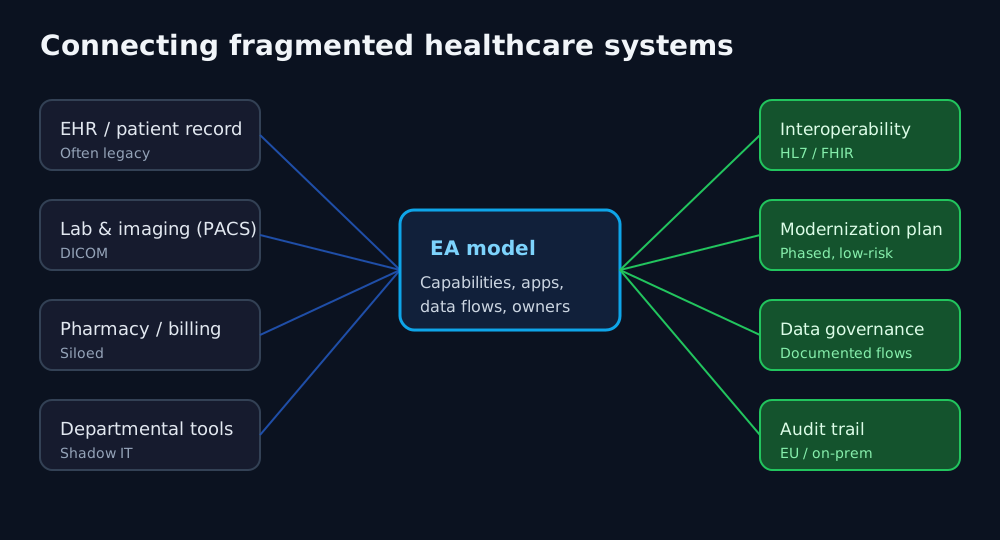
Few sectors carry as much accidental complexity as healthcare. A single hospital or care group can run dozens of specialized systems — electronic health records, laboratory and imaging platforms, pharmacy, scheduling, billing — bought at different times from different vendors, each with its own data model.
Layered on top is the highest stakes for continuity and data sensitivity. You cannot simply switch off a clinical system to tidy the architecture. Enterprise architecture earns its place here by making the whole landscape visible and changeable in a controlled, low-risk way.
Interoperability: the central challenge
Interoperability is the defining problem of healthcare IT. Standards such as HL7, FHIR and DICOM exist precisely because systems struggle to exchange data, but standards alone do not deliver it — real environments mix versions, partial implementations and point-to-point interfaces that nobody fully documents.
An architecture model addresses this by making the application landscape and its data flows explicit: which systems hold which data, how it moves, and where the brittle integrations are. That shared picture is what lets you plan toward standards-based interoperability instead of adding yet another fragile interface.
Modernizing legacy systems without breaking care
Many core clinical systems are old, deeply embedded and risky to touch — yet costly and limiting to keep. The instinct to replace everything at once is exactly what makes modernization fail in healthcare, where downtime has clinical consequences.
A capability and application map turns this into a sequenced programme. By seeing what each legacy system supports, what depends on it, and where risk concentrates, you can phase modernization — wrapping, replacing or retiring components in an order that protects clinical continuity and spreads cost and risk over time.
- Map each legacy system to the capabilities it supports
- Expose dependencies before any replacement starts
- Phase change to protect clinical continuity
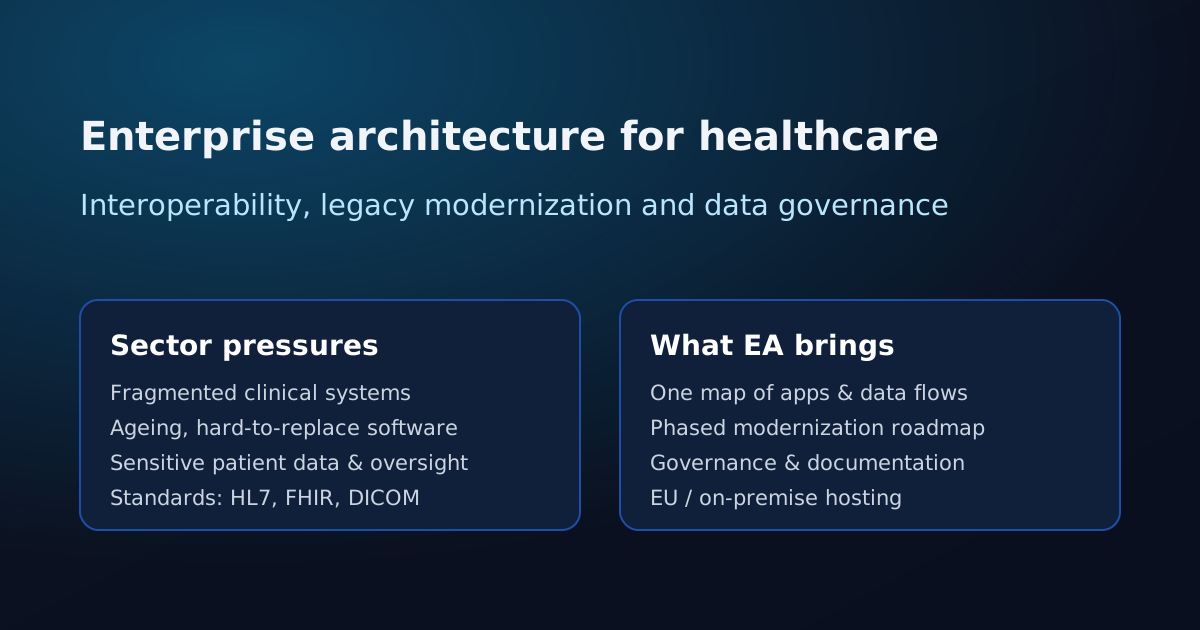
How enterprise architecture helps healthcare organizations tackle interoperability, legacy modernization and data governance — with an EU-sovereign approach.
Data governance for sensitive patient data
Patient data is among the most sensitive information an organization can hold, and it flows across many systems. Good governance starts with knowing where it lives and how it moves — which is exactly what a connected architecture model documents.
By linking applications, the data they process and the flows between them, you create a defensible record of your data landscape: useful for access decisions, for risk reviews, and for demonstrating to oversight bodies that flows are understood and controlled rather than ad hoc.
The regulatory context (not a compliance claim)
Healthcare operates under demanding rules on data protection and, increasingly, on the resilience of critical digital infrastructure. The relevant point for architecture is that regulators expect organizations to understand and document their systems, data and dependencies.
This is context, not a compliance guarantee. Archilu helps you produce and maintain that documentation — clear maps of capabilities, applications and data flows — but legal compliance with the health-data and resilience rules that apply to you remains your organization's responsibility, supported by your own legal and security functions.
Where Archilu fits for healthcare
Archilu's fit in healthcare rests on a few concrete properties rather than sweeping claims. It offers EU or on-premise hosting you control, which matters where patient data must stay within a defined jurisdiction or inside your own infrastructure. It holds capabilities, applications, data and technology in one connected model, so interoperability, modernization and governance all draw on the same picture.
It also includes application portfolio management, so the legacy estate can be assessed for cost, risk and technical health — the raw material of a modernization roadmap. To find your starting point, Archilu's free EA Maturity Assessment scores ten dimensions and returns a prioritized plan in about ten minutes, and the linked sector guides turn that into concrete next steps.
Execution alignment KPIs
These indicators show whether architecture is improving strategic execution quality.
- Capability outcome attainment vs roadmap target
- Strategic initiative delay caused by architecture dependencies
- Architecture debt trend on critical value streams
- Portfolio re-prioritization speed after risk change
Common mistakes
Strategic architecture work fails when it is disconnected from delivery sequencing and budget decisions.
- Publishing target states without execution ownership
- No dependency mapping across initiatives
- No cadence for architecture refresh based on outcomes
- No explicit link between architecture debt and portfolio risk
Practical checklist
Use this sequence to connect strategy to execution outcomes.
- Translate strategic goals into capability-level outcomes
- Map dependencies across business, app, data, and tech domains
- Define architecture decision checkpoints in roadmap cadence
- Track progress with measurable delivery and risk indicators
How enterprise architecture helps healthcare organizations tackle interoperability, legacy modernization and data governance — with an EU-sovereign approach.
FAQ
Why is interoperability so hard in healthcare?
Healthcare environments accumulate many specialized systems — electronic health records, laboratory, imaging, pharmacy, billing — often from different vendors and different eras. Even with standards like HL7, FHIR and DICOM, real-world data lives in incompatible formats and partial implementations. An enterprise architecture model makes the systems and their data flows explicit, which is the precondition for planning interoperability rather than improvising it.
Can enterprise architecture help modernize legacy clinical systems?
Yes, by making modernization sequenced and low-risk instead of a big-bang gamble. Mapping which capabilities each legacy system supports, what depends on it, and where the risk concentrates lets you plan a phased roadmap — replacing or wrapping components in an order that protects clinical continuity. EA does not replace the migration project; it gives it a defensible plan.
Does Archilu help with healthcare data residency requirements?
Archilu offers EU or on-premise hosting that you control, which is relevant where patient data must stay within a defined jurisdiction or inside your own infrastructure. Archilu is an architecture and documentation tool, not a compliance certification: it helps you map, document and govern data flows, while legal compliance with the applicable health-data rules remains your organization's responsibility.
How do we keep architecture aligned with strategy over time?
Run quarterly roadmap refresh using business outcomes, risk signals, and execution data.
Who should own strategy-to-architecture translation?
Enterprise architecture leadership with shared accountability from business and delivery leaders.
Strategic links
Compare enterprise architecture platforms
Related articles
IT Cost and Supplier Risk: One Map for Money and DORA
Cost and ICT third-party risk are usually managed in separate spreadsheets. Mapping applications to suppliers and cost in one model lets you see concentration, license exposure and rationalisation candidates at once — and produce the evidence DORA-minded reviews expect.
NIS2 and Enterprise Architecture: Mapping the Systems and Dependencies Risk Management Touches
NIS2 broadens the entities covered and raises the bar on cyber risk management, supply-chain security and incident handling. Each of those expectations rests on one prior question: do you actually know your systems and how they depend on each other? An EA map is the natural place to hold that — honestly, as evidence, not as a compliance badge.
CSSF and Enterprise Architecture: One Map for ICT, Outsourcing and Resilience Documentation
Banks, PFS, investment firms and fund actors supervised by the CSSF carry recurring documentation expectations around ICT, outsourcing and operational resilience. Each rests on a prior question: can you actually show your capabilities, applications, data flows and the third parties behind them? An EA repository is the natural place to hold that — honestly, as evidence, not as a compliance badge.