


Published on June 20, 2026 | Updated on June 20, 2026 | 9 min read
Enterprise Architecture for Enterprise Architects: A Guide
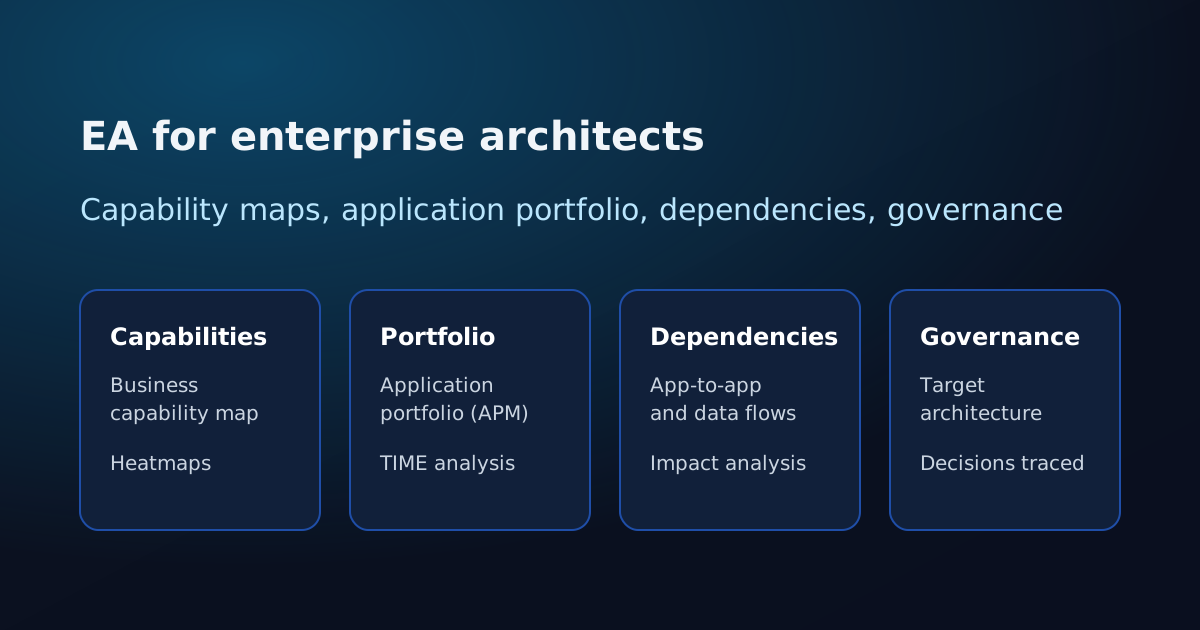
How an enterprise architect actually works: capability maps, application portfolio, dependencies, target architecture and governance, with frameworks as references.
Looking for an enterprise architecture software platform? Use our EA tool evaluation guide and run the EA maturity assessment.
Key takeaways
- How to choose architecture patterns using operating model constraints.
- How to manage API and integration dependencies at enterprise scale.
- How to reduce coupling risk while preserving delivery speed.
Table of contents
- Application landscape design
- Written for the practitioner, not the slide deck
- Start from capabilities, not applications
- Connect the application portfolio (APM)
- Make dependencies and impact analysis cheap
- Target architecture and governance
- Frameworks as references, a connected model as the engine
- Application architecture KPIs
- Common mistakes
- Practical checklist
Application landscape design
Application architecture should optimize for clear domain boundaries, low coupling, and predictable change impact.
The best pattern is the one that your teams can operate reliably with your current maturity and constraints.
- Define domain boundaries before choosing monolith vs microservices
- Control API lifecycle with versioning, ownership, and deprecation policy
- Use dependency mapping to prevent cascading failure risk
Written for the practitioner, not the slide deck
If you do the work — mapping capabilities, untangling the application portfolio, planning a target architecture and keeping it governed — most EA content is too abstract to help. This page is about how the practice actually runs, and where a tool helps versus gets in the way.
It is honest about Archilu: claims are limited to features you can verify, and frameworks are treated as references you draw on, not a methodology you must perform before producing anything.
Start from capabilities, not applications
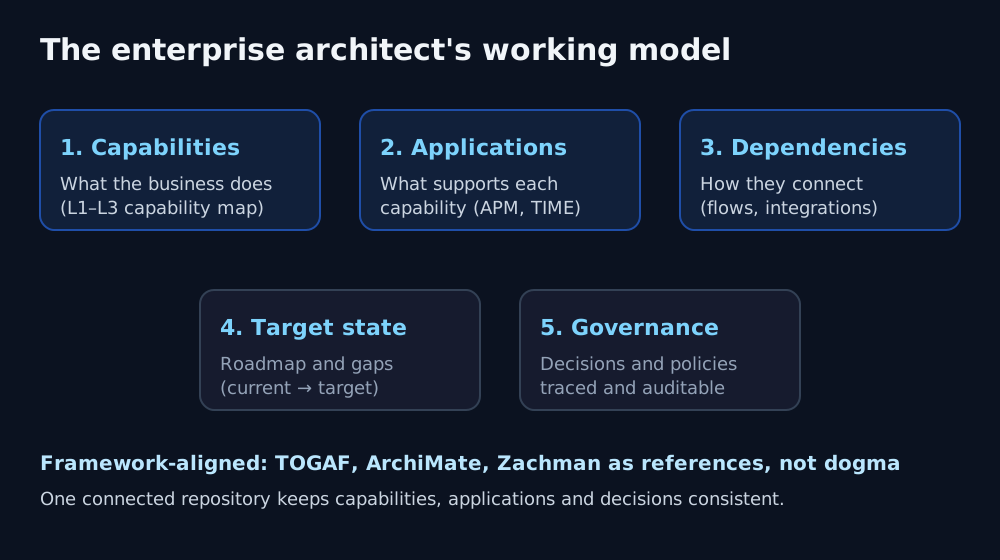
A business capability map is the most durable artifact you own: it describes what the organization does, independent of the systems that happen to support it today. That stability is what lets you compare current state to target, run heatmaps, and have a conversation with the business that survives the next reorganization.
Build it in levels (L1 to L3), assign owners, and you have the backbone everything else hangs on. The capability mapping guide linked below covers levels, ownership and heatmaps in depth.
Connect the application portfolio (APM)
Once capabilities are stable, connect the applications that support them. Application portfolio management lets you see coverage, overlap and gaps, and assess each application on cost, business value, technical health and risk.
A common lens is the TIME model — tolerate, invest, migrate, eliminate — which turns the portfolio into a set of decisions rather than an inventory. That is where rationalization candidates and target-state moves come from.
- Map applications to the capabilities they support
- Assess cost, value, technical health and risk
- Use TIME to drive invest / migrate / eliminate decisions
A practitioner's view of enterprise architecture: capability mapping, application portfolio, dependencies, target architecture and governance — framework-aligned.
Make dependencies and impact analysis cheap
Architecture decisions live or die on dependencies: which application calls which, where data flows, what breaks if a system is retired. When that information is in a connected model, an impact analysis is a query you can answer in minutes.
When it lives across spreadsheets, every change request becomes archaeology. A connected repository is what makes dependency and impact work sustainable.
Target architecture and governance
Practitioners do not just document the present; they steer toward a target. That means a current-state baseline, a defined target, a gap analysis and a roadmap of moves — each governed so decisions are recorded and consistent with stated principles.
When decisions, policies and approvals sit alongside the model rather than in a separate document, governance stops being overhead and becomes part of how you work. Archilu keeps the architecture and the governance trail in one place.
Frameworks as references, a connected model as the engine
TOGAF gives method and vocabulary, ArchiMate a modeling language across business, application and technology layers, Zachman a classification ontology. Use them as references that sharpen your thinking — not as a ceremony to complete before delivering value.
The practical advantage of Archilu for an architect is the connected model behind all of this, with EU or on-premise hosting. To see where your own practice stands, the free EA Maturity Assessment scores ten dimensions and returns a prioritized plan in about ten minutes.
Application architecture KPIs
Use KPIs that reveal coupling risk and change friction early.
- Cross-domain dependency count on critical journeys
- API version deprecation compliance
- Change failure rate by architecture pattern
- Cycle time impact of integration dependencies
Common mistakes
Application architecture quality drops when teams choose patterns before clarifying domain boundaries.
- Adopting microservices before domain decomposition
- Scaling API usage without lifecycle governance
- Ignoring runtime dependency risk in design reviews
- Mixing tactical integration fixes with target architecture decisions
Practical checklist
This checklist helps teams avoid architecture churn and delivery risk.
- Map domain boundaries before selecting architecture patterns
- Define API lifecycle ownership and version policy
- Track critical runtime dependencies and failure modes
- Review integration debt in portfolio governance cadence
A practitioner's view of enterprise architecture: capability mapping, application portfolio, dependencies, target architecture and governance — framework-aligned.
FAQ
Where should an enterprise architect start?
Most practitioners start with a business capability map, because it gives a stable, technology-independent backbone to hang everything else on. From there you connect applications to capabilities, map dependencies, define a target architecture and govern the moves. The capability mapping guide linked below walks through levels, ownership and heatmaps.
How do frameworks like TOGAF and ArchiMate fit in?
As references, not dogma. TOGAF gives you a method and a vocabulary; ArchiMate gives you a modeling language across business, application and technology layers; Zachman gives you a classification ontology. Archilu lets you work in a way aligned with these frameworks without forcing a heavyweight methodology before you produce anything useful.
What makes a tool good for the practitioner specifically?
A connected model. When capabilities, applications, dependencies and decisions live in one repository, an impact analysis or a heatmap is a query, not a manual reconciliation. Archilu is built around that connected model with EU or on-premise hosting, so architects spend time on analysis rather than on keeping spreadsheets in sync.
How do we reduce application sprawl?
Use capability mapping and lifecycle governance to retire redundant systems consistently.
Is API-first always the right choice?
It is effective for interoperability, but only with clear lifecycle and ownership governance.
Strategic links
Compare enterprise architecture platforms
Related articles
IT Cost and Supplier Risk: One Map for Money and DORA
Cost and ICT third-party risk are usually managed in separate spreadsheets. Mapping applications to suppliers and cost in one model lets you see concentration, license exposure and rationalisation candidates at once — and produce the evidence DORA-minded reviews expect.
NIS2 and Enterprise Architecture: Mapping the Systems and Dependencies Risk Management Touches
NIS2 broadens the entities covered and raises the bar on cyber risk management, supply-chain security and incident handling. Each of those expectations rests on one prior question: do you actually know your systems and how they depend on each other? An EA map is the natural place to hold that — honestly, as evidence, not as a compliance badge.
CSSF and Enterprise Architecture: One Map for ICT, Outsourcing and Resilience Documentation
Banks, PFS, investment firms and fund actors supervised by the CSSF carry recurring documentation expectations around ICT, outsourcing and operational resilience. Each rests on a prior question: can you actually show your capabilities, applications, data flows and the third parties behind them? An EA repository is the natural place to hold that — honestly, as evidence, not as a compliance badge.