


Published on June 19, 2026 | Updated on June 19, 2026 | 12 min read
Business Capability Mapping: A Complete Practical Guide
A practical, end-to-end guide to business capability mapping — from levels and owners to heatmaps, value streams and capability-based planning.
Looking for an enterprise architecture software platform? Use our EA tool evaluation guide and run the EA maturity assessment.
Key takeaways
- How to translate strategy into architecture priorities and delivery increments.
- How to align business, data, application, and technology decisions.
- How to sustain execution discipline with measurable architecture governance.
Table of contents
- Strategy-to-execution alignment
- What a business capability map actually is
- Levels and hierarchy: structuring the map
- Owners and coverage: making the map accountable
- Heatmaps: turning the map into a decision tool
- Value streams: connecting capabilities to outcomes
- Capability-based planning
- Common mistakes to avoid
- Getting started with Archilu
- Execution alignment KPIs
- Practical checklist
Strategy-to-execution alignment
Enterprise architecture creates leverage when strategic priorities are translated into capability-level outcomes and delivery sequencing.
This requires a shared language between executives, architecture leaders, and delivery organizations.
- Define measurable capability outcomes tied to strategic goals
- Map cross-domain dependencies before portfolio commitment
- Review architecture assumptions at each roadmap increment
What a business capability map actually is
A business capability map answers one deceptively simple question: what is this organization able to do? It is a structured inventory of capabilities — stable, outcome-oriented building blocks like 'Pricing', 'Order Fulfilment' or 'Risk Management' — arranged so leaders can see the whole business on a single page.
The power of the map comes from what it deliberately leaves out. It does not describe processes, teams, or software. By separating what from how, the map stays stable while everything underneath it changes, which is why it works so well as a common language between business and IT.
Levels and hierarchy: structuring the map
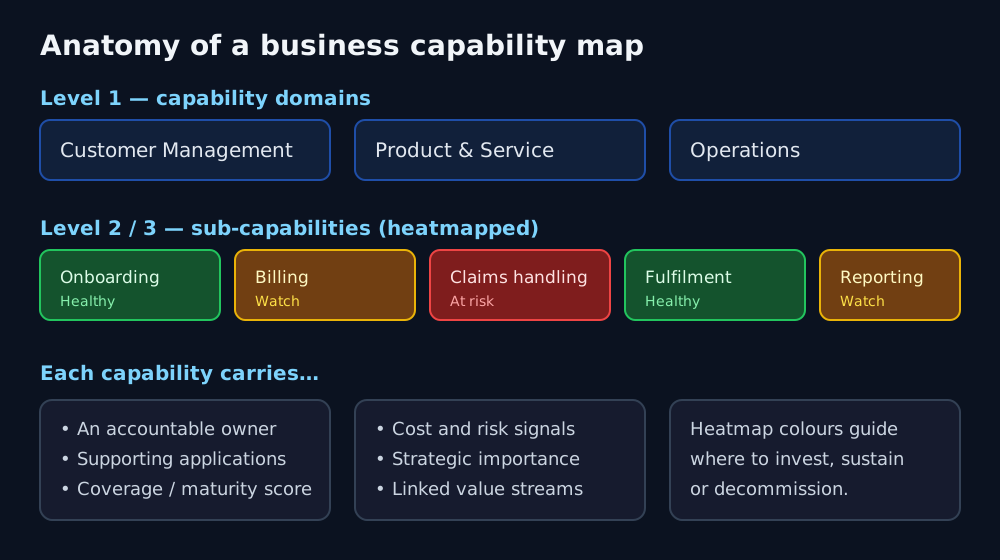
A capability map is organized as a hierarchy. Level 1 holds a manageable set of capability domains — usually grouped into customer-facing, value-creating and enabling capabilities. Each domain decomposes into Level 2 sub-capabilities, and a Level 3 only where finer granularity changes a decision.
The discipline is to keep each level mutually exclusive and collectively exhaustive enough to be useful, without chasing perfection. A good first map is readable in a single glance and stable for years; you refine it as questions arise, not before.
- Level 1: 8 to 15 capability domains, business-readable
- Level 2: sub-capabilities that carry real decisions
- Level 3: only where extra detail changes an investment call
Owners and coverage: making the map accountable
A map that nobody owns quickly goes stale. Each capability — at least at Level 1 and the important Level 2 entries — should have an accountable owner who can speak to its performance and its supporting systems.
Coverage is the other half: which applications, data and teams actually support each capability. Once you connect capabilities to the application portfolio, you can see overlap (several systems doing the same thing) and gaps (capabilities with weak or no support) — both are direct inputs to rationalization.
Heatmaps: turning the map into a decision tool
A heatmap colours each capability against a chosen dimension — maturity, cost, risk, strategic importance, or technical health of the supporting systems. The result is an executive-friendly view that shows, at a glance, where attention and money should go.
Heatmaps are most useful when the dimension is explicit and the scoring is consistent. A 'strategic importance vs current maturity' heatmap, for instance, immediately surfaces capabilities that matter to the strategy but are underdeveloped — the classic place to invest first.
Learn what a business capability map is, how to structure levels and heatmaps, and how to use capability-based planning to drive investment decisions.
Value streams: connecting capabilities to outcomes
Capabilities describe what the business can do; value streams describe how value is delivered end to end to a stakeholder, such as 'Acquire a customer' or 'Settle a claim'. Mapping which capabilities each value stream depends on links the static map to real outcomes.
This connection is what stops a capability map from being an academic artefact. When a value stream underperforms, you can trace it to the specific capabilities — and their supporting systems — that constrain it, and prioritize accordingly.
Capability-based planning
Capability-based planning uses the map as the frame for investment. Instead of funding projects or systems in isolation, you ask which capabilities need to improve to deliver the strategy, by how much, and by when — then align initiatives, budgets and roadmaps to those targets.
The advantage is continuity. Strategies, projects and vendors come and go, but the capability frame persists, so year-over-year decisions stack on a stable reference instead of being reinvented each planning cycle. It also makes trade-offs explicit: investing in one capability is visibly a choice not to invest elsewhere.
Common mistakes to avoid
Most capability-mapping efforts fail in predictable ways. The map drifts toward processes or org structure; it is decomposed to exhaustive depth before anyone uses it; or it is built once in a workshop and never connected to the application portfolio, so it never informs a real decision.
Two more traps are worth naming. First, confusing the modelling notation with the goal — the map exists to support decisions, not to be a perfect taxonomy. Second, treating it as an IT artefact; without business owners the map loses authority and decays.
- Modelling processes or org charts instead of capabilities
- Over-decomposing before the map is used
- Never linking capabilities to applications and value streams
- No business owner, so the map goes stale
Getting started with Archilu
A pragmatic first map takes a focused workshop, not a year-long programme: draft Level 1 with business leaders, decompose only the domains under active change, assign owners, then connect each capability to its supporting applications. From there a heatmap and capability-based planning follow naturally.
Archilu supports this by holding capabilities, applications, data and technology in one connected model, so a capability map is not a slide but a living view linked to your real portfolio. To find your starting point, Archilu's free EA Maturity Assessment scores ten dimensions and returns a prioritized plan in about ten minutes, and the linked guides on the capability mapping tool and a step-by-step method turn the map into concrete next steps.
Execution alignment KPIs
These indicators show whether architecture is improving strategic execution quality.
- Capability outcome attainment vs roadmap target
- Strategic initiative delay caused by architecture dependencies
- Architecture debt trend on critical value streams
- Portfolio re-prioritization speed after risk change
Practical checklist
Use this sequence to connect strategy to execution outcomes.
- Translate strategic goals into capability-level outcomes
- Map dependencies across business, app, data, and tech domains
- Define architecture decision checkpoints in roadmap cadence
- Track progress with measurable delivery and risk indicators
Learn what a business capability map is, how to structure levels and heatmaps, and how to use capability-based planning to drive investment decisions.
FAQ
What is a business capability?
A business capability is a stable expression of what an organization does to deliver value — for example 'Customer Onboarding' or 'Claims Handling' — independent of how it is done, which department owns it, or which application supports it. Capabilities change far more slowly than processes, org charts or systems, which is exactly what makes them a durable backbone for planning.
How is capability mapping different from process mapping?
A process map describes how work flows step by step; a capability map describes what the business is able to do, at a stable level of abstraction. Processes change often and are many; capabilities are fewer and stable. The two are complementary: capabilities tell you where to focus, processes tell you how the work runs inside that focus.
How many levels should a capability map have?
Most organizations use two or three levels. Level 1 is a small set of capability domains (often 8 to 15), Level 2 breaks each into sub-capabilities, and Level 3 adds detail only where decisions require it. Going deeper everywhere is a common mistake — depth should follow decision needs, not completeness for its own sake.
How do we keep architecture aligned with strategy over time?
Run quarterly roadmap refresh using business outcomes, risk signals, and execution data.
Who should own strategy-to-architecture translation?
Enterprise architecture leadership with shared accountability from business and delivery leaders.
Strategic links
Compare enterprise architecture platforms
Related articles
IT Cost and Supplier Risk: One Map for Money and DORA
Cost and ICT third-party risk are usually managed in separate spreadsheets. Mapping applications to suppliers and cost in one model lets you see concentration, license exposure and rationalisation candidates at once — and produce the evidence DORA-minded reviews expect.
NIS2 and Enterprise Architecture: Mapping the Systems and Dependencies Risk Management Touches
NIS2 broadens the entities covered and raises the bar on cyber risk management, supply-chain security and incident handling. Each of those expectations rests on one prior question: do you actually know your systems and how they depend on each other? An EA map is the natural place to hold that — honestly, as evidence, not as a compliance badge.
CSSF and Enterprise Architecture: One Map for ICT, Outsourcing and Resilience Documentation
Banks, PFS, investment firms and fund actors supervised by the CSSF carry recurring documentation expectations around ICT, outsourcing and operational resilience. Each rests on a prior question: can you actually show your capabilities, applications, data flows and the third parties behind them? An EA repository is the natural place to hold that — honestly, as evidence, not as a compliance badge.