


Published on June 20, 2026 | Updated on June 20, 2026 | 13 min read
Enterprise Architecture: The Complete Guide for Practitioners
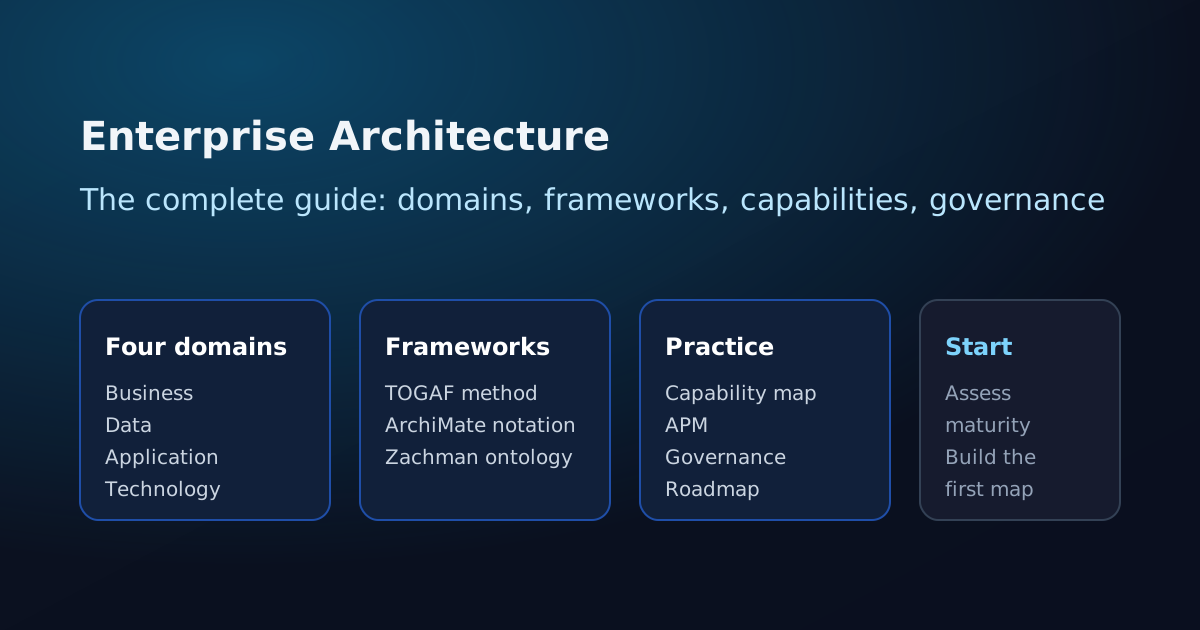
How the pieces of enterprise architecture fit together — domains, frameworks, capability mapping, governance and roadmap — and a pragmatic path to start.
Looking for an enterprise architecture software platform? Use our EA tool evaluation guide and run the EA maturity assessment.
Key takeaways
- How to design governance that accelerates delivery instead of blocking it.
- How to define decision rights and exception workflows that teams can use.
- How to measure governance quality with concrete portfolio indicators.
Table of contents
- Governance operating model
- What enterprise architecture is — and why it matters
- The four domains: business, data, application, technology
- Frameworks: TOGAF, ArchiMate and Zachman
- Capability mapping and application portfolio management
- Governance: keeping the architecture honest
- Roadmap: from current state to target
- Maturity: knowing where you actually stand
- Where to start, concretely
- Governance KPIs
- Common mistakes
- Practical checklist
Governance operating model
Governance should be designed as a service that improves decision quality and speed, not as a review ritual.
A mature model combines clear decision rights, risk-tiered review depth, and transparent outcome tracking.
- Create risk tiers with explicit approval authorities
- Standardize decision records with rationale and trade-offs
- Track exceptions with expiration dates and remediation plans
What enterprise architecture is — and why it matters
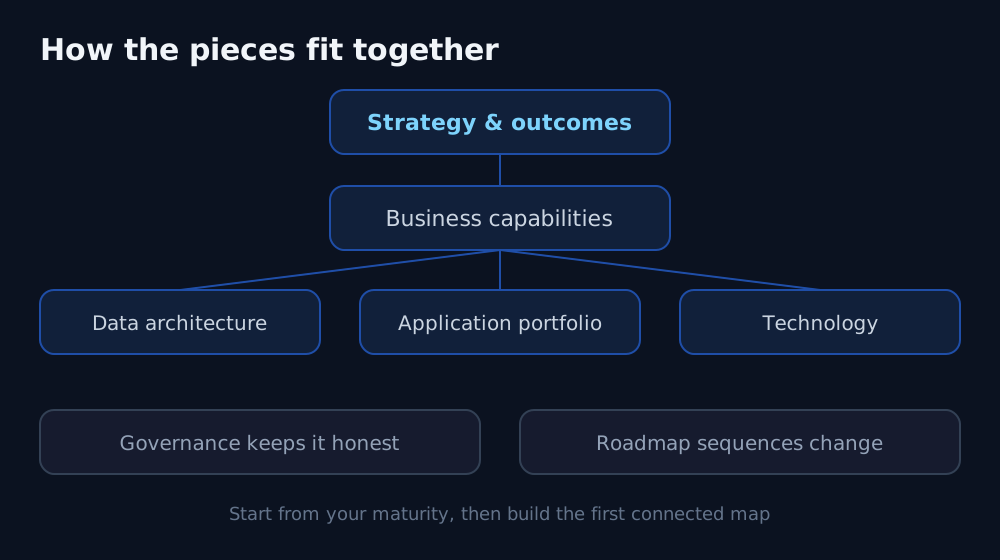
Most organizations do not lack technology; they lack a shared, trustworthy picture of how that technology supports the business. Enterprise architecture (EA) is the discipline that builds and maintains that picture, connecting strategy to business capabilities, data, applications and infrastructure so change can be planned on purpose.
This is the complete guide to the practice. If you are new to the term, start with our explainer on what enterprise architecture is, then come back here for how the parts fit together. The promise of EA is simple: fewer surprises, fewer duplicate systems, and decisions made with a map instead of guesswork.
EA is not an ivory-tower diagram exercise. Done well, it answers concrete questions — what supports this capability, what breaks if we retire that application, where are we paying for the same thing twice — and it does so with evidence rather than opinion.
The four domains: business, data, application, technology
Enterprise architecture is usually organized into four interlocking domains. Keeping them distinct but connected is what lets you reason about change without losing the whole.
- Business architecture: capabilities, value streams, processes and the organization that performs them — the 'what' the company does.
- Data architecture: the information assets, their meaning, ownership and flows between systems.
- Application architecture: the portfolio of applications, what each supports, and how they integrate.
- Technology architecture: the infrastructure, platforms and standards the applications run on.
Frameworks: TOGAF, ArchiMate and Zachman
Frameworks save you from reinventing structure. The three most cited each play a different role, and you can adopt them partially.
TOGAF, from The Open Group, is primarily a method — its Architecture Development Method gives a repeatable cycle for moving from vision to implementation. ArchiMate, also from The Open Group, is a modeling notation: a common visual language for the business, application and technology layers. The Zachman Framework, from Zachman International, is an ontology — a classification grid that asks what, how, where, who, when and why across stakeholder perspectives.
You do not have to choose one and reject the others; in practice TOGAF gives the process, ArchiMate the notation, and Zachman a way to check coverage. Read our explainers on TOGAF, ArchiMate and the Zachman framework before committing to any of them.
Capability mapping and application portfolio management
If frameworks are the grammar, capability mapping and application portfolio management (APM) are where EA earns its keep. A business capability map names what the organization does — independent of how or by whom — and gives every stakeholder a stable backbone to anchor discussions to.
APM catalogs the applications and, crucially, connects each to the capabilities it supports. That single relationship powers most of the value: you can spot duplication, score applications for cost, health and risk, and assess the impact of retiring or changing any system. Our business capability mapping guide goes deep on building the map; pair it with APM to turn it into decisions.
A practical guide to enterprise architecture: the four domains, frameworks like TOGAF and ArchiMate, capability mapping, governance, roadmap and where to start.
Governance: keeping the architecture honest
A model nobody maintains decays into fiction. Governance is the lightweight process that keeps the architecture trustworthy — an architecture review for significant changes, recorded decisions with their rationale, and clear principles that guide choices without dictating every detail.
For regulated organizations, governance also produces evidence: an application inventory, dependency maps and an audit trail of who approved what and why. The goal is not bureaucracy; it is that the next person inherits context instead of archaeology, and that auditors can see the reasoning behind decisions.
Roadmap: from current state to target
Architecture is only useful if it changes something. A roadmap sequences the move from today's landscape to a target state, broken into transition states so the organization can absorb change without stalling delivery.
Good roadmaps are anchored to capabilities, not just projects: they show which capabilities improve, what each step depends on, and where risk concentrates. That framing lets a steering committee fund outcomes rather than activity, and lets architects defend sequencing with dependencies instead of opinion.
Maturity: knowing where you actually stand
Teams overestimate how mature their practice is. Maturity models give an honest baseline across dimensions like capability coverage, portfolio visibility, governance, roadmap discipline and data quality — so you invest where the gap is real, not where it feels comfortable.
A pragmatic way to start is Archilu's free EA Maturity Assessment, which scores ten dimensions and returns a prioritized action plan in about ten minutes. Use it to decide which of the practices above to build first, rather than trying to do everything at once.
Where to start, concretely
Do not try to model the whole enterprise on day one. Start narrow and connected: a first-level capability map, an application inventory, and the link between them. That alone answers leaders' most common questions and gives you something maintainable.
From there, add governance for significant changes, then a roadmap anchored to capabilities, then deepen data and technology views as needed. A connected EA platform helps because the map, portfolio, dependencies, roadmap and decision trail stay in one model instead of scattered slides. When you are ready to see how that works in practice, request a demo — but start from your maturity, not from a vendor pitch.
Governance KPIs
A governance model is credible only if it produces faster and better decisions over time.
- Review-to-decision SLA by risk tier
- Exception backlog aging trend
- Rework rate after architecture decision
- Cross-domain dependency risk trend
Common mistakes
Governance fails when it is heavy on control but weak on decision clarity.
- Reviewing low-risk changes with full committee overhead
- No explicit decision rights by risk category
- No expiration date on architecture exceptions
- No measurable quality indicators in governance forums
Practical checklist
This baseline keeps governance useful without creating delivery drag.
- Define risk tiers and matching decision rights
- Create standard review templates and acceptance criteria
- Set SLA for architecture decisions by risk level
- Track exceptions, aging, and closure outcomes monthly
A practical guide to enterprise architecture: the four domains, frameworks like TOGAF and ArchiMate, capability mapping, governance, roadmap and where to start.
FAQ
What is enterprise architecture in simple terms?
Enterprise architecture is the discipline of describing how a company's strategy, business capabilities, data, applications and technology fit together, so that change can be planned and governed deliberately instead of by accident. It is a shared, structured picture of the organization used to make better investment and transformation decisions.
Do I need TOGAF or ArchiMate to do enterprise architecture?
No. TOGAF gives you a method and a common vocabulary, and ArchiMate gives you a notation, but neither is mandatory. Many teams adopt parts of them pragmatically. What matters more is a maintained model of your capabilities, applications and dependencies, plus a lightweight governance process. The frameworks help you avoid reinventing structure, not replace judgment.
Where should a team start with enterprise architecture?
Start with a business capability map and an application portfolio, then connect applications to the capabilities they support. That single relationship already answers questions leaders ask — what supports this capability, what would a change impact, where is duplication. From there, add roadmap and governance. Starting from a maturity assessment helps you see which gap to close first.
How do we prove governance value to executives?
Show reduction of decision delays, exception backlog, and high-risk dependencies over time.
Should governance standards be fixed forever?
No. Keep a quarterly refresh loop based on outcomes and changing risk context.
Strategic links
Compare enterprise architecture platforms
Related articles
IT Cost and Supplier Risk: One Map for Money and DORA
Cost and ICT third-party risk are usually managed in separate spreadsheets. Mapping applications to suppliers and cost in one model lets you see concentration, license exposure and rationalisation candidates at once — and produce the evidence DORA-minded reviews expect.
NIS2 and Enterprise Architecture: Mapping the Systems and Dependencies Risk Management Touches
NIS2 broadens the entities covered and raises the bar on cyber risk management, supply-chain security and incident handling. Each of those expectations rests on one prior question: do you actually know your systems and how they depend on each other? An EA map is the natural place to hold that — honestly, as evidence, not as a compliance badge.
CSSF and Enterprise Architecture: One Map for ICT, Outsourcing and Resilience Documentation
Banks, PFS, investment firms and fund actors supervised by the CSSF carry recurring documentation expectations around ICT, outsourcing and operational resilience. Each rests on a prior question: can you actually show your capabilities, applications, data flows and the third parties behind them? An EA repository is the natural place to hold that — honestly, as evidence, not as a compliance badge.