

Published on June 21, 2026 | Updated on June 21, 2026 | 9 min read
Context Acquisition vs Context Exposition: The Real AI-Readiness Gap
Exposing context is a commodity. Acquiring and maintaining good context — across ServiceNow, Jira, Azure, CMDB, IAM and M365 — is where durable value and defensibility live.
Looking for an enterprise architecture software platform? Use our EA tool evaluation guide and run the EA maturity assessment.
Key takeaways
- Exposing context is a commodity; acquiring and governing good context is the durable moat.
- Why MCP is plumbing — and the governed, sovereign context behind it is the real differentiator.
- How to let AI agents reason on your architecture without sending your SI map to external clouds.
Table of contents
- Sovereign context operating model
- Execution focus for this topic
- Everyone is solving the easy half of the problem
- Exposition is a commodity
- Acquisition is the hard, valuable problem
- Why acquisition is defensible and exposition is not
- Be honest: ServiceNow and SAP play here too
- Continuous acquisition is the direction — and our conviction
- Regulated AI context KPIs
- Common mistakes
- Practical checklist
Sovereign context operating model
An AI agent is only as good as the context it can reach. For a regulated enterprise, that context — the architecture repository — is also one of its most sensitive assets.
The operating model that matters is not "expose the repository over MCP"; it is "govern what context leaves, to whom, and under which residency and audit constraints".
- Decide which object types are queryable, and which are never exposed
- Keep context fresh: reconcile the repository against live sources, not a yearly snapshot
- Make every answer traceable to a governed source the user is entitled to see
Execution focus for this topic
Exposing context is a commodity; acquiring and governing good context is the durable moat.
Use this page as a decision support asset: align stakeholders, validate trade-offs, and connect architecture choices to measurable business outcomes.
- Primary query focus: Context Acquisition vs Context Exposition: The Real AI-Readiness Gap
- Decision scope: strategy, governance, operating model, and execution constraints
- Expected output: clear next actions with ownership and measurable indicators
Everyone is solving the easy half of the problem
There is a gold rush around making context available to AI agents. Vendors announce MCP servers, connectors and "talk to your data" demos every week. It looks like progress, and in a narrow sense it is. But it is solving the easy half of the problem.
Two distinct jobs hide under the word "context". The first is exposition: making context reachable by an agent over a standard interface. The second is acquisition: building context worth reaching in the first place. The industry is racing on the first because it demos well. The durable value, and the defensibility, live in the second.
This piece draws that line clearly, argues why acquisition is the real AI-readiness gap, and is honest about who else plays here and how far our own thinking is shipped versus still a direction.
Exposition is a commodity
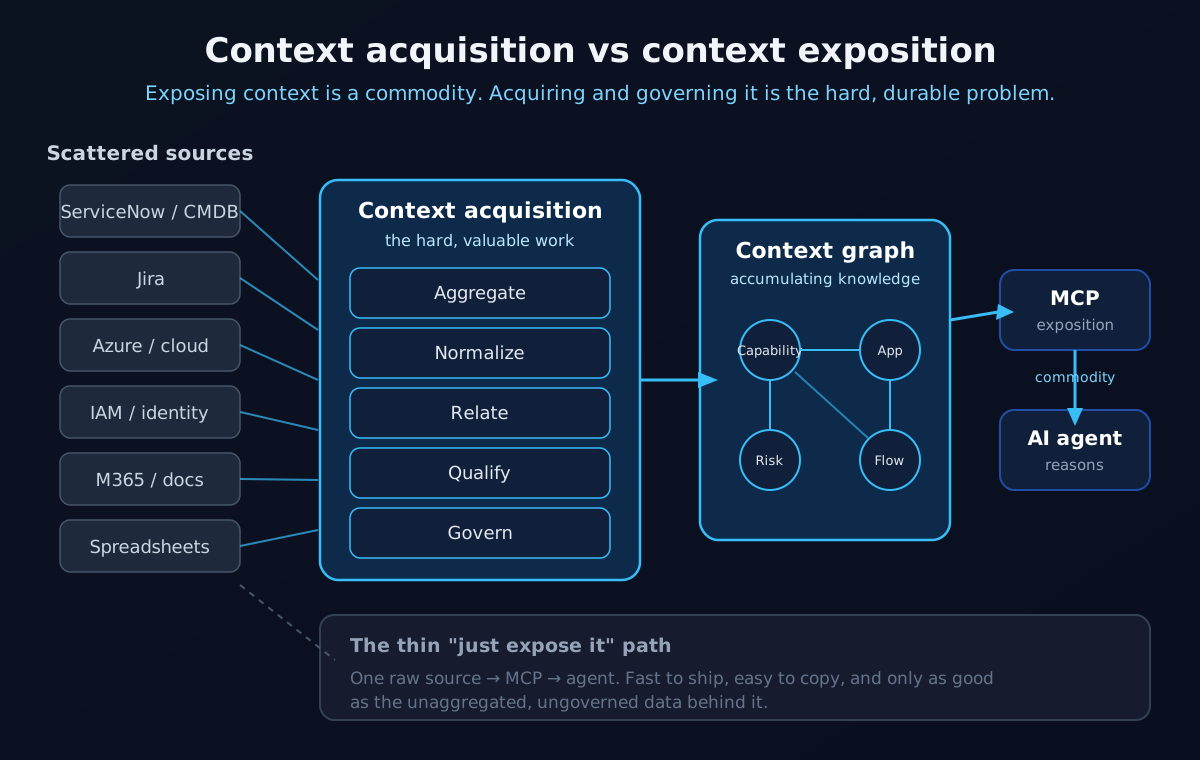
Exposition is the act of opening a source so an agent can query it — typically through an MCP server, the emerging "USB port" for AI. It is genuinely useful and increasingly standard. But standard is the point: a protocol that everyone implements the same way is, by definition, a commodity.
An MCP endpoint does not create knowledge. It carries whatever sits behind it. Point one at a stale spreadsheet and the agent reasons on a stale spreadsheet, fluently and confidently. The protocol adds reach, not truth. So "we support MCP" is never a moat — it is table stakes, and a thin one.
- A standard protocol everyone implements the same way cannot differentiate a product
- Exposition adds reach, not correctness — it surfaces whatever quality already exists
- An MCP server over a poor source produces fluent, confident, wrong answers
Acquisition is the hard, valuable problem
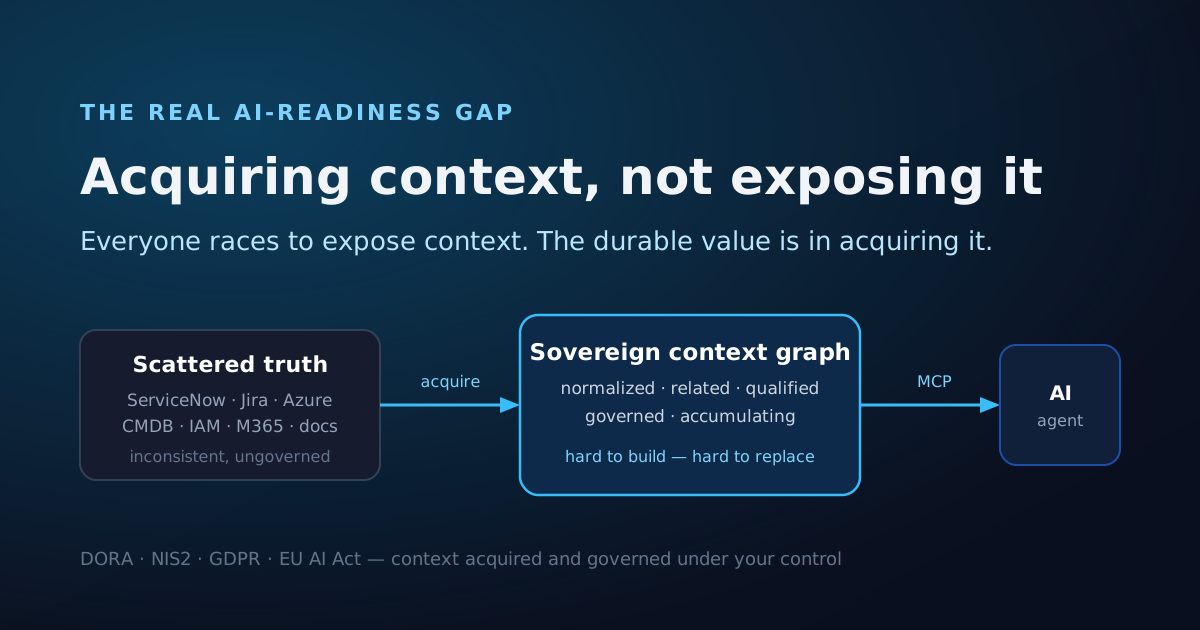
The truth an agent needs is scattered. It lives in ServiceNow and the CMDB, in Jira tickets, in Azure and other clouds, in the IAM directory, in M365 and a long tail of documents and spreadsheets. None of these agree on naming, granularity or freshness, and none of them, alone, describes how the estate actually fits together.
Acquisition is the work of turning that scatter into something an agent can reason on. It is five distinct steps, and each is genuine engineering: aggregate the sources, normalize them into a shared vocabulary, relate the pieces into a connected graph, qualify what is trustworthy and current, and govern who and what may use it. This is where AI-readiness is won or lost.
- Aggregate — pull from ServiceNow, Jira, Azure, CMDB, IAM, M365 and documents
- Normalize — reconcile naming, granularity and overlapping records into one vocabulary
- Relate — connect capabilities, applications, dependencies, data flows and risks
- Qualify — mark what is current, sourced and trustworthy, and what is stale
- Govern — control access in a permission- and data-residency-aware way
Everyone races to expose context to AI agents through MCP. The hard, durable value is acquiring it — aggregating, normalizing, relating, qualifying and governing the truth scattered across your systems.
Why acquisition is defensible and exposition is not
A context graph that has been acquired well accumulates knowledge. Every reconciliation, every relationship qualified, every correction fed back makes the model a little more accurate and a little more specific to the organization. That accumulated, governed truth is hard to copy — a competitor cannot clone two years of careful normalization and relating overnight.
An exposition layer has the opposite economics. Anyone can stand up an MCP server in a sprint. There is nothing accumulated, nothing organization-specific, nothing that gets better with use. That is the textbook shape of a commodity versus an asset: the moat is the graph you built, not the port you opened.
Be honest: ServiceNow and SAP play here too
It would be dishonest to claim acquisition is unclaimed ground. ServiceNow has invested heavily in a CMDB and service graph; SAP holds deep process and master-data context. Within their domains they acquire context at a scale and breadth ArchiLU does not match, and we will not pretend otherwise.
Our edge is not raw breadth — it is the lens. We focus on the architecture context for regulated FR/Lux/EU institutions, under a sovereignty and governance constraint the broad operational suites are not built around: context that can be reasoned on without the sensitive blueprint leaving your control, fit for DORA, NIS2, GDPR and EU AI Act scrutiny. Narrower scope, sharper fit — not a bigger net.
- ServiceNow / SAP: strong, broad operational-context acquisition within their domains
- ArchiLU: architecture context under a regulated, sovereign, governance-first lens
- We compete on fit and data-residency control, not on breadth
Continuous acquisition is the direction — and our conviction
Mature acquisition is never finished, because the estate never stops changing. Systems are added, retired and reorganized; what was true last quarter drifts. So the goal is not a one-off import but continuous acquisition — a model that keeps reconciling and re-qualifying itself as reality moves.
We are honest about the gap between vision and shipped. A sovereign, data-residency-aware MCP server is a conviction and a roadmap, not a product you can buy today. What exists now is a connected EA model — capabilities, application portfolio and dependencies — hosted in an EU region or on-premise under your control, in native French and English, built around DORA and CSSF documentation needs. (A tool helps you document and prove governance; it does not by itself make you compliant.)
The strategic point stands regardless of timeline: build context first, govern it, and treat exposition as the last, easy step. If you only remember one thing, make it the order — acquire and qualify the truth before you wire any agent to it. The fastest way to see where your own organization sits on that curve is our free EA Maturity Assessment.
Regulated AI context KPIs
Measure whether your context is trustworthy and governed, not how many queries the agent runs.
- Context freshness: median age of architecture objects vs live reality
- Share of answers traceable to a governed, permission-scoped source
- Sensitive object types covered by redaction/residency policy
- Audit coverage: prompts and responses logged and reviewable
Common mistakes
Most MCP-for-EA initiatives fail on context quality and governance long before they fail on the protocol.
- Exposing the full architecture repository to external LLMs without data-residency controls
- Treating MCP as the differentiator instead of the governed context behind it
- Connecting an 18-month-old, hand-maintained repository an agent cannot trust
- No permission-awareness, logging, or redaction of sensitive object types
Practical checklist
Run this before connecting any AI agent to your architecture repository.
- Confirm where prompts and responses go, and whether data stays in your region
- Enforce permission-aware access so the agent only sees what the user may see
- Classify and redact sensitive object types (vulnerabilities, data flows, controls)
- Log prompts and answers for audit, and keep a human in the loop for any change
Everyone races to expose context to AI agents through MCP. The hard, durable value is acquiring it — aggregating, normalizing, relating, qualifying and governing the truth scattered across your systems.
FAQ
What is the difference between context exposition and context acquisition?
Exposition is making context reachable by an AI agent — typically through an MCP server that opens a source over a standard protocol. Acquisition is the upstream work of building good context in the first place: aggregating data from many systems, normalizing it, relating the pieces, qualifying what is trustworthy, and governing access. Exposition is a commodity; acquisition is the hard, valuable problem.
Why isn't an MCP server enough to make my organization AI-ready?
An MCP server only exposes what already exists. If the context behind it is scattered, stale, inconsistent or ungoverned, the agent reasons on a poor picture. MCP is the USB port; it does not create the truth it carries. The readiness gap is almost always on the acquisition side — the connected, normalized, qualified model — not on the protocol side.
Don't ServiceNow and SAP already solve context acquisition?
They do a great deal of it within their own domains, and honestly so — ServiceNow has a strong CMDB and service graph, SAP holds deep process and master-data context. Their breadth across the operational estate is real. ArchiLU does not out-breadth them. The edge we pursue is narrower and different: a regulated, sovereign, governance-first lens on the architecture context — for FR/Lux/EU institutions where where the data goes matters as much as what it says.
Is good context acquisition actually achievable, or is it just a long project?
It is a real, sustained effort, not a switch you flip — anyone claiming otherwise is overselling. Mature acquisition means continuously aggregating, reconciling and qualifying inputs as systems change. We treat continuous acquisition as a direction and a conviction: a context graph that keeps learning becomes more accurate and harder to replace over time, which is precisely why the effort pays off.
Does ArchiLU's MCP server let agents query this context today?
No. A sovereign, data-residency-aware MCP layer is our conviction and roadmap, not something shipped. What exists today is a connected EA model — capabilities, application portfolio and dependencies — hosted in an EU region or on-premise under your control, with native French and English. The exposition layer is where we are heading; the acquisition and governance of the model is the value we build on.
Is MCP enough to make our architecture AI-ready?
No. MCP is the transport; the value is the quality, freshness, governance, and sovereignty of the context it exposes.
Strategic links
Compare enterprise architecture platforms
Related articles
IT Cost and Supplier Risk: One Map for Money and DORA
Cost and ICT third-party risk are usually managed in separate spreadsheets. Mapping applications to suppliers and cost in one model lets you see concentration, license exposure and rationalisation candidates at once — and produce the evidence DORA-minded reviews expect.
NIS2 and Enterprise Architecture: Mapping the Systems and Dependencies Risk Management Touches
NIS2 broadens the entities covered and raises the bar on cyber risk management, supply-chain security and incident handling. Each of those expectations rests on one prior question: do you actually know your systems and how they depend on each other? An EA map is the natural place to hold that — honestly, as evidence, not as a compliance badge.
CSSF and Enterprise Architecture: One Map for ICT, Outsourcing and Resilience Documentation
Banks, PFS, investment firms and fund actors supervised by the CSSF carry recurring documentation expectations around ICT, outsourcing and operational resilience. Each rests on a prior question: can you actually show your capabilities, applications, data flows and the third parties behind them? An EA repository is the natural place to hold that — honestly, as evidence, not as a compliance badge.