

Published on June 19, 2026 | Updated on June 19, 2026 | 11 min read
AI in Enterprise Architecture: A Governed Assistant
A measured look at what AI realistically brings to enterprise architecture, where its limits are, and how a governed assistant prepares decisions without ever bypassing human approval.
Looking for an enterprise architecture software platform? Use our EA tool evaluation guide and run the EA maturity assessment.
Key takeaways
- How to design governance that accelerates delivery instead of blocking it.
- How to define decision rights and exception workflows that teams can use.
- How to measure governance quality with concrete portfolio indicators.
Table of contents
- Governance operating model
- Why AI is entering enterprise architecture now
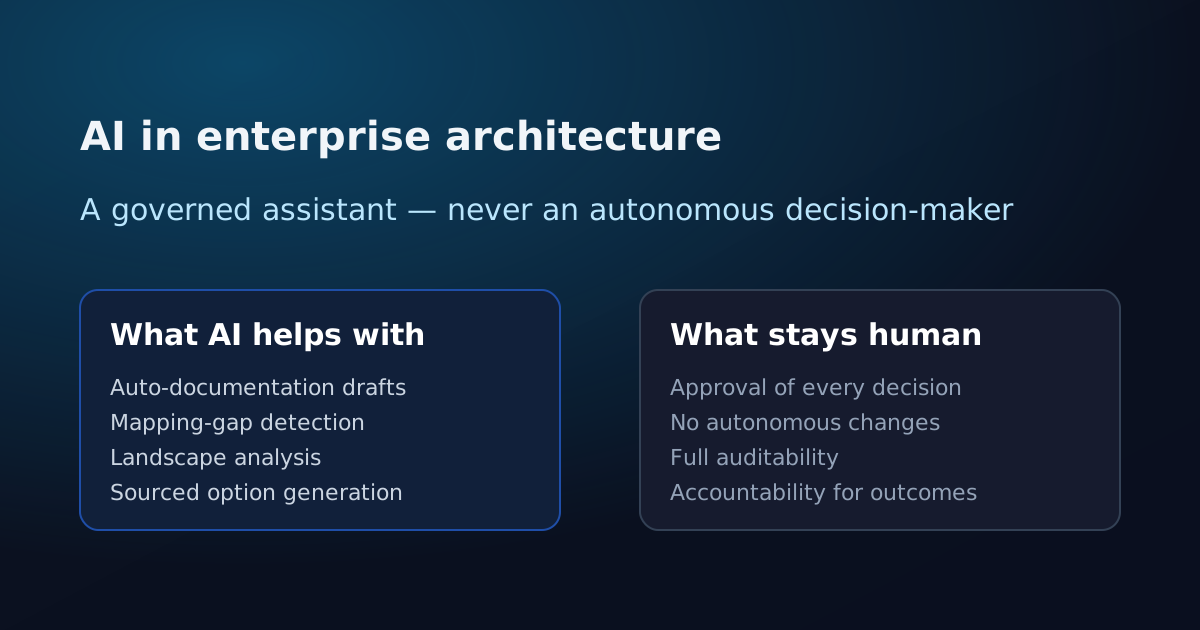
- What AI realistically helps with
- Where AI's limits are — and why that matters
- Governance: the non-negotiable part
- Why this fits regulated and risk-aware organizations
- How Archilu approaches AI in EA
- A practical way to start
- Governance KPIs
- Common mistakes
- Practical checklist
Governance operating model
Governance should be designed as a service that improves decision quality and speed, not as a review ritual.
A mature model combines clear decision rights, risk-tiered review depth, and transparent outcome tracking.
- Create risk tiers with explicit approval authorities
- Standardize decision records with rationale and trade-offs
- Track exceptions with expiration dates and remediation plans
Why AI is entering enterprise architecture now
Enterprise architecture has always struggled with one quiet problem: the model is never quite up to date. Applications change, owners move, dependencies drift, and the documentation that decisions depend on lags behind reality. Most of that gap is manual labor — reading, mapping, cross-checking — and that is exactly the kind of work modern AI is good at accelerating.
So the interest is real, not just hype. But the value only holds if AI is applied where it is genuinely strong and kept away from where it is weak. This article takes a measured view: what AI realistically brings to EA, where its limits are, and how to use it without surrendering control of decisions that carry cost and compliance weight.
What AI realistically helps with
The honest list is narrower than the marketing, but it is still meaningful. AI is most useful on tasks that are tedious, repetitive and grounded in data you already hold. It compresses the time between having a landscape and having a usable picture of it.
- Auto-documentation: drafting descriptions, summaries and capability notes from existing data, which a human then reviews
- Gap detection: flagging missing owners, unmapped applications and orphaned dependencies that humans routinely overlook
- Landscape analysis: summarizing a large estate so an architect can see concentration, redundancy and risk faster
- Option generation: proposing candidate rationalization or modernization moves, with the reasoning and sources attached
Where AI's limits are — and why that matters
A language model can be confidently wrong. It can invent a dependency that does not exist, miss context a model never captured, or propose a 'clean' rationalization that ignores a contractual or regulatory constraint nobody wrote down. In enterprise architecture those mistakes are not cosmetic — they feed budgets, audits and operational risk.
That is why the right posture is skeptical by design. AI output should be treated as a draft and a prompt for human judgment, never as an authority. The architect's role does not shrink; it shifts from manual assembly toward reviewing, challenging and deciding. Used this way, AI raises throughput without raising risk.
Governance: the non-negotiable part
If AI is going to touch architecture work, governance has to come with it. Three properties make the difference between a useful assistant and an uncontrolled one.
- Human-in-the-loop: a person validates before anything becomes a decision — AI prepares, the human approves, edits or rejects
- No autonomous changes: the assistant does not silently rewrite your model; it proposes, and the model only changes when a human commits the change
- Auditability: every suggestion, the data it drew on, and the human decision are logged, so the result can be explained to a reviewer or regulator
How AI helps enterprise architects with documentation, gap detection and option generation — and why governance, human-in-the-loop and audit still matter.
Why this fits regulated and risk-aware organizations
In regulated finance, public sector and other risk-aware contexts, 'the AI changed it' is not an acceptable answer to an auditor. What those organizations need is traceability: who decided, on what basis, and with what evidence. A governed assistant strengthens that record rather than eroding it, because it forces every proposal through a logged human decision.
This also aligns with the broader governance work an architecture function already does — review boards, recorded decisions, application registers and dependency maps. AI sits inside that discipline, not around it. For how that governance frame works in a DORA and NIS2 context, see the linked governance pillar below.
How Archilu approaches AI in EA
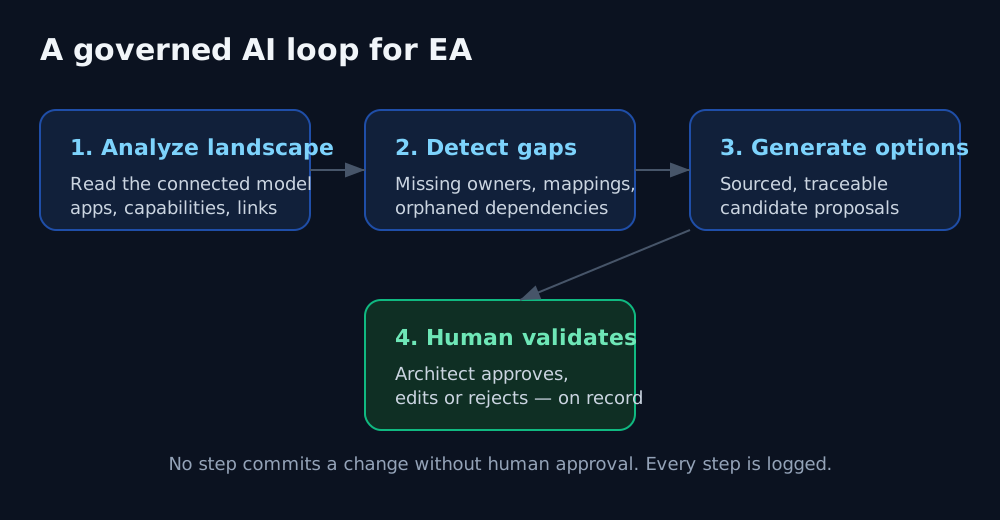
Archilu treats AI as a governed assistant, not an autonomous agent. It analyzes the connected landscape, detects mapping gaps, generates sourced options and prepares decisions for human validation. The principle is explicit in the product: support governed decisions without bypassing approval.
Concretely, that means the assistant never commits a change to your model on its own. It does the legwork — reading the estate, surfacing what is missing, drafting candidate options with their sources — and then hands a clear, reviewable proposal to the architect. The human stays accountable, and the audit trail stays intact. The diagram above shows the loop: analyze, detect, generate, then validate.
A practical way to start
You do not need a finished AI strategy to benefit. Start by making sure your landscape is connected and your decisions are recorded, because AI is only as good as the model it reads and the governance it operates inside. From there, let the assistant take on the legwork — documentation drafts, gap flags, option proposals — while your architects keep the final say.
If you want a concrete starting point, Archilu's free EA Maturity Assessment scores ten dimensions and returns a prioritized action plan in about ten minutes. It is a grounded way to see where AI assistance would actually help your organization, rather than where a vendor claims it will.
Governance KPIs
A governance model is credible only if it produces faster and better decisions over time.
- Review-to-decision SLA by risk tier
- Exception backlog aging trend
- Rework rate after architecture decision
- Cross-domain dependency risk trend
Common mistakes
Governance fails when it is heavy on control but weak on decision clarity.
- Reviewing low-risk changes with full committee overhead
- No explicit decision rights by risk category
- No expiration date on architecture exceptions
- No measurable quality indicators in governance forums
Practical checklist
This baseline keeps governance useful without creating delivery drag.
- Define risk tiers and matching decision rights
- Create standard review templates and acceptance criteria
- Set SLA for architecture decisions by risk level
- Track exceptions, aging, and closure outcomes monthly
How AI helps enterprise architects with documentation, gap detection and option generation — and why governance, human-in-the-loop and audit still matter.
FAQ
Can AI replace the enterprise architect?
No. AI can accelerate parts of the work — drafting documentation, surfacing gaps, proposing options — but the judgment about tradeoffs, risk appetite, sequencing and stakeholder alignment stays with the architect. The realistic framing is augmentation, not replacement: AI does the legwork so the human can spend more time on decisions that need context and accountability.
Is it safe to let AI make architecture changes automatically?
We would advise against it, and Archilu does not do it. Architecture decisions carry cost, compliance and operational consequences, and a model can be confidently wrong. The defensible pattern is human-in-the-loop: AI prepares and proposes, a person validates, and every step is logged so the decision can be explained and audited later.
What does Archilu's AI actually do?
Archilu's AI assistant analyzes the connected landscape, detects mapping gaps, generates sourced options and prepares decisions for human validation. It supports governed decisions without bypassing approval — it does not commit autonomous changes to your model. The architect remains accountable; the AI removes the manual legwork around them.
How do we prove governance value to executives?
Show reduction of decision delays, exception backlog, and high-risk dependencies over time.
Should governance standards be fixed forever?
No. Keep a quarterly refresh loop based on outcomes and changing risk context.
Strategic links
Compare enterprise architecture platforms
Related articles
IT Cost and Supplier Risk: One Map for Money and DORA
Cost and ICT third-party risk are usually managed in separate spreadsheets. Mapping applications to suppliers and cost in one model lets you see concentration, license exposure and rationalisation candidates at once — and produce the evidence DORA-minded reviews expect.
NIS2 and Enterprise Architecture: Mapping the Systems and Dependencies Risk Management Touches
NIS2 broadens the entities covered and raises the bar on cyber risk management, supply-chain security and incident handling. Each of those expectations rests on one prior question: do you actually know your systems and how they depend on each other? An EA map is the natural place to hold that — honestly, as evidence, not as a compliance badge.
CSSF and Enterprise Architecture: One Map for ICT, Outsourcing and Resilience Documentation
Banks, PFS, investment firms and fund actors supervised by the CSSF carry recurring documentation expectations around ICT, outsourcing and operational resilience. Each rests on a prior question: can you actually show your capabilities, applications, data flows and the third parties behind them? An EA repository is the natural place to hold that — honestly, as evidence, not as a compliance badge.