

Published on June 21, 2026 | Updated on June 21, 2026 | 9 min read
DORA and Architecture Traceability in the Age of AI Agents
A practical look at how a living, governed architecture model supports DORA evidence — and how to keep AI-agent usage inside that frame instead of creating a new, untraced ICT dependency.
Looking for an enterprise architecture software platform? Use our EA tool evaluation guide and run the EA maturity assessment.
Key takeaways
- Why MCP is plumbing — and the governed, sovereign context behind it is the real differentiator.
- How to let AI agents reason on your architecture without sending your SI map to external clouds.
- How to keep an EA repository fresh enough that an AI agent's answers are actually trustworthy.
Table of contents
- Sovereign context operating model
- DORA already asked you to make architecture traceable
- What an AI agent changes about your ICT supply chain
- Prompts and responses are a data flow you have to describe
- A living, governed model is the traceability anchor
- Keeping AI-influenced decisions inside the frame
- Toward a sovereign context layer for regulated AI
- Regulated AI context KPIs
- Common mistakes
- Practical checklist
Sovereign context operating model
An AI agent is only as good as the context it can reach. For a regulated enterprise, that context — the architecture repository — is also one of its most sensitive assets.
The operating model that matters is not "expose the repository over MCP"; it is "govern what context leaves, to whom, and under which residency and audit constraints".
- Decide which object types are queryable, and which are never exposed
- Keep context fresh: reconcile the repository against live sources, not a yearly snapshot
- Make every answer traceable to a governed source the user is entitled to see
DORA already asked you to make architecture traceable
Long before AI agents entered the picture, DORA set a clear expectation for regulated finance: know your ICT dependencies, identify which of them support critical or important functions, document your third-party arrangements, and be able to explain — with evidence — how your operational resilience holds together. That is, at heart, a traceability requirement applied to your architecture.
Our companion pillar on architecture governance for DORA and NIS2 covers the machinery that produces this: the review board, decision records, the application register and ICT dependency mapping. This article does not repeat it. It looks at what changes when AI agents start reasoning over that same architecture data — because the traceability bar does not drop when a model joins the workflow; it rises.
One disclaimer up front, and we will keep it honest throughout: nothing here makes you legally compliant. DORA compliance is decided by regulators and auditors against your organisational, contractual and security measures. A governed architecture model — with or without AI — helps you document and evidence what you do. It does not replace legal, risk and security work.
What an AI agent changes about your ICT supply chain
An AI agent that answers questions about your architecture, or proposes a remediation, is not a neutral feature. It usually depends on an external large language model. The moment that model influences an operational or resilience decision, the provider behind it has a claim to be part of your ICT supply chain — exactly the kind of relationship DORA expects you to identify, document and assess.
Treated honestly, this raises familiar third-party questions in a new place. Who is the provider, and under what contract? Where does the data go? And — the one teams forget — if three or four critical workflows all quietly depend on the same model, you have a concentration risk you never recorded. The discipline is to treat any external model as a dependency to document, not an invisible utility you reach for by default.
- An external model provider behind an agent is a candidate ICT third party
- Several critical workflows on one model is a concentration risk to record
- Contract, data location and exit posture are the usual third-party questions, applied to AI
- The honest default: document the model dependency, do not hide it
Prompts and responses are a data flow you have to describe
When an agent sends architecture context to a model, think about what that context actually is. It can include system inventory, criticality ratings, dependency maps, hosting details — in aggregate, a near-complete blueprint of the organisation. The prompt is an outbound data flow; the response that shapes a decision is an inbound one. DORA-minded governance expects you to know what data moves where, and AI does not get an exemption.
This is where the source of the context matters enormously. If the agent draws from scattered exports and ad-hoc copies, you cannot describe the flow with confidence — and you certainly cannot prove it later. If the context comes from one governed model you can point to, the flow becomes describable: this defined slice of the architecture, with these residency attributes, was the input. The cleaner the source, the cleaner the evidence.
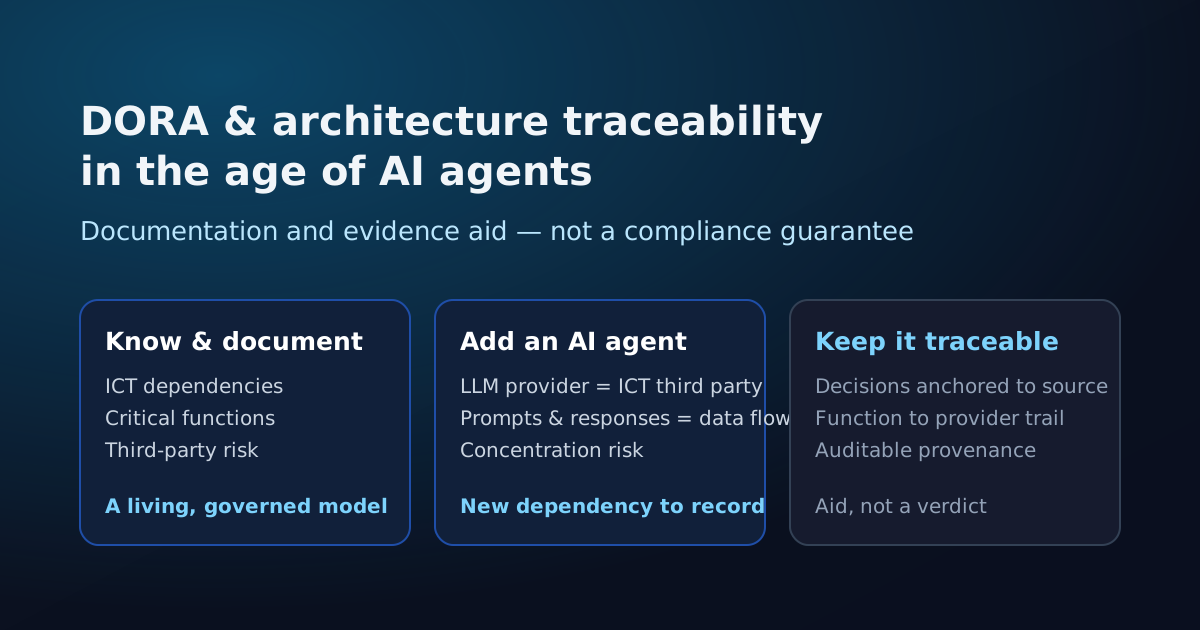
DORA expects you to know and document your ICT dependencies and third-party risk. When AI agents reason over that architecture, the LLM provider, the prompts and the decisions all become things you must keep traceable.
A living, governed model is the traceability anchor
The asset that makes any of this defensible is a current, governed architecture model — not an eighteen-month-old snapshot. A living application register, mapped ICT dependencies and recorded decisions are already what a resilience review wants to see. They are also what an AI agent should be reasoning over, because grounding an agent in stale or shallow data produces confident answers that no auditor would accept.
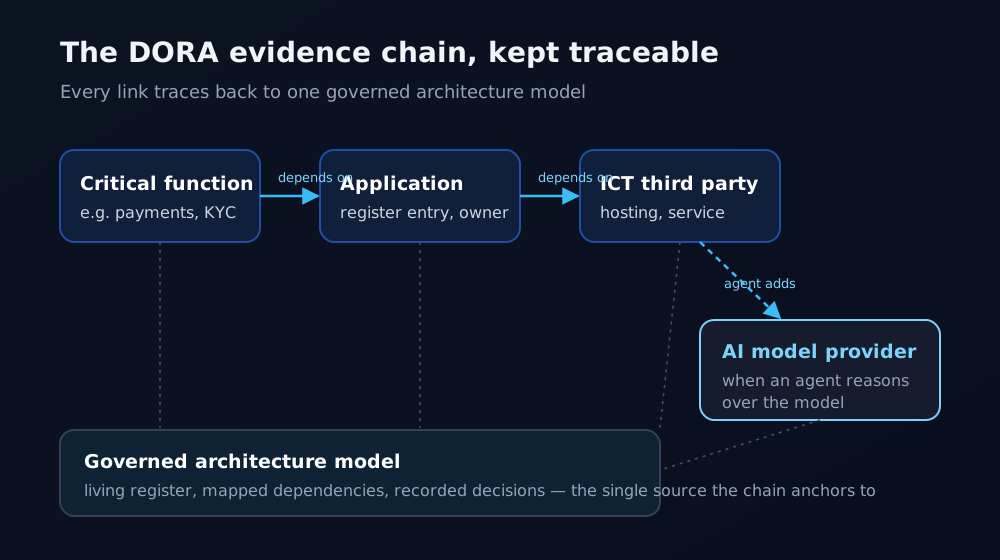
Concretely, this is the same backbone the governance pillar describes, used for a new purpose. The register tells you which applications support a critical function. The dependency map tells you what those applications rely on. When an agent's recommendation is grounded in that model, the recommendation inherits the model's traceability instead of floating free in a chat window.
- An application register with owners, criticality and hosting attributes
- Mapped ICT dependencies from critical functions down to providers
- Decision records that capture the human choice and its rationale
- Continuously maintained, so the agent reasons on current reality
Keeping AI-influenced decisions inside the frame
The risk with agents is not that they give bad answers; it is that a good-looking answer arrives with no provenance. A resilience decision that can only be traced to an opaque conversation is precisely what a supervisory review does not want. The remedy is to anchor the decision: the agent's input was this versioned slice of the model, the human choice was recorded as a decision linked to the affected applications, and the trail runs from critical function to dependency to provider without a gap.
This is the practical discipline. Use the agent to accelerate analysis, then capture the outcome as a first-class decision in the same governed model — context, options, decision, rationale — exactly as you would for any significant architecture change. The AI speeds up the thinking; the governed record keeps it traceable. One without the other is either slow or indefensible.
Toward a sovereign context layer for regulated AI
There is a forward-looking version of this we are convinced is the right direction, and we will be clear that it is conviction and roadmap, not a shipped feature. We believe regulated organisations should be able to give their AI agents a sovereign context layer: a governed system of context, kept in a region you control, that an agent can reason over without the sensitive architecture map leaving your boundary. The goal is to answer the DORA questions — what depends on what, where does the data go — by design rather than after the fact.
That is where ArchiLU is heading: context first, regulatory reasoning next, and any data-residency-aware access for agents built on top of a model that was already governed, current and yours. For today, the defensible move is unglamorous and real — keep a living architecture model, treat any external model as a documented dependency, and anchor every AI-influenced decision to a governed source. If you want a fast read on where your practice stands, the free EA Maturity Assessment scores ten dimensions and returns a prioritised plan in about ten minutes.
Regulated AI context KPIs
Measure whether your context is trustworthy and governed, not how many queries the agent runs.
- Context freshness: median age of architecture objects vs live reality
- Share of answers traceable to a governed, permission-scoped source
- Sensitive object types covered by redaction/residency policy
- Audit coverage: prompts and responses logged and reviewable
Common mistakes
Most MCP-for-EA initiatives fail on context quality and governance long before they fail on the protocol.
- Exposing the full architecture repository to external LLMs without data-residency controls
- Treating MCP as the differentiator instead of the governed context behind it
- Connecting an 18-month-old, hand-maintained repository an agent cannot trust
- No permission-awareness, logging, or redaction of sensitive object types
Practical checklist
Run this before connecting any AI agent to your architecture repository.
- Confirm where prompts and responses go, and whether data stays in your region
- Enforce permission-aware access so the agent only sees what the user may see
- Classify and redact sensitive object types (vulnerabilities, data flows, controls)
- Log prompts and answers for audit, and keep a human in the loop for any change
DORA expects you to know and document your ICT dependencies and third-party risk. When AI agents reason over that architecture, the LLM provider, the prompts and the decisions all become things you must keep traceable.
FAQ
Does using an AI agent over my architecture make me DORA compliant?
No. DORA compliance is a legal determination made by your regulator and auditors against your organisational, contractual and security measures — not by any software or AI feature. A governed architecture model helps you document ICT dependencies, third-party relationships and the rationale behind resilience decisions, which makes evidence faster to produce. But the tool, and any AI on top of it, is an evidence aid, not a compliance guarantee.
Is the LLM provider behind an AI agent an ICT third party under DORA?
It can be. If an AI agent that influences operational or resilience decisions depends on an external model provider, that provider is part of your ICT supply chain and a candidate for your register of information and third-party risk assessment — including concentration risk if several critical workflows lean on the same model. The honest position is to treat any external model as a third-party dependency to document and assess, not as an invisible utility.
Why do prompts and responses matter for DORA documentation?
Because they are a data flow. When an agent sends architecture context to a model and acts on what comes back, you have created a flow of potentially sensitive information (system inventory, dependencies, criticality) leaving one boundary and a decision input coming back. DORA-minded governance expects you to know what data moves where; that is easier when the context the agent uses comes from one governed source you can describe, rather than from scattered exports.
How do you keep an AI-influenced decision traceable?
Anchor it to a governed source. If an agent's answer is grounded in a specific, versioned architecture model — a known application register, mapped dependencies, recorded decisions — then a reviewer can trace the recommendation back to the data it rested on and the decision record that captured the human choice. A decision traceable only to an opaque chat session is the opposite of what a resilience review wants to see.
Is MCP enough to make our architecture AI-ready?
No. MCP is the transport; the value is the quality, freshness, governance, and sovereignty of the context it exposes.
Strategic links
Compare enterprise architecture platforms
Related articles
IT Cost and Supplier Risk: One Map for Money and DORA
Cost and ICT third-party risk are usually managed in separate spreadsheets. Mapping applications to suppliers and cost in one model lets you see concentration, license exposure and rationalisation candidates at once — and produce the evidence DORA-minded reviews expect.
NIS2 and Enterprise Architecture: Mapping the Systems and Dependencies Risk Management Touches
NIS2 broadens the entities covered and raises the bar on cyber risk management, supply-chain security and incident handling. Each of those expectations rests on one prior question: do you actually know your systems and how they depend on each other? An EA map is the natural place to hold that — honestly, as evidence, not as a compliance badge.
CSSF and Enterprise Architecture: One Map for ICT, Outsourcing and Resilience Documentation
Banks, PFS, investment firms and fund actors supervised by the CSSF carry recurring documentation expectations around ICT, outsourcing and operational resilience. Each rests on a prior question: can you actually show your capabilities, applications, data flows and the third parties behind them? An EA repository is the natural place to hold that — honestly, as evidence, not as a compliance badge.