

Published on June 21, 2026 | Updated on June 21, 2026 | 10 min read
MCP for Enterprise Architecture: 6 Use Cases AI Agents Unlock
From application rationalization to DORA scope to end-of-life risk: six natural-language questions an AI agent can answer against a living EA model — and where each one stops.
Looking for an enterprise architecture software platform? Use our EA tool evaluation guide and run the EA maturity assessment.
Key takeaways
- Every use case is only as reliable as the freshness and governance of the architecture context behind the query.
- Why MCP is plumbing — and the governed, sovereign context behind it is the real differentiator.
- How to let AI agents reason on your architecture without sending your SI map to external clouds.
Table of contents
- Sovereign context operating model
- Execution focus for this topic
- From a static map to a System of Context
- 1. Application rationalization — find and justify the overlap
- 2. Impact analysis — know what breaks before you touch it
- 3. Compliance reporting — scope the regulation, faster
- 4. Risk and vulnerabilities — concentrate attention where it counts
- 5. Strategic alignment — connect initiatives to objectives
- 6. End-of-life and obsolescence — see the cliff before you reach it
- The caveat that makes or breaks all six: sovereignty
- Why the regulated profile fits this approach
- Regulated AI context KPIs
- Common mistakes
- Practical checklist
Sovereign context operating model
An AI agent is only as good as the context it can reach. For a regulated enterprise, that context — the architecture repository — is also one of its most sensitive assets.
The operating model that matters is not "expose the repository over MCP"; it is "govern what context leaves, to whom, and under which residency and audit constraints".
- Decide which object types are queryable, and which are never exposed
- Keep context fresh: reconcile the repository against live sources, not a yearly snapshot
- Make every answer traceable to a governed source the user is entitled to see
Execution focus for this topic
Every use case is only as reliable as the freshness and governance of the architecture context behind the query.
Use this page as a decision support asset: align stakeholders, validate trade-offs, and connect architecture choices to measurable business outcomes.
- Primary query focus: MCP for Enterprise Architecture: 6 Use Cases AI Agents Unlock
- Decision scope: strategy, governance, operating model, and execution constraints
- Expected output: clear next actions with ownership and measurable indicators
From a static map to a System of Context
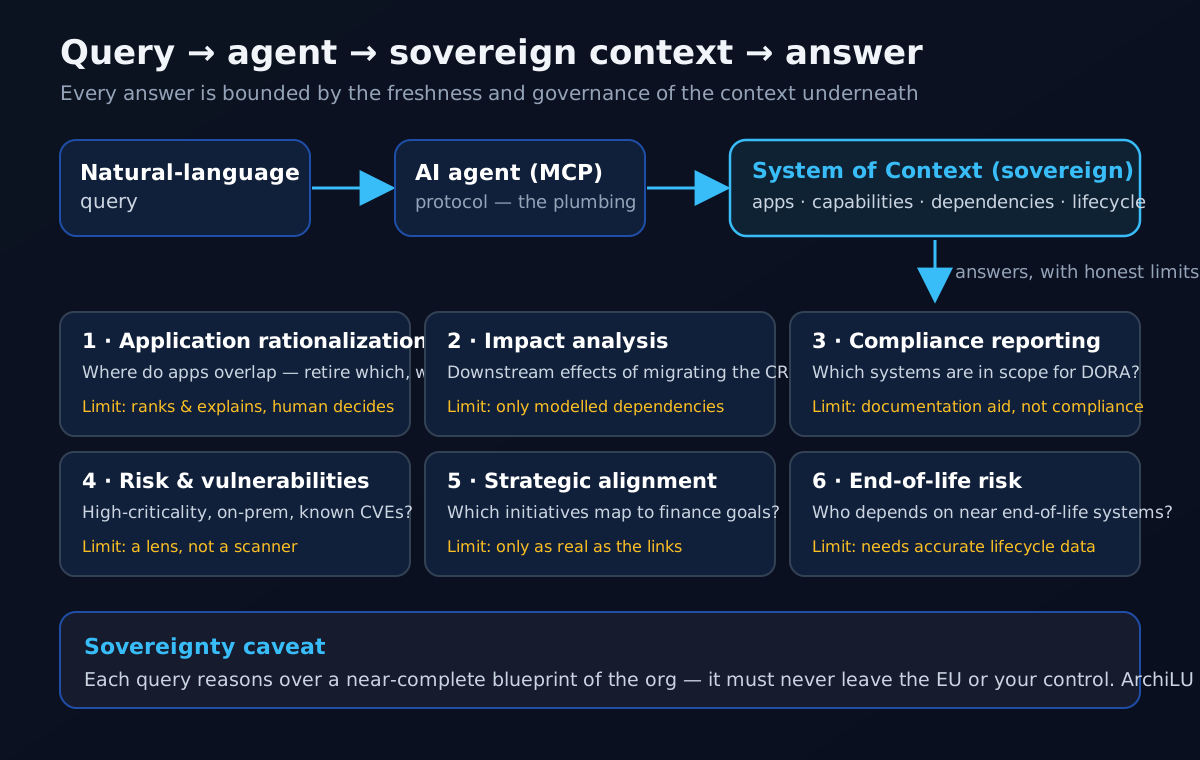
Most enterprise architecture repositories are read by humans, slowly, one diagram at a time. The shift underway is not that someone added a protocol called MCP — MCP is plumbing, the USB port of AI, and nobody buys a product because it speaks it. The shift is that the EA model can become a System of Context: a governed layer that AI agents query directly, alongside the Systems of Record like your CRM, ERP and service catalogue.
When that happens, a natural-language question replaces a week of cross-referencing spreadsheets. The six use cases below are the ones that matter most for a regulated enterprise. For each, we give the question you would actually ask, what the answer unlocks, and — just as important — the honest limit on what an agent can do. Throughout, hold one principle: the value is not the protocol, it is the quality, freshness and governance of the context the agent reasons over.
1. Application rationalization — find and justify the overlap
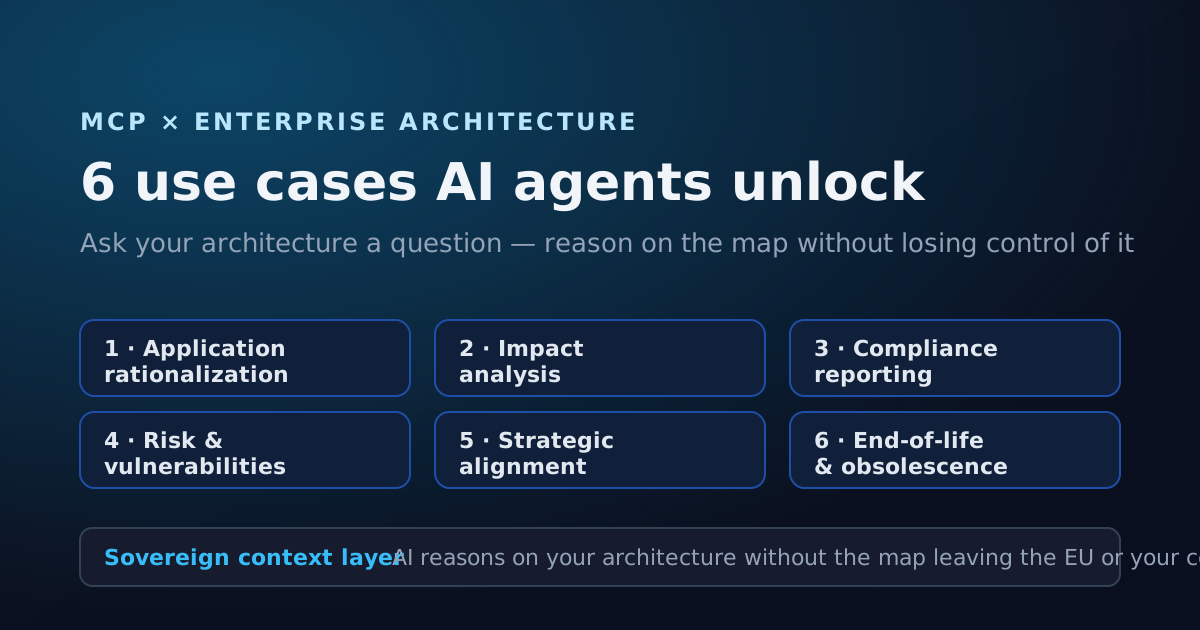
The query: "Where do we have overlapping applications, and which ones should we retire and why?" An agent walks the capability map, finds the capabilities served by more than one application, and cross-references cost, ownership, user count and lifecycle to propose retirement candidates with a rationale.
What it unlocks: a defensible shortlist instead of a political argument. Rationalization usually stalls because nobody can prove the overlap quickly; an agent reasoning over a living portfolio surfaces it in a sentence and shows the dependencies you would have to unwind first.
The honest limit: the agent ranks and explains, it does not decide. Whether a duplicate is genuine waste or a deliberate redundancy for resilience is a human judgement, and the shortlist is only as trustworthy as the cost and usage attributes in the model.
2. Impact analysis — know what breaks before you touch it
The query: "What are the downstream effects of migrating the CRM?" The agent traverses the dependency graph from the CRM outward — integrations, data flows, the business capabilities and processes that consume it — and returns the blast radius as a ranked list rather than a diagram you have to decode by hand.
What it unlocks: change planning that starts from evidence. Migration and decommissioning risk lives in the second- and third-order dependencies nobody remembers; an agent that reasons over the graph makes them explicit before the change board meeting, not during the incident review.
The honest limit: it can only trace dependencies that are modelled. An undocumented integration or a shadow-IT consumer is invisible to the agent. Impact analysis is a force multiplier on a complete graph and a false comfort on a sparse one.
3. Compliance reporting — scope the regulation, faster
The query: "Which systems are in scope for DORA?" The agent identifies the applications and infrastructure supporting your critical and important functions, surfaces the third-party providers behind them, and assembles a first-draft scope list with the dependency evidence attached.
What it unlocks: the tedious, error-prone scoping pass becomes a draft in minutes, leaving your team to do the judgement work — confirming which functions are genuinely critical, where the boundaries sit, what evidence a regulator will accept.
The honest limit, stated plainly: this is a documentation and evidence aid, not a compliance verdict. An agent helps you document and prove; it does not make you compliant. The interpretation of DORA, NIS2 or CSSF expectations, and the regulator-facing position, stay with a human who is accountable for them.
Six practical enterprise architecture use cases an AI agent can answer when your EA model becomes a System of Context — each with the query, what it unlocks, and the honest limit.
4. Risk and vulnerabilities — concentrate attention where it counts
The query: "Show me high-criticality applications, hosted on-premise, with known vulnerabilities." The agent filters the portfolio across several attributes at once — business criticality, hosting model, vulnerability status, ownership — and returns a focused risk surface instead of a 400-row spreadsheet.
What it unlocks: triage by intersection. The dangerous systems are rarely the ones flagged on a single dimension; they sit at the crossing of high criticality, weak hosting posture and an open vulnerability. An agent expresses that intersection as one question.
The honest limit: the agent reflects the vulnerability and criticality data you feed it. It is a lens on the model, not a scanner — it does not discover vulnerabilities, it correlates the ones already recorded. Keep that data current or the lens distorts.
5. Strategic alignment — connect initiatives to objectives
The query: "Which initiatives map to our finance objectives, and which objectives have no initiative behind them?" The agent traces the chain from strategic objectives through the capabilities they depend on to the projects and applications delivering against them, exposing both coverage and gaps.
What it unlocks: a portfolio conversation grounded in the model rather than in slideware. Architecture earns its seat at the strategy table when it can show, on demand, where investment is concentrated and where a stated objective has nothing behind it.
The honest limit: alignment is only as real as the links in the model. If objectives, capabilities and initiatives are not connected, the agent has nothing to traverse. This use case rewards the organizations that maintain those relationships and exposes the ones that do not.
6. End-of-life and obsolescence — see the cliff before you reach it
The query: "Which business units depend on systems that are near end of life?" The agent joins the technology lifecycle data to the capability and business-unit map, and returns who is exposed to which obsolescence risk, ranked by how critical the dependent function is.
What it unlocks: proactive remediation. End-of-life risk is usually discovered late, when a vendor announcement collides with a critical process. An agent that reasons over lifecycle attributes turns that surprise into a planned, prioritized backlog.
The honest limit: it depends entirely on lifecycle attributes being populated and accurate. End-of-support dates that are wrong or missing produce a false sense of safety. The use case is only as good as the discipline behind the lifecycle data.
The caveat that makes or breaks all six: sovereignty
Read those six queries again and notice what they have in common. Each one makes the agent reason over a near-complete blueprint of the organization: the full system inventory, the critical dependencies, the obsolete components, the known vulnerabilities, the sensitive data flows. That is precisely the asset a regulated institution cannot afford to leak.
Ardoq and Bizzdesign are racing to own "MCP × EA," but their race rests on an unstated assumption — that connecting Claude, ChatGPT, Gemini or Copilot to your EA repository is acceptable. For regulated finance it often is not: sending that blueprint to a US-cloud LLM is a DORA, CSSF, GDPR and EU AI Act exposure. The unanswered question is not "can AI talk to my architecture?" but "can it do so without the architecture leaving my control?"
That is the conviction ArchiLU is building toward — a sovereign context layer where AI reasons on the map without the map leaving the EU or your control. To be precise about claim discipline: the ArchiLU MCP server is not shipped. These six use cases describe where a sovereign, regulatory-grade context layer is heading, not a switch you flip today. What exists now is the connected EA model, native FR/EN, unlimited users, and EU-region or on-premise hosting you control — the context that has to come first.
Why the regulated profile fits this approach
A CISO, DPO or Head of Architecture at an EU-regulated institution does not need flashier AI; they need AI they can put in front of an auditor. The build order matters here: context first, then regulatory intelligence, then the protocol. An MCP over a stale or shallow repository is worthless — the value is the living, governed context underneath, and the assurance that querying it does not move sensitive data across a border.
If these use cases describe questions your team asks slowly today, the first move is not to chase a protocol. It is to make the context underneath agent-ready: current, governed and sovereign. Start by seeing where your architecture practice actually stands with our free EA Maturity Assessment — ten dimensions, a prioritized action plan, about ten minutes — and read the cluster hub on MCP and the System of Context to see how the pieces fit together.
Regulated AI context KPIs
Measure whether your context is trustworthy and governed, not how many queries the agent runs.
- Context freshness: median age of architecture objects vs live reality
- Share of answers traceable to a governed, permission-scoped source
- Sensitive object types covered by redaction/residency policy
- Audit coverage: prompts and responses logged and reviewable
Common mistakes
Most MCP-for-EA initiatives fail on context quality and governance long before they fail on the protocol.
- Exposing the full architecture repository to external LLMs without data-residency controls
- Treating MCP as the differentiator instead of the governed context behind it
- Connecting an 18-month-old, hand-maintained repository an agent cannot trust
- No permission-awareness, logging, or redaction of sensitive object types
Practical checklist
Run this before connecting any AI agent to your architecture repository.
- Confirm where prompts and responses go, and whether data stays in your region
- Enforce permission-aware access so the agent only sees what the user may see
- Classify and redact sensitive object types (vulnerabilities, data flows, controls)
- Log prompts and answers for audit, and keep a human in the loop for any change
Six practical enterprise architecture use cases an AI agent can answer when your EA model becomes a System of Context — each with the query, what it unlocks, and the honest limit.
FAQ
What can an AI agent actually answer against an EA model via MCP?
When your enterprise architecture model is exposed as a System of Context — applications, capabilities, dependencies, ownership, lifecycle — an agent can answer planning questions in natural language: where applications overlap, what breaks if you migrate the CRM, which systems fall in DORA scope, where end-of-life risk concentrates. The agent retrieves and reasons over context you already maintain; it does not invent facts the model does not contain. The quality of every answer is bounded by the freshness and completeness of that context.
Does ArchiLU ship an MCP server today?
No. The ArchiLU MCP server is a conviction and a roadmap, not a shipped feature. We describe these use cases as where a sovereign context layer is heading, not as something you can switch on today. What exists now is the connected EA model itself — capabilities, application portfolio, dependencies — plus EU-region or on-premise hosting you control. MCP is the last layer in the build order: context first, then regulatory intelligence, then the protocol.
Can an AI agent prove DORA or NIS2 compliance from the EA model?
No. An agent can help you scope, document and evidence — list the systems supporting a critical function, surface third-party dependencies, flag obsolete components — but it does not make you compliant. Regulatory work is a documentation and evidence aid here, not a compliance verdict. A human owns the interpretation, the control design and the regulator-facing position. Treat agent output as a faster first draft your team validates, never as the determination itself.
Why does sovereignty matter for these use cases specifically?
Every one of these queries makes the agent reason over a near-complete blueprint of your organization: the full system inventory, critical dependencies, obsolete components, known vulnerabilities and sensitive data flows. Sending that to a US-cloud LLM is a DORA, CSSF, GDPR and EU AI Act exposure for regulated finance. The point of a sovereign context layer is that AI can reason on the map without the map leaving your control. That is the governance question Ardoq and Bizzdesign's MCP race leaves unanswered.
Do I need a perfect EA model before any of this is useful?
Not perfect, but living. A stale, eighteen-month-old snapshot produces confidently wrong answers, which is worse than no answer. You need an agent-ready repository: continuously refreshed, with ownership and lifecycle attributes populated for the systems that matter. Start with the critical-function estate, keep it current, and the use cases below become trustworthy on that subset before you scale the model wider.
Is MCP enough to make our architecture AI-ready?
No. MCP is the transport; the value is the quality, freshness, governance, and sovereignty of the context it exposes.
Strategic links
Compare enterprise architecture platforms
Related articles
IT Cost and Supplier Risk: One Map for Money and DORA
Cost and ICT third-party risk are usually managed in separate spreadsheets. Mapping applications to suppliers and cost in one model lets you see concentration, license exposure and rationalisation candidates at once — and produce the evidence DORA-minded reviews expect.
NIS2 and Enterprise Architecture: Mapping the Systems and Dependencies Risk Management Touches
NIS2 broadens the entities covered and raises the bar on cyber risk management, supply-chain security and incident handling. Each of those expectations rests on one prior question: do you actually know your systems and how they depend on each other? An EA map is the natural place to hold that — honestly, as evidence, not as a compliance badge.
CSSF and Enterprise Architecture: One Map for ICT, Outsourcing and Resilience Documentation
Banks, PFS, investment firms and fund actors supervised by the CSSF carry recurring documentation expectations around ICT, outsourcing and operational resilience. Each rests on a prior question: can you actually show your capabilities, applications, data flows and the third parties behind them? An EA repository is the natural place to hold that — honestly, as evidence, not as a compliance badge.