

Published on June 21, 2026 | Updated on June 21, 2026 | 9 min read
Living Architecture: Keeping an EA Repository Agent-Ready
An AI agent inherits the freshness of the repository it reads. Here is the operating discipline that turns an annual snapshot into living context an agent — and an auditor — can trust.
Looking for an enterprise architecture software platform? Use our EA tool evaluation guide and run the EA maturity assessment.
Key takeaways
- An agent inherits the freshness of the model it reads — keep the repository alive before you wire anything to it.
- Why MCP is plumbing — and the governed, sovereign context behind it is the real differentiator.
- How to let AI agents reason on your architecture without sending your SI map to external clouds.
Table of contents
- Sovereign context operating model
- Execution focus for this topic
- An agent inherits the freshness of the model it reads
- The annual snapshot is the anti-pattern
- Ownership per object: the unit of accountability
- Reconciliation and freshness signals: prove the model is current
- Decommission discipline: removing is as important as adding
- Lightweight governance that doesn't rot — and why this is the AI precondition
- Regulated AI context KPIs
- Common mistakes
- Practical checklist
Sovereign context operating model
An AI agent is only as good as the context it can reach. For a regulated enterprise, that context — the architecture repository — is also one of its most sensitive assets.
The operating model that matters is not "expose the repository over MCP"; it is "govern what context leaves, to whom, and under which residency and audit constraints".
- Decide which object types are queryable, and which are never exposed
- Keep context fresh: reconcile the repository against live sources, not a yearly snapshot
- Make every answer traceable to a governed source the user is entitled to see
Execution focus for this topic
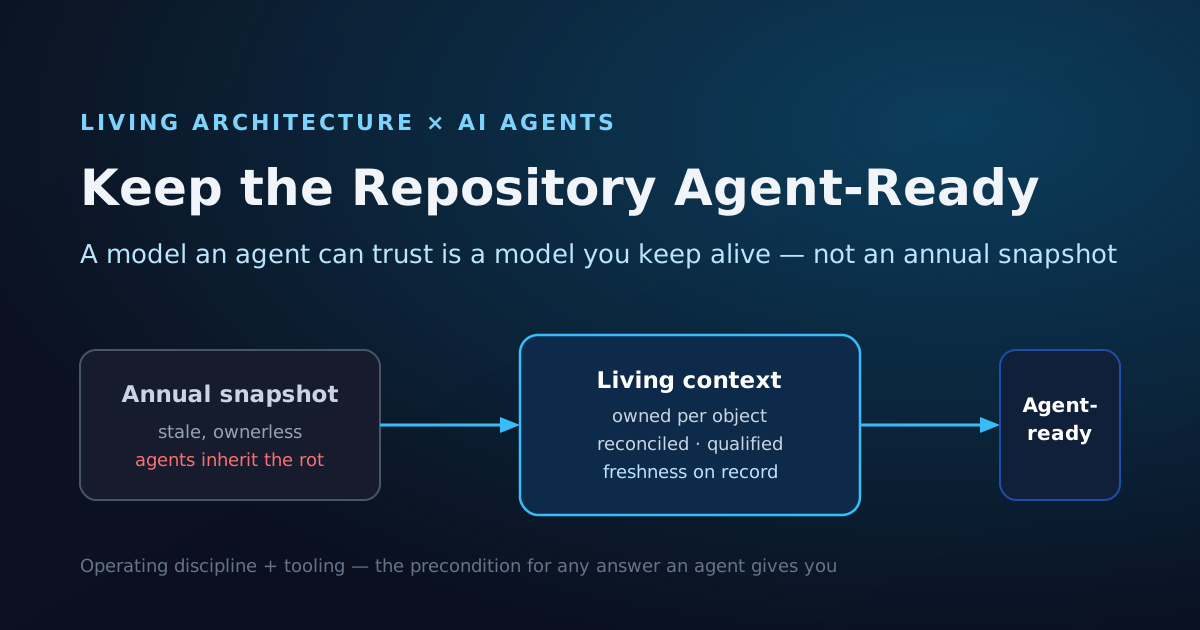
An agent inherits the freshness of the model it reads — keep the repository alive before you wire anything to it.
Use this page as a decision support asset: align stakeholders, validate trade-offs, and connect architecture choices to measurable business outcomes.
- Primary query focus: Living Architecture: Keeping an EA Repository Agent-Ready
- Decision scope: strategy, governance, operating model, and execution constraints
- Expected output: clear next actions with ownership and measurable indicators
An agent inherits the freshness of the model it reads
Most enterprise architecture repositories were built for human readers who already know which parts to trust. An architect glances at a diagram, silently notes that the integration layer was last touched two reorganizations ago, and discounts it. That tacit correction is invisible — and it does not survive contact with an AI agent.
An agent reads the model as written. It does not know that the dependency it just used to answer "what breaks if we retire this database" was captured eighteen months ago and three migrations stale. It answers with the same confidence whether the data is fresh or fossilized. So the freshness of your repository stops being a quiet quality concern and becomes the ceiling on how much any agent answer can be trusted.
This is why "living architecture" is not a slogan. It is the precondition. Before you connect any agent to your architecture — before MCP, before context engineering — the model has to be alive enough that an answer drawn from it is worth acting on.
The annual snapshot is the anti-pattern
The default operating model in many organizations is the annual snapshot: a heroic once-a-year effort to refresh the repository before a board review or an audit, after which it drifts untouched for eleven months. It looks complete on the day it ships and decays from the next morning.
The snapshot fails an agent in three specific ways. It has no owners, so nobody is accountable when an object goes stale between refreshes. It has no freshness signal, so every object looks equally current even though half of it is fossil. And it has no decommission discipline, so retired systems linger in the graph and an agent happily reasons over things that no longer exist.
Living context is the opposite stance: freshness as a continuous property of the model, maintained by the people closest to each object, rather than a project you run once a year and hope holds.
- No ownership — staleness is nobody's job between refreshes
- No freshness signal — fossil and fresh objects look identical
- No decommission discipline — retired systems pollute every query
- No reconciliation — the model drifts from the live estate by design
Ownership per object: the unit of accountability
The first move from snapshot to living is assigning an owner to each object class — applications, capabilities, critical dependencies, data flows — and ideally to the high-criticality objects within them. Ownership is not a name in a metadata field for its own sake; it is the answer to "who notices and fixes this when it drifts."
Practical ownership is bounded. An application owner is responsible for keeping that application's record true: its lifecycle status, its dependencies, its hosting and data-residency facts. They are not asked to maintain the whole model, only their slice. That bound is what makes the discipline sustainable — and it is exactly the granularity an agent needs, because a permission-aware answer is only as good as the object-level ownership behind it.
- Assign owners by object class, then by criticality within the class
- Make the owner accountable for that object's truth, not the whole model
- Record ownership in the model so it is queryable, not in a side spreadsheet
- Use ownership gaps as a first-class signal: an unowned critical object is a risk, not a blank cell
A practical playbook for keeping your enterprise architecture model fresh enough to trust — ownership, reconciliation, freshness SLAs and decommission discipline — the precondition for any AI agent answer.
Reconciliation and freshness signals: prove the model is current
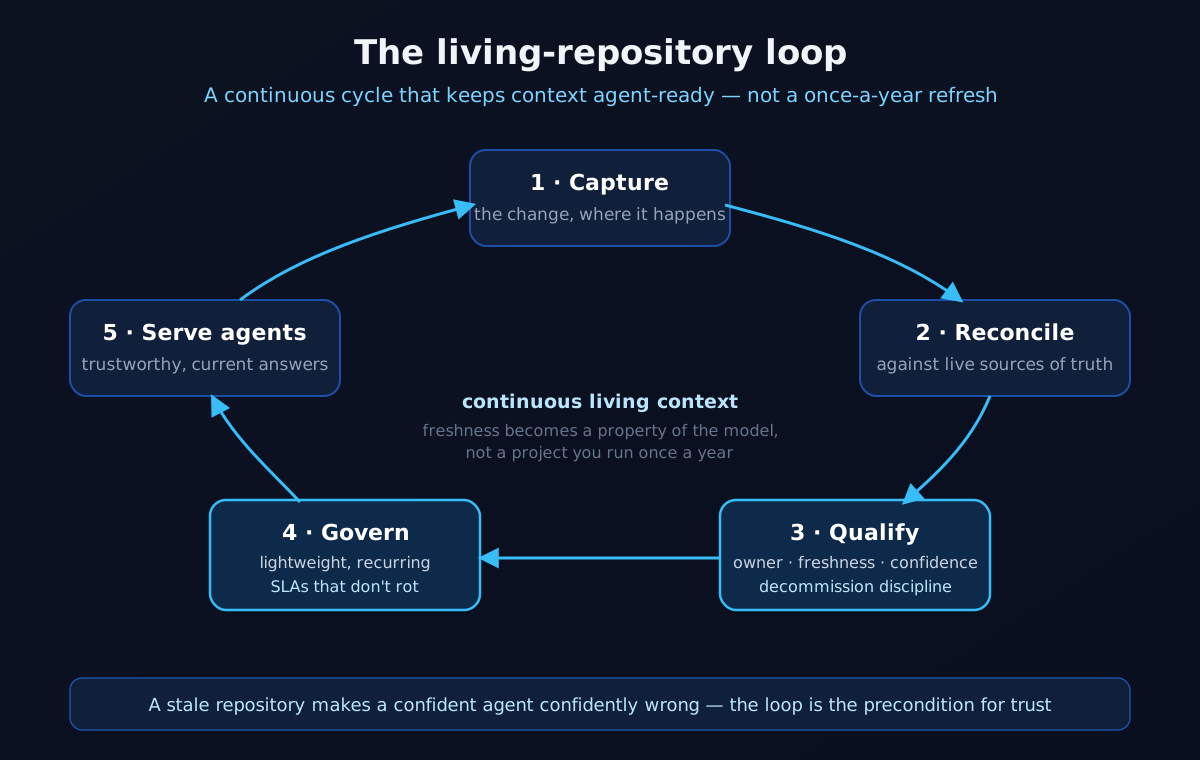
Ownership keeps objects accountable; reconciliation keeps them true. Reconciliation means comparing the repository against the live sources that already know the answer — the CMDB for what is actually deployed, the cloud account for what is actually running, the identity system for who actually owns what — and resolving the differences on a known cadence. Manual modeling alone always drifts; reconciliation against authoritative sources is what pulls it back.
Then make freshness visible. Every object should carry a last-verified date and, ideally, a freshness SLA tuned to its volatility: a tight cadence for the application portfolio and the critical dependencies that feed regulatory reporting, a looser one for a stable capability map. The point is not to pretend everything is current — it is to be honest about what is, so that an agent (and an auditor) can see the confidence behind each fact rather than assume it.
- Reconcile against live sources of truth (CMDB, cloud, identity), not memory
- Set a freshness SLA per object class, sized to its volatility and criticality
- Surface a last-verified date and a stale flag on every object
- Govern by exception: act on what is past SLA instead of re-validating everything
Decommission discipline: removing is as important as adding
Repositories grow easily and shrink reluctantly. New systems get added with some enthusiasm; retired ones almost never get removed, because deletion feels risky and nobody owns the cleanup. The result is a graph thick with ghosts — applications switched off years ago, dependencies on systems that no longer exist.
For a human this is mild clutter. For an agent it is a trap: it will cheerfully include a decommissioned system in an impact analysis or a dependency chain, producing an answer that is precise and wrong. Living architecture treats decommission as a first-class event with its own owner and its own trigger — when a system is retired in the real estate, it is retired in the model, with the change captured rather than silently dropped. Removing the dead is part of keeping the living trustworthy.
Lightweight governance that doesn't rot — and why this is the AI precondition
Heavy governance is its own failure mode: an exhaustive review framework so demanding that it is performed once, admired, and never repeated. The discipline that survives is the light one — a short, recurring reconciliation ritual owners can actually sustain, focused on exceptions rather than re-validating the entire model each cycle. Govern the deltas: what is stale, what is unowned, what was retired but never removed.
Done honestly, this is not magic and we will not pretend it is. It is operating discipline plus the right tooling to make ownership, reconciliation and freshness cheap to maintain. At ArchiLU we are convinced this living, governed context is the foundation a regulated organization needs before any AI agent touches its architecture — sovereign, continuously refreshed, auditable. That continuous-context direction is where we are building; the freshness discipline in this article pays off today regardless, because a model worth an agent's trust is first a model worth your own.
If you want to know where your repository sits on that spectrum, our free EA Maturity Assessment scores ten dimensions — including how current and governed your model is — and returns a prioritized action plan in about ten minutes. It is a concrete way to see how agent-ready your architecture really is before you connect anything to it.
Regulated AI context KPIs
Measure whether your context is trustworthy and governed, not how many queries the agent runs.
- Context freshness: median age of architecture objects vs live reality
- Share of answers traceable to a governed, permission-scoped source
- Sensitive object types covered by redaction/residency policy
- Audit coverage: prompts and responses logged and reviewable
Common mistakes
Most MCP-for-EA initiatives fail on context quality and governance long before they fail on the protocol.
- Exposing the full architecture repository to external LLMs without data-residency controls
- Treating MCP as the differentiator instead of the governed context behind it
- Connecting an 18-month-old, hand-maintained repository an agent cannot trust
- No permission-awareness, logging, or redaction of sensitive object types
Practical checklist
Run this before connecting any AI agent to your architecture repository.
- Confirm where prompts and responses go, and whether data stays in your region
- Enforce permission-aware access so the agent only sees what the user may see
- Classify and redact sensitive object types (vulnerabilities, data flows, controls)
- Log prompts and answers for audit, and keep a human in the loop for any change
A practical playbook for keeping your enterprise architecture model fresh enough to trust — ownership, reconciliation, freshness SLAs and decommission discipline — the precondition for any AI agent answer.
FAQ
What makes an EA repository "agent-ready"?
Not a protocol — freshness, ownership and reconciliation. An agent-ready repository is one where each object has a named owner, is reconciled against the live source of truth on a known cadence, carries a visible freshness signal, and where retired systems are actually removed. An agent reading that model inherits its trustworthiness; an agent reading an 18-month-old snapshot inherits its rot.
Why is a stale repository so dangerous for an AI agent specifically?
Because an agent answers with confidence regardless of the data's age. A human architect knows which parts of the model are out of date and mentally discounts them; an agent does not. A stale dependency map makes an impact analysis confidently wrong, and that wrong answer can feed a change decision or a regulatory statement. Freshness is the precondition for trusting any agent answer.
Does this require an MCP server or a special AI feature?
No. The living-repository discipline is upstream of any AI access. It is ownership, reconciliation and governance — operating discipline plus tooling, not magic. At ArchiLU we are convinced continuous, governed context is the right foundation for sovereign AI access, and that is the direction we are building toward; but the freshness work described here pays off today, with or without an agent connected.
How fresh is fresh enough?
It depends on the object's volatility and criticality, not a single global rule. The application portfolio and critical dependencies for regulated functions deserve a tight reconciliation cadence; a stable capability map can move slowly. Set a freshness SLA per object class, make the last-verified date visible, and flag anything past its SLA rather than pretending the whole model is current.
How do you stop governance itself from rotting?
Keep it lightweight and recurring rather than heavy and annual. A short, regular reconciliation ritual that owners can actually sustain beats an exhaustive yearly review that nobody repeats. Govern by exception — surface what is stale or unowned and act on that — instead of trying to re-validate everything at once.
Is MCP enough to make our architecture AI-ready?
No. MCP is the transport; the value is the quality, freshness, governance, and sovereignty of the context it exposes.
Strategic links
Compare enterprise architecture platforms
Related articles
IT Cost and Supplier Risk: One Map for Money and DORA
Cost and ICT third-party risk are usually managed in separate spreadsheets. Mapping applications to suppliers and cost in one model lets you see concentration, license exposure and rationalisation candidates at once — and produce the evidence DORA-minded reviews expect.
NIS2 and Enterprise Architecture: Mapping the Systems and Dependencies Risk Management Touches
NIS2 broadens the entities covered and raises the bar on cyber risk management, supply-chain security and incident handling. Each of those expectations rests on one prior question: do you actually know your systems and how they depend on each other? An EA map is the natural place to hold that — honestly, as evidence, not as a compliance badge.
CSSF and Enterprise Architecture: One Map for ICT, Outsourcing and Resilience Documentation
Banks, PFS, investment firms and fund actors supervised by the CSSF carry recurring documentation expectations around ICT, outsourcing and operational resilience. Each rests on a prior question: can you actually show your capabilities, applications, data flows and the third parties behind them? An EA repository is the natural place to hold that — honestly, as evidence, not as a compliance badge.