

Published on March 18, 2026 | Updated on March 18, 2026 | 11 min read
LeanIX Alternatives: How to Choose the Right Enterprise Architecture Platform
A practical decision guide to compare LeanIX competitors and select the best-fit EA platform.
Looking for an enterprise architecture software platform? Use our EA tool evaluation guide and run the EA maturity assessment.
Key takeaways
- A serious alternative analysis starts from migration risk and workflow fit, not from feature parity claims.
- How to compare platforms on decision outcomes, not feature volume.
- How to reduce adoption risk with a short but rigorous pilot.
LeanIX alternatives: context and core question
Enterprise architecture teams today are looking for platforms capable of connecting strategy, applications, technologies, and transformation initiatives within a single repository.
In this context, LeanIX has established itself as one of the most popular solutions, particularly thanks to its SaaS approach and its strong focus on application portfolio management and IT landscape visibility.
However, as organizations evolve their architecture practices, many begin asking a legitimate question: are there better alternatives to LeanIX depending on the organization’s needs?
The answer largely depends on the maturity of the enterprise architecture practice, the level of governance required, and the type of architecture that needs to be modeled.
Why LeanIX became a reference platform
LeanIX differentiated itself from traditional enterprise architecture tools by emphasizing IT landscape transparency and cross-team collaboration.
This approach addressed a concrete need for many organizations: understanding and rationalizing increasingly complex application portfolios.
- Map applications
- Visualize technology dependencies
- Connect applications to business capabilities
- Analyze IT landscape evolution over time
Main LeanIX use cases
In practice, LeanIX is commonly used in three main areas.
- Application Portfolio Management (APM): identify support coverage, redundancy, and lifecycle risk.
- Technology Lifecycle Management: track versions, end-of-support dates, and modernization priorities.
- Capability and Dependency Mapping: connect capabilities, applications, technologies, and transformation initiatives.
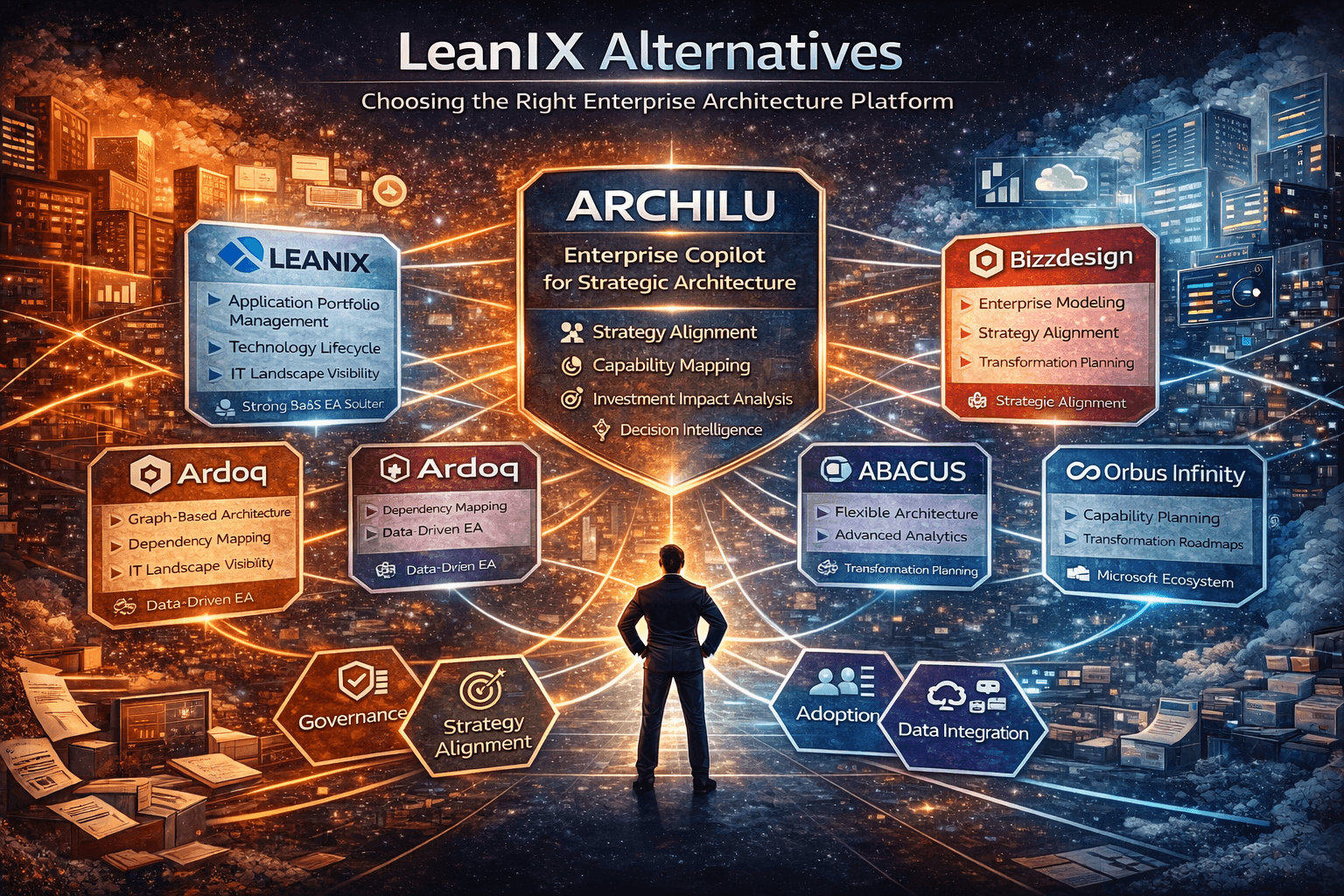
How to evaluate LeanIX alternatives based on architecture maturity, governance needs, and modeling requirements.
Why some organizations look for alternatives
Despite its strengths, LeanIX does not always meet every organization’s needs.
- Need for more advanced modeling (ArchiMate, complex diagrams, detailed infrastructure layers)
- Stronger architecture governance requirements (approval workflows, standards, compliance, decision management)
- Complex dependency modeling needs in multi-layer technology environments
- Licensing, cost, and time-to-value constraints
Main alternatives to LeanIX
The EA tooling market is relatively concentrated, and several alternatives are frequently evaluated.
- Ardoq: data-driven graph model, strong for dependency analysis and evolving models
- Bizzdesign Horizzon: advanced modeling, transformation planning, and strategy-to-IT alignment
- Orbus Infinity: strong linkage between EA and business transformation, capability and portfolio planning
- Avolution ABACUS: high modeling flexibility and advanced analytics
- Sparx Enterprise Architect: detailed UML/BPMN/ArchiMate/system modeling depth
How to choose a LeanIX alternative
Platform selection should not rely only on feature comparison. It should answer three strategic questions.
- What is the maturity of the architecture practice?
- What role does architecture play in the organization (governance/compliance vs transformation/rationalization/dependency analysis)?
- Who must use the platform (architects, product teams, IT managers, business decision-makers)?
Conclusion
Searching for a LeanIX alternative is not simply about replacing a tool.
It is about identifying the platform that best aligns with how the organization practices enterprise architecture.
Some organizations prioritize simplicity and visibility. Others prioritize advanced modeling. Others focus on dependency analysis and governance.
There is no universal solution.
The right platform is the one that allows enterprise architecture to effectively support strategic decisions and organizational transformation.
How to evaluate LeanIX alternatives based on architecture maturity, governance needs, and modeling requirements.
FAQ
Why do organizations evaluate alternatives to LeanIX?
Because architecture practices evolve and some organizations need stronger governance workflows, advanced modeling, or deeper dependency analysis.
Is LeanIX still a strong EA platform?
Yes. LeanIX is widely adopted and strong for application portfolio visibility, technology lifecycle analysis, and capability mapping.
What is the main risk when comparing alternatives?
Selecting based on feature checklists without clarifying architecture practice, stakeholder adoption needs, and governance goals.
Which alternatives are most frequently compared with LeanIX?
Ardoq, Bizzdesign, Orbus Infinity, Avolution ABACUS, and Sparx Enterprise Architect are common comparison candidates.
How should we choose the right LeanIX alternative?
Match platform choice to architecture maturity, governance model, required modeling depth, and who must use the tool across the enterprise.
Strategic links
Compare enterprise architecture platforms
Related articles
IT Cost and Supplier Risk: One Map for Money and DORA
Cost and ICT third-party risk are usually managed in separate spreadsheets. Mapping applications to suppliers and cost in one model lets you see concentration, license exposure and rationalisation candidates at once — and produce the evidence DORA-minded reviews expect.
NIS2 and Enterprise Architecture: Mapping the Systems and Dependencies Risk Management Touches
NIS2 broadens the entities covered and raises the bar on cyber risk management, supply-chain security and incident handling. Each of those expectations rests on one prior question: do you actually know your systems and how they depend on each other? An EA map is the natural place to hold that — honestly, as evidence, not as a compliance badge.
CSSF and Enterprise Architecture: One Map for ICT, Outsourcing and Resilience Documentation
Banks, PFS, investment firms and fund actors supervised by the CSSF carry recurring documentation expectations around ICT, outsourcing and operational resilience. Each rests on a prior question: can you actually show your capabilities, applications, data flows and the third parties behind them? An EA repository is the natural place to hold that — honestly, as evidence, not as a compliance badge.