


Published on June 21, 2026 | Updated on June 21, 2026 | 9 min read
Permission-aware and data-residency-aware: governing AI agent access to your EA
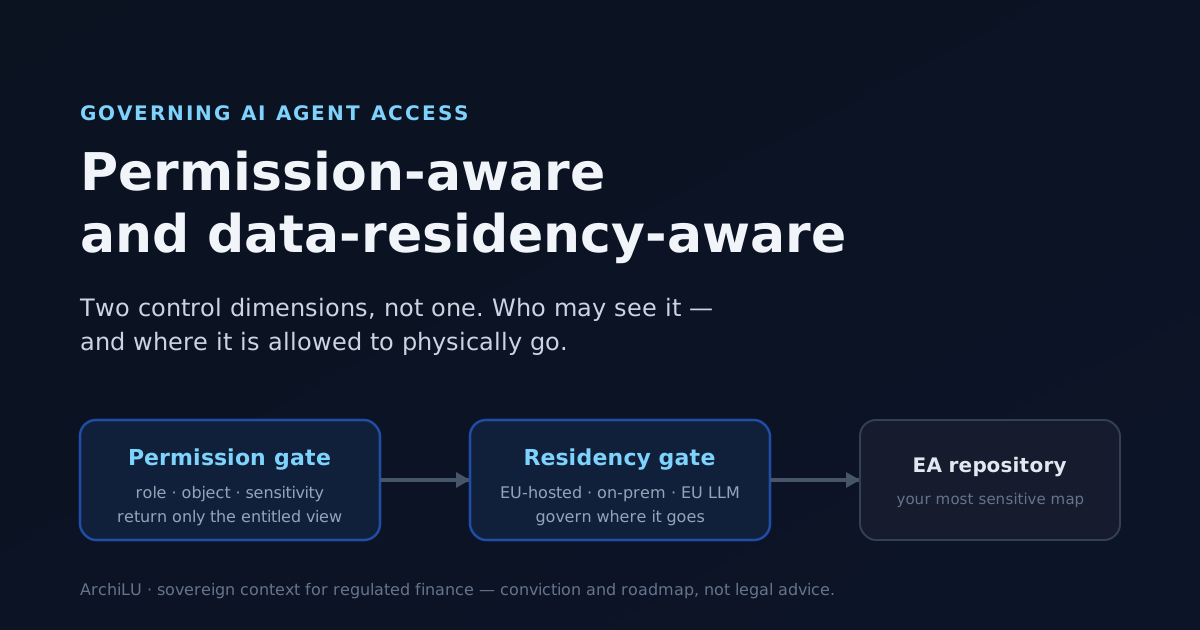
There are two control dimensions when an AI agent reads your architecture: who is entitled to see a given object, and where the data is allowed to physically go. Most incumbents address only the first. Here is a practical control model for both.
Looking for an enterprise architecture software platform? Use our EA tool evaluation guide and run the EA maturity assessment.
Key takeaways
- Why MCP is plumbing — and the governed, sovereign context behind it is the real differentiator.
- How to let AI agents reason on your architecture without sending your SI map to external clouds.
- How to keep an EA repository fresh enough that an AI agent's answers are actually trustworthy.
Table of contents
- Sovereign context operating model
- Two control dimensions, not one
- Permission-aware: only what the requesting user may see
- Why permission-aware alone is insufficient for regulated finance
- A practical control model: classification to logging
- Data-residency-aware: governing where the data goes
- The data-residency-aware MCP: where we are heading
- Regulated AI context KPIs
- Common mistakes
- Practical checklist
Sovereign context operating model
An AI agent is only as good as the context it can reach. For a regulated enterprise, that context — the architecture repository — is also one of its most sensitive assets.
The operating model that matters is not "expose the repository over MCP"; it is "govern what context leaves, to whom, and under which residency and audit constraints".
- Decide which object types are queryable, and which are never exposed
- Keep context fresh: reconcile the repository against live sources, not a yearly snapshot
- Make every answer traceable to a governed source the user is entitled to see
Two control dimensions, not one
When an AI agent reads your enterprise architecture, there are two distinct questions to answer, and they are easy to conflate. The first is a question of entitlement: of everything in the repository, what is this particular user allowed to see? The second is a question of geography and custody: wherever the answer comes from, where is that data allowed to physically go?
Most of the conversation in the market is about the first dimension. It is the easier one to reason about because it maps onto access control we already understand. The second dimension is the one regulated finance cannot skip — and the one incumbents tend to under-serve. Getting both right is what separates a demo from something a CISO or a CSSF-facing team will actually sign off.
Permission-aware: only what the requesting user may see
Permission-aware access means the agent returns only what the requesting user is entitled to see, scoped by role, by object and by sensitivity. The agent acts on behalf of a person; that person's identity and entitlements must propagate all the way through to the answer. An architect in payments should not, via a chatbot, surface objects they could never open in the application itself.
This is a real and important control, and it is fair to credit those who highlight it. Ardoq, for instance, emphasizes permission-aware access so the agent respects each user's existing entitlements. We agree it is necessary. Our argument is not that permission-aware is wrong — it is that, on its own, it is incomplete for a regulated context.
- Scope by role: the agent inherits the requesting user's entitlements, never a superset
- Scope by object: per-object access, not all-or-nothing repository access
- Scope by sensitivity: classify objects so critical ones are treated differently
- Propagate identity: the user behind the agent is who the gate evaluates
Why permission-aware alone is insufficient for regulated finance
Imagine a perfectly permission-correct answer. The user is entitled to every object in it; nothing leaked across an entitlement boundary. Now ask the second question: to produce that answer, did the prompt — your dependency map, your critical-function inventory — travel to a US-hosted model? If so, you can be fully permission-aware and still have created a DORA, CSSF or GDPR exposure, because the issue was never who asked. It was where the data went.
An EA map is close to a complete blueprint of the organization: system inventory, critical dependencies, obsolete components, known vulnerabilities, sensitive data flows. Scoping who can read it does not change the fact that, once an answer is computed, the underlying context may have left your jurisdiction. Permission control governs visibility; it does not govern residency. That gap is the missing dimension.
Permission-aware access controls who sees what. For regulated finance it is not enough on its own — you also need a data-residency-aware layer governing where prompts, responses and embeddings physically go.
A practical control model: classification to logging
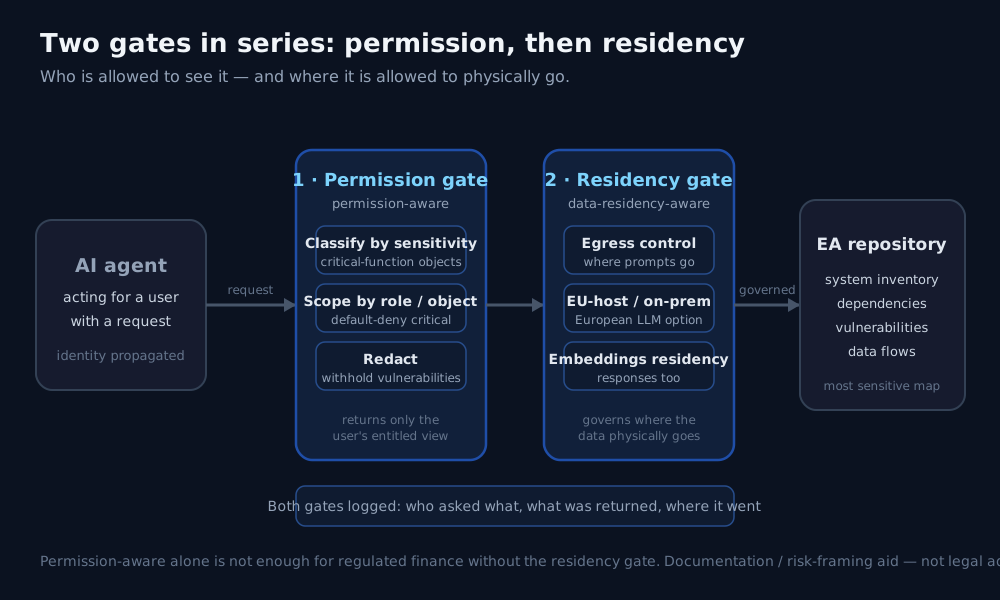
A workable model puts two gates in series between the agent and the repository, and logs across both. Start with classification, then default-deny the most dangerous objects, then control egress. The order matters: decide what may be seen before you decide where it may go, and record both decisions.
Default-deny on critical-function objects is the deliberately conservative stance. For the systems that underpin a critical or important function, the safe default is to withhold unless a request is explicitly allowed — the opposite of a permissive map where everything is reachable until restricted. Redaction handles the items that should never leave at all: known vulnerabilities, security measures, and similar material that has no business in an external prompt even for an entitled user.
- Classify every object by sensitivity, flagging critical-function systems
- Default-deny on critical-function objects: withhold unless explicitly allowed
- Redact items that must never leave (known vulnerabilities, security measures)
- Apply egress control before any prompt or response crosses a boundary
- Log who asked what, what was returned, and where it went
Data-residency-aware: governing where the data goes
The residency gate governs the geography and custody of every prompt, response and embedding. The practical levers are deployment choices: an EU-hosted model, an on-premise deployment under your own control, or a European LLM where the inference itself stays in the jurisdiction. Embeddings deserve explicit attention — vectorizing your architecture can quietly persist a derivative of sensitive content in a place you did not intend.
Concretely, in EU-regulated finance, the question a CISO asks is rarely 'can the agent see this?' alone; it is 'if it sees this, where does the computation happen and where do the artifacts rest?'. A residency-aware layer makes that answer a configured, auditable property rather than an accident of which model was cheapest to call. This is the part of the picture that, today, most platforms leave to the customer.
- EU-hosted inference, on-premise deployment, or a European LLM option
- Egress control on prompts and responses, not just on stored data
- Treat embeddings as residency-bearing: they persist a derivative of the content
- Make residency a configured, auditable property, not an implicit default
The data-residency-aware MCP: where we are heading
Tie the two gates together and you get what we call a data-residency-aware MCP: a context layer that governs not only who queries the architecture but where the data physically goes when it does. To be clear about claim discipline: this is our conviction and our roadmap, the approach we are building toward — not a shipped product. We will not write that it exists when it does not.
What we can stand behind today is the foundation it needs: EU-region or on-premise hosting you control, native French and English, a connected EA model built around DORA/CSSF documentation needs, and a free EA Maturity Assessment to see where your practice stands. And one honest caveat throughout: this control model is a documentation and risk-framing aid, not legal compliance. It helps you show an auditor how AI access to your architecture is governed; the compliance judgment remains yours to make.
Regulated AI context KPIs
Measure whether your context is trustworthy and governed, not how many queries the agent runs.
- Context freshness: median age of architecture objects vs live reality
- Share of answers traceable to a governed, permission-scoped source
- Sensitive object types covered by redaction/residency policy
- Audit coverage: prompts and responses logged and reviewable
Common mistakes
Most MCP-for-EA initiatives fail on context quality and governance long before they fail on the protocol.
- Exposing the full architecture repository to external LLMs without data-residency controls
- Treating MCP as the differentiator instead of the governed context behind it
- Connecting an 18-month-old, hand-maintained repository an agent cannot trust
- No permission-awareness, logging, or redaction of sensitive object types
Practical checklist
Run this before connecting any AI agent to your architecture repository.
- Confirm where prompts and responses go, and whether data stays in your region
- Enforce permission-aware access so the agent only sees what the user may see
- Classify and redact sensitive object types (vulnerabilities, data flows, controls)
- Log prompts and answers for audit, and keep a human in the loop for any change
Permission-aware access controls who sees what. For regulated finance it is not enough on its own — you also need a data-residency-aware layer governing where prompts, responses and embeddings physically go.
FAQ
What is the difference between permission-aware and data-residency-aware access?
Permission-aware means the agent only returns what the requesting user is entitled to see — scoped by role, object and sensitivity. Data-residency-aware means governing where the prompt, the response and any embeddings physically go: which region, which model, on-premise or EU-hosted. The first answers 'who may see this?'; the second answers 'where is this data allowed to travel?'. A regulated organization needs both.
Isn't permission-aware access enough?
It is necessary but not sufficient for regulated finance. Ardoq, for example, rightly highlights permission-aware access so the agent respects each user's entitlements — a real and important control. But scoping who sees what does nothing about where the data goes. If a permitted answer is still routed to a US-hosted model, you can be fully permission-correct and still create a DORA, CSSF or GDPR exposure. The residency gate is the part most incumbents under-serve.
What does a practical control model look like?
Classify objects by sensitivity, default-deny on critical-function objects, redact what should never leave (known vulnerabilities, security measures), then apply egress control so prompts and responses stay within an approved region or model — EU-hosted, on-premise, or a European LLM. Log every request and response: who asked what, what was returned, and where it went. Permission first, residency second, logging throughout.
Does this make us compliant with DORA or GDPR?
No. These controls help you document and prove how AI access to your architecture is governed — they are a documentation and risk-framing aid, not legal compliance. Compliance is a determination your own risk, legal and regulatory functions make against the actual regulations. Treat the model here as evidence you can show an auditor, not as a compliance guarantee.
Is ArchiLU's data-residency-aware MCP available today?
No. The data-residency-aware MCP described here is our conviction and roadmap — the approach we are building toward — not a shipped product. What we can offer today is EU-region or on-premise hosting you control, native French and English, and a connected EA model designed around DORA/CSSF documentation needs. We are explicit about the line between what exists and where we are heading.
Is MCP enough to make our architecture AI-ready?
No. MCP is the transport; the value is the quality, freshness, governance, and sovereignty of the context it exposes.
Strategic links
Compare enterprise architecture platforms
Related articles
IT Cost and Supplier Risk: One Map for Money and DORA
Cost and ICT third-party risk are usually managed in separate spreadsheets. Mapping applications to suppliers and cost in one model lets you see concentration, license exposure and rationalisation candidates at once — and produce the evidence DORA-minded reviews expect.
NIS2 and Enterprise Architecture: Mapping the Systems and Dependencies Risk Management Touches
NIS2 broadens the entities covered and raises the bar on cyber risk management, supply-chain security and incident handling. Each of those expectations rests on one prior question: do you actually know your systems and how they depend on each other? An EA map is the natural place to hold that — honestly, as evidence, not as a compliance badge.
CSSF and Enterprise Architecture: One Map for ICT, Outsourcing and Resilience Documentation
Banks, PFS, investment firms and fund actors supervised by the CSSF carry recurring documentation expectations around ICT, outsourcing and operational resilience. Each rests on a prior question: can you actually show your capabilities, applications, data flows and the third parties behind them? An EA repository is the natural place to hold that — honestly, as evidence, not as a compliance badge.