

Published on June 21, 2026 | Updated on June 21, 2026 | 9 min read
From Prompt Engineering to Context Engineering: the 2026 Shift
The center of gravity in applied AI has moved from writing clever prompts to engineering the context an agent reasons over. For regulated enterprises, that context lives in enterprise architecture — and must be governed.
Looking for an enterprise architecture software platform? Use our EA tool evaluation guide and run the EA maturity assessment.
Key takeaways
- Why MCP is plumbing — and the governed, sovereign context behind it is the real differentiator.
- How to let AI agents reason on your architecture without sending your SI map to external clouds.
- How to keep an EA repository fresh enough that an AI agent's answers are actually trustworthy.
Table of contents
- Sovereign context operating model
- The four-year shift: from prompt to context
- Why the bottleneck moved to context
- Structured enterprise context already lives in EA
- The condition the context must be living
- Sovereign context engineering: the regulated lens
- EA as the System of Context — and the honesty rail
- Regulated AI context KPIs
- Common mistakes
- Practical checklist
Sovereign context operating model
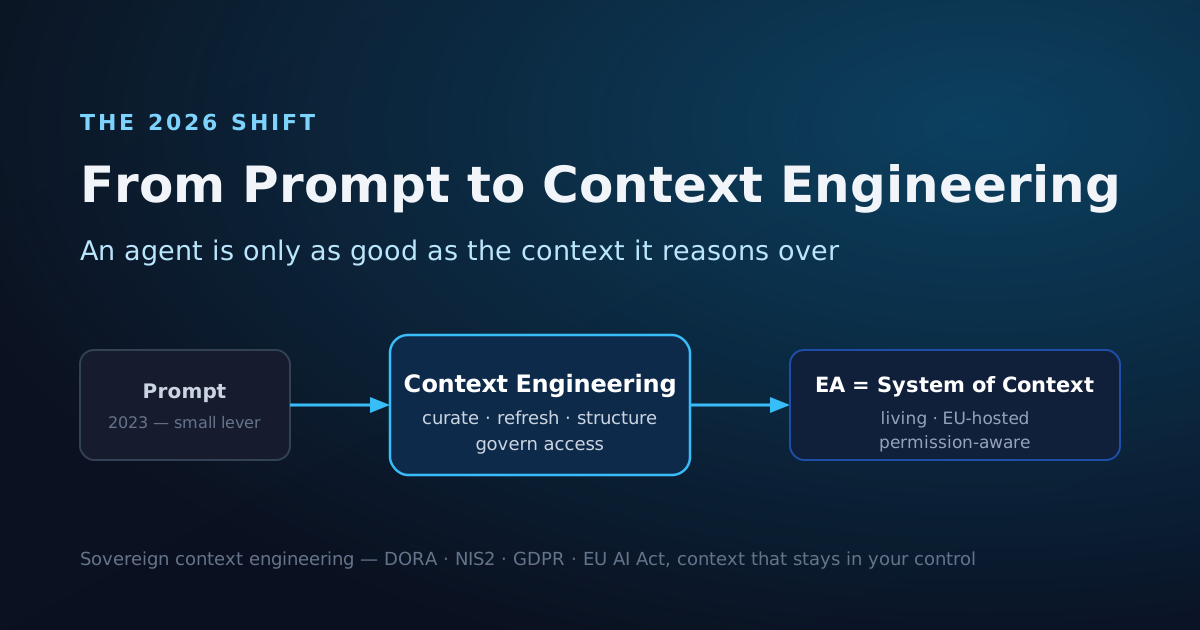
An AI agent is only as good as the context it can reach. For a regulated enterprise, that context — the architecture repository — is also one of its most sensitive assets.
The operating model that matters is not "expose the repository over MCP"; it is "govern what context leaves, to whom, and under which residency and audit constraints".
- Decide which object types are queryable, and which are never exposed
- Keep context fresh: reconcile the repository against live sources, not a yearly snapshot
- Make every answer traceable to a governed source the user is entitled to see
The four-year shift: from prompt to context
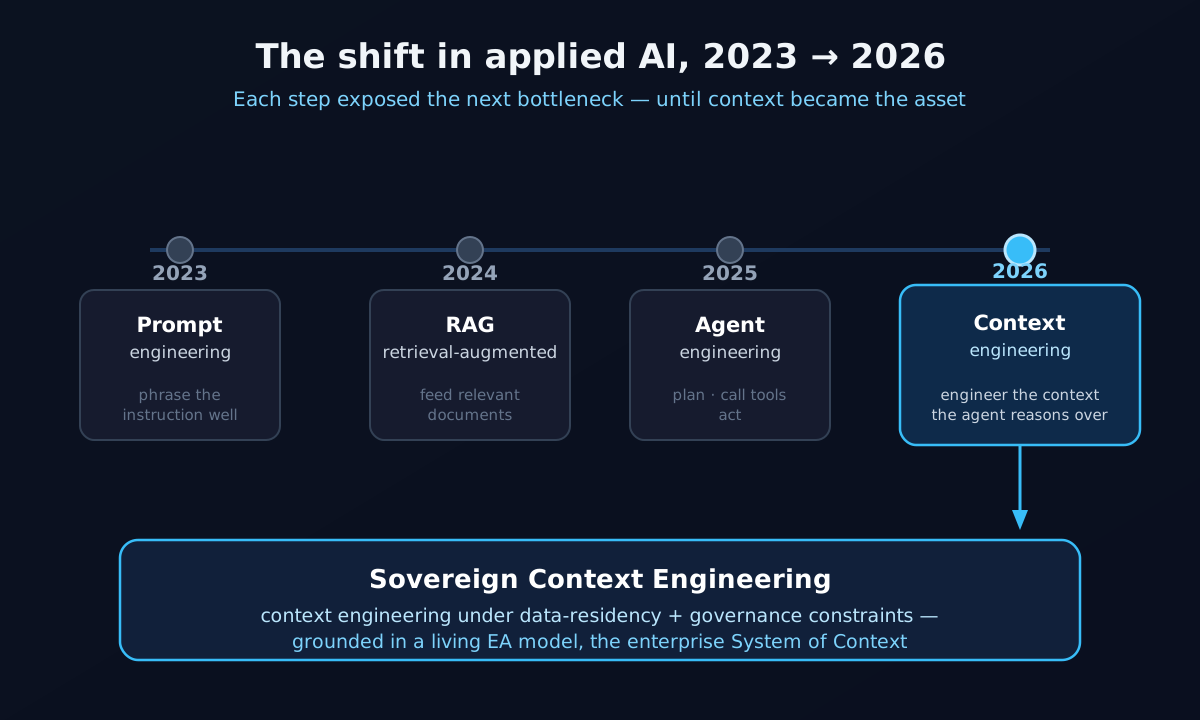
In 2023, the headline skill was prompt engineering — phrase the instruction well and a single model would do impressive things. By 2024 the conversation had moved to retrieval-augmented generation (RAG): the model was no longer asked to know everything, it was fed relevant documents at query time. In 2025 the spotlight turned to agent engineering — multi-step systems that plan, call tools and act, not just answer. And in 2026 the discipline underneath all of it has a name: context engineering.
Each step did not replace the last so much as expose its real bottleneck. Better prompts revealed that the model lacked knowledge — hence RAG. Better retrieval revealed that single answers were not enough — hence agents. And capable agents revealed the deepest constraint of all: an agent is only ever as good as the context it can reason over. That is the thesis of 2026.
Why the bottleneck moved to context
As frontier models became excellent at following instructions, clever wording stopped being the differentiator. Two systems running the same model now diverge almost entirely on what they put in front of it: which sources, how fresh, in what structure, with which permissions. That is context engineering — deciding and delivering the right information into an agent's working context.
The vocabulary is worth recovering deliberately, because vendors are already claiming it. Ardoq, among others, helped popularize the term context engineering for enterprise architecture, and the framing is correct: in an enterprise, the hard part is never the prompt, it is assembling trustworthy context across a sprawling estate. We credit that framing — and then push it somewhere it has not yet gone.
- Prompt engineering (2023): optimize the instruction sent to one model
- RAG (2024): feed the model relevant documents at query time
- Agent engineering (2025): plan, call tools, act over multiple steps
- Context engineering (2026): engineer the knowledge the agent reasons over
Structured enterprise context already lives in EA
Here is the part most context-engineering discussions skip. The richest enterprise context an agent needs is not scattered loose in wikis and tickets — much of it is already modeled. Which applications exist, which business capabilities they support, what depends on what, which data flows where, what is obsolete or at risk: this is precisely the content of an enterprise architecture model.
That makes EA the natural System of Context — the layer an agent queries to reason about the whole estate — sitting alongside the Systems of Record (CRM, ERP, ITSM) that each answer for one domain. A System of Record tells you what happened in a silo. The System of Context tells you what breaks if a component fails, what is redundant, and what is exposed. RAG over loose documents is shallow context; a connected EA graph is deep, structured context.
- Application portfolio and the capabilities each system supports
- Dependencies — what breaks if a component fails
- Data flows — where sensitive data actually goes
- Lifecycle signals — what is obsolete, redundant or at risk
Prompt engineering (2023) became RAG (2024), then agent engineering (2025), and now context engineering (2026). An agent is only as good as its context — and the best enterprise context lives in EA.
The condition the context must be living
There is a hard prerequisite. An EA repository only works as a System of Context if it is current. An agent that reasons confidently over an eighteen-month-old snapshot will give confident, wrong answers — and in a regulated setting, a confident wrong answer is worse than no answer.
So context engineering in the enterprise is not a one-off retrieval pipeline; it is a commitment to a living, agent-ready repository that is continuously refreshed. The model behind the agent is a commodity you can swap. The freshness, structure and governance of your context is the durable asset. Get the order right: context first, then the rest.
Sovereign context engineering: the regulated lens
Now add the constraint the giants tend to skip. An enterprise architecture map is, in effect, a near-complete blueprint of the organization: full system inventory, critical dependencies, obsolete components, known weaknesses, sensitive data flows. Feeding that to a US-cloud model by default is a DORA, NIS2, GDPR and EU AI Act landmine for a regulated bank, insurer or public body.
Context engineering done under data-residency and governance constraints deserves its own name: sovereign context engineering. It keeps the context inside the EU or your own infrastructure, makes access permission-aware, and leaves an audit trail an auditor will accept. The question stops being can AI talk to your architecture and becomes can AI reason on your architecture without you losing control of it. For regulated finance, that second question is the only one that matters.
- Data-residency-aware: context stays in the EU or on infrastructure you control
- Permission-aware: who can query what is enforced, not assumed
- Auditable: a defensible trail for DORA / CSSF / NIS2 scrutiny
EA as the System of Context — and the honesty rail
Put the pieces together and the 2026 picture is clear: the agent is a commodity, the prompt is a small lever, and the decisive asset is a living, governed, sovereign context layer. Enterprise architecture is the natural home of that layer — the System of Context that makes an agent's answers trustworthy and an auditor's acceptance possible.
We will be precise about what exists. A sovereign MCP server connecting agents to that context is a direction ArchiLU is building toward — a conviction about how regulated enterprises should do this, not a shipped product we claim today. What is real now is the foundation: a living EA model, EU-region or on-premise hosting you control, native French and English, unlimited users. Build the System of Context first; the protocol on top comes last, and only once the context is worth querying.
Regulated AI context KPIs
Measure whether your context is trustworthy and governed, not how many queries the agent runs.
- Context freshness: median age of architecture objects vs live reality
- Share of answers traceable to a governed, permission-scoped source
- Sensitive object types covered by redaction/residency policy
- Audit coverage: prompts and responses logged and reviewable
Common mistakes
Most MCP-for-EA initiatives fail on context quality and governance long before they fail on the protocol.
- Exposing the full architecture repository to external LLMs without data-residency controls
- Treating MCP as the differentiator instead of the governed context behind it
- Connecting an 18-month-old, hand-maintained repository an agent cannot trust
- No permission-awareness, logging, or redaction of sensitive object types
Practical checklist
Run this before connecting any AI agent to your architecture repository.
- Confirm where prompts and responses go, and whether data stays in your region
- Enforce permission-aware access so the agent only sees what the user may see
- Classify and redact sensitive object types (vulnerabilities, data flows, controls)
- Log prompts and answers for audit, and keep a human in the loop for any change
Prompt engineering (2023) became RAG (2024), then agent engineering (2025), and now context engineering (2026). An agent is only as good as its context — and the best enterprise context lives in EA.
FAQ
What is context engineering?
Context engineering is the discipline of deciding, curating and delivering the right information into an AI agent's working context so it can reason correctly — instead of relying on clever wording in a single prompt. It covers what to retrieve, from where, how fresh it is, in what structure, and under which access rules. Ardoq helped popularize the term for enterprise architecture; the underlying idea is that an agent's answer is only as good as the context it was given.
How is context engineering different from prompt engineering?
Prompt engineering optimizes the instruction you send to a model. Context engineering optimizes the surrounding knowledge the model reasons over — the documents, the graph of systems, the freshness, the permissions. As models got better at following instructions, the bottleneck shifted from phrasing to context quality. Prompting still matters, but it is now the smaller lever.
Why does enterprise architecture matter for context engineering?
Most enterprise context an agent needs — which applications exist, which capabilities they support, what depends on what, which data flows where — is exactly what an enterprise architecture model already captures. EA is the structured, connected representation of the organization, so it is the natural System of Context an agent should query, provided it is kept living rather than left as an 18-month-old snapshot.
What is sovereign context engineering?
Sovereign context engineering is context engineering done under data-residency and governance constraints. For a regulated bank or insurer, an EA map is effectively a blueprint of the organization, so feeding it to AI is only acceptable if you control where the data goes and who can query what. Sovereign context engineering keeps that context inside the EU or your own infrastructure, permission-aware and auditable, rather than shipping it to a US-cloud model by default.
Does ArchiLU offer a context engineering or MCP product today?
Not as a shipped MCP server — that is a direction we are building toward, a conviction about how regulated enterprises should connect AI to their architecture, not a feature we claim exists today. What ArchiLU offers now is a living EA model with EU-region or on-premise hosting you control, native French and English, and unlimited users — the governed System of Context that sovereign context engineering needs as its foundation.
Is MCP enough to make our architecture AI-ready?
No. MCP is the transport; the value is the quality, freshness, governance, and sovereignty of the context it exposes.
Strategic links
Compare enterprise architecture platforms
Related articles
IT Cost and Supplier Risk: One Map for Money and DORA
Cost and ICT third-party risk are usually managed in separate spreadsheets. Mapping applications to suppliers and cost in one model lets you see concentration, license exposure and rationalisation candidates at once — and produce the evidence DORA-minded reviews expect.
NIS2 and Enterprise Architecture: Mapping the Systems and Dependencies Risk Management Touches
NIS2 broadens the entities covered and raises the bar on cyber risk management, supply-chain security and incident handling. Each of those expectations rests on one prior question: do you actually know your systems and how they depend on each other? An EA map is the natural place to hold that — honestly, as evidence, not as a compliance badge.
CSSF and Enterprise Architecture: One Map for ICT, Outsourcing and Resilience Documentation
Banks, PFS, investment firms and fund actors supervised by the CSSF carry recurring documentation expectations around ICT, outsourcing and operational resilience. Each rests on a prior question: can you actually show your capabilities, applications, data flows and the third parties behind them? An EA repository is the natural place to hold that — honestly, as evidence, not as a compliance badge.