

Published on June 20, 2026 | Updated on June 20, 2026 | 10 min read
Enterprise Architecture for Mid-Market Companies and ETIs
EA scaled to the mid-market: a leaner practice, unlimited users, fast value — plus an honest note on when a heavier enterprise suite still fits better.
Looking for an enterprise architecture software platform? Use our EA tool evaluation guide and run the EA maturity assessment.
Key takeaways
- How to compare platforms on decision outcomes, not feature volume.
- How to reduce adoption risk with a short but rigorous pilot.
- How to link tool selection to governance and transformation cadence.
Table of contents
- Operating model deep dive
- The mid-market has the same problems, at a different scale
- A leaner practice, not a smaller copy of enterprise EA
- No per-seat budget for big suites
- Fast time-to-value matters more without a dedicated team
- EU hosting, on-premise and broad participation
- When a heavier enterprise suite still fits better
- Metrics that matter
- Common mistakes
- Practical checklist
Operating model deep dive
Enterprise architecture software only creates value when it improves how decisions are made across strategy, portfolio, and delivery.
Before selecting a platform, define who makes which architecture decisions, what evidence is required, and how exceptions are tracked to closure.
- Map decision workflows by role (EA, domain leads, product, security, finance)
- Define minimal evidence pack for each decision type
- Set escalation path when standards and delivery pressure conflict
The mid-market has the same problems, at a different scale
Mid-market companies and ETIs — large enough to have real complexity, small enough not to have a dedicated EA department — sit in an awkward gap. They carry duplicate applications, brittle integrations and transformation decisions that deserve a map, but they rarely have the budget or headcount that enterprise architecture tools were designed around.
The good news is that the practice scales down cleanly. You do not need a fifty-person architecture team to get value; you need a focused model, a predictable tool and a way to prove value quickly. This page is about doing EA at mid-market scale, honestly — including when a heavier suite is the better call.
A leaner practice, not a smaller copy of enterprise EA
The mistake is to imitate a global bank's architecture program at a tenth of the size. Instead, keep only what pays for itself: a first-level capability map, an application inventory, and the link between them, plus lightweight governance for significant changes.
That minimal core already answers the questions leadership asks — what supports this capability, what would a change impact, where is duplication — without a multi-year rollout. You can deepen data, technology and roadmap views later, as the practice earns trust.
No per-seat budget for big suites
Pricing is where mid-market EA often stalls. Several established suites charge per seat or only on quote, which means the cost rises as you invite the business stakeholders who make the model useful — exactly the wrong incentive.
Archilu includes unlimited users on every plan, so inviting more contributors does not increase the bill. A mid-market team can involve every owner and stakeholder without the per-seat penalty that makes wide adoption expensive elsewhere.
- Archilu: unlimited users with no per-seat fee, so adoption does not inflate the bill
- Several incumbents: per-seat or quote-only pricing (no public list; any figure is an estimate)
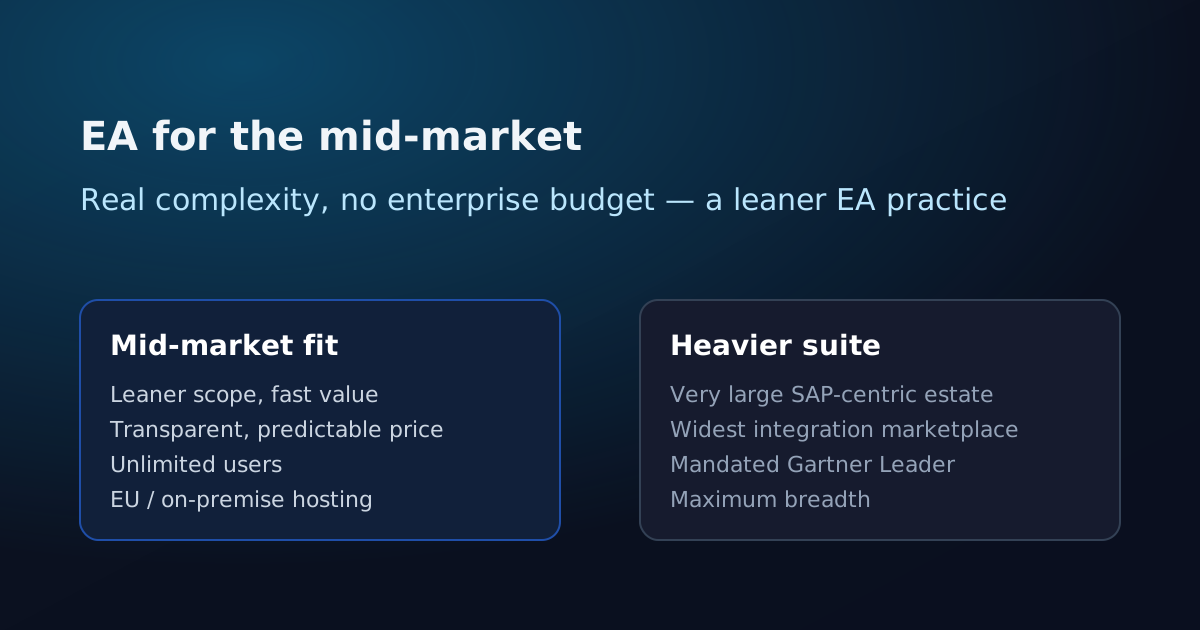
How mid-market companies and ETIs do enterprise architecture without an enterprise budget: leaner scope, fast time-to-value, unlimited users and EU hosting.
Fast time-to-value matters more without a dedicated team
When the same people run architecture, projects and operations, a tool that takes months to configure never gets adopted. Mid-market EA lives or dies on time-to-value: how quickly you can stand up a usable capability map and portfolio and show a decision it improved.
Favor a focused model you can populate fast over a deep metamodel that needs analysts to drive it. The aim is a maintained, trustworthy picture in weeks, not a perfect one in years.
EU hosting, on-premise and broad participation
Mid-market buyers tend to value two things highly: control over where their data lives and the ability to involve the whole team. Archilu addresses both with EU or on-premise hosting you control and unlimited users on every plan — relevant for organizations in regulated or data-sensitive sectors that cannot defer residency decisions.
You can pressure-test the economics with our EA TCO calculator, which lets you model setup, subscription and internal effort instead of trusting a slide. For a broader view of the category, our guide to enterprise architecture software frames where a tool like Archilu fits.
When a heavier enterprise suite still fits better
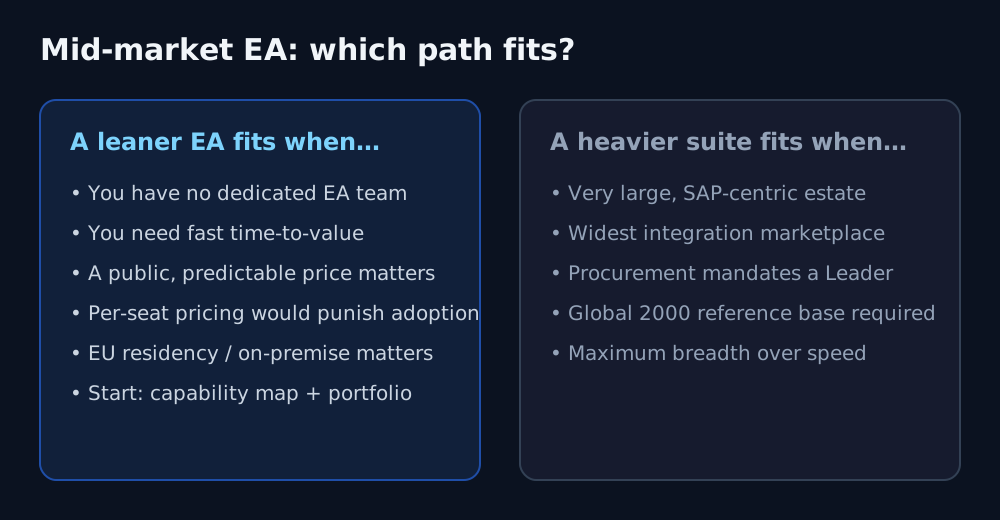
Honesty builds trust, so we say it plainly. If you run a very large, SAP-centric landscape, need the widest integration marketplace, or your procurement mandates a long-standing Gartner Leader with a Global 2000 reference base, a heavier suite's breadth and scale are genuine advantages we will not pretend away.
Archilu is a focused fit for the mid-market: it trades maximum breadth for fast time-to-value, unlimited users and EU sovereignty. If that profile matches your context, request a demo — and decide on your numbers, not a vendor's slides.
Metrics that matter
Use KPIs that measure decision quality and adoption, not tool activity volume.
- Decision lead time by workflow
- Adoption rate by role and business domain
- Architecture exception closure rate
- Portfolio decisions supported by evidence
Common mistakes
Most software selection failures are operating model failures before they are tooling failures.
- Comparing feature lists without testing real decision workflows
- Ignoring integration and data model constraints
- No adoption plan by stakeholder group
- No migration strategy for existing repositories
Practical checklist
Run this checklist before committing to a platform contract.
- Define top 5 decision workflows and success metrics
- Run a time-boxed pilot with real portfolio data
- Score adoption risk by role and business domain
- Validate migration and integration effort before selection sign-off
How mid-market companies and ETIs do enterprise architecture without an enterprise budget: leaner scope, fast time-to-value, unlimited users and EU hosting.
FAQ
Is enterprise architecture only for large enterprises?
No. The label says 'enterprise', but the practice scales down. A mid-market company or ETI still has duplicate applications, integration sprawl and transformation decisions to make. What changes is scope and tooling: a leaner capability map, a focused application portfolio and lightweight governance deliver most of the value without an enterprise-sized program or budget.
Can a mid-market company afford an EA tool?
It depends on the pricing model. Suites that charge per seat or quote-only can become expensive fast as you add contributors. Archilu includes unlimited users on every plan, so inviting the business stakeholders who make the model useful does not raise the bill — which suits a mid-market team that cannot license dozens of named seats. You can model the comparison with our EA TCO calculator before committing.
When does a mid-market company still need a heavier enterprise suite?
Honestly, sometimes it does. If you run a very large, SAP-centric estate, need the widest third-party integration marketplace, or your procurement mandates a long-standing Gartner Leader with a Global 2000 reference base, a heavier suite's scale is a real advantage. Archilu's fit is strongest when time-to-value, predictable cost and EU sovereignty matter more than maximum breadth.
What is the best first KPI after software rollout?
Track decision lead time and stakeholder adoption by role within the first 90 days.
Should procurement drive platform selection alone?
No. Procurement, architecture, and transformation leadership should evaluate together.
Strategic links
Compare enterprise architecture platforms
Related articles
IT Cost and Supplier Risk: One Map for Money and DORA
Cost and ICT third-party risk are usually managed in separate spreadsheets. Mapping applications to suppliers and cost in one model lets you see concentration, license exposure and rationalisation candidates at once — and produce the evidence DORA-minded reviews expect.
NIS2 and Enterprise Architecture: Mapping the Systems and Dependencies Risk Management Touches
NIS2 broadens the entities covered and raises the bar on cyber risk management, supply-chain security and incident handling. Each of those expectations rests on one prior question: do you actually know your systems and how they depend on each other? An EA map is the natural place to hold that — honestly, as evidence, not as a compliance badge.
CSSF and Enterprise Architecture: One Map for ICT, Outsourcing and Resilience Documentation
Banks, PFS, investment firms and fund actors supervised by the CSSF carry recurring documentation expectations around ICT, outsourcing and operational resilience. Each rests on a prior question: can you actually show your capabilities, applications, data flows and the third parties behind them? An EA repository is the natural place to hold that — honestly, as evidence, not as a compliance badge.