

Published on June 21, 2026 | Updated on June 21, 2026 | 8 min read
Context Engineering Explained for CIOs and CISOs
Context engineering is becoming a CIO/CISO concern because an AI agent is only as good — and as safe — as the context it can reach. Here is what it means and what to ask.
Looking for an enterprise architecture software platform? Use our EA tool evaluation guide and run the EA maturity assessment.
Key takeaways
- Why MCP is plumbing — and the governed, sovereign context behind it is the real differentiator.
- How to let AI agents reason on your architecture without sending your SI map to external clouds.
- How to keep an EA repository fresh enough that an AI agent's answers are actually trustworthy.
Table of contents
- Sovereign context operating model
- Why this lands on your desk now
- What context engineering actually means
- Why the context layer is also the risk layer
- Five questions a decision-maker should ask
- The compliance angle, stated honestly
- What to do first
- Regulated AI context KPIs
- Common mistakes
- Practical checklist
Sovereign context operating model
An AI agent is only as good as the context it can reach. For a regulated enterprise, that context — the architecture repository — is also one of its most sensitive assets.
The operating model that matters is not "expose the repository over MCP"; it is "govern what context leaves, to whom, and under which residency and audit constraints".
- Decide which object types are queryable, and which are never exposed
- Keep context fresh: reconcile the repository against live sources, not a yearly snapshot
- Make every answer traceable to a governed source the user is entitled to see
Why this lands on your desk now
If you run IT or security at a regulated institution, you have probably been asked some version of the same question this year: can we point an AI agent at our own systems? The honest answer is not yes or no — it is a question about context. An AI agent is only as good, and only as safe, as the context it can reach. Context engineering is the discipline that decides what that context is, where it comes from, and how tightly it is governed.
This is not a hype piece. There is no claim here that agents will replace your architects or that a model will read your estate and hand you a compliance certificate. The point is narrower and more useful: the value and the risk of enterprise AI both concentrate in the same place — the context layer — and that layer is now a decision-maker's concern, not a detail left to whoever wired up the integration.
What context engineering actually means
A useful way to separate the terms: prompting tells a model what to do; context engineering governs what it is allowed to reason over. The prompt is the question. The context is everything the model can see while answering — your application portfolio, your dependency maps, your decision records, your policies. Most of the quality of an answer, and almost all of the risk, lives in that second part.
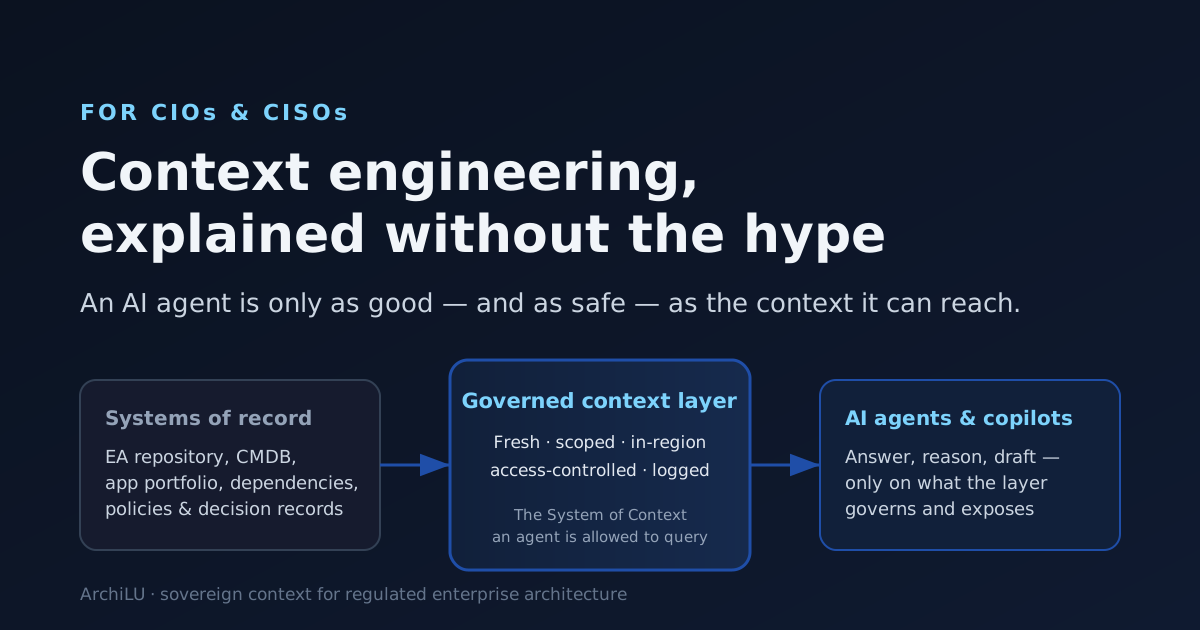
For a regulated enterprise the natural home of that context is the enterprise architecture model: the connected picture of capabilities, applications and dependencies that describes how the organization actually runs. Treated well, it becomes what we call a System of Context — a governed layer that agents query — sitting alongside the Systems of Record (your ERP, CRM, ITSM) rather than replacing them. Context engineering is the work of making that layer fresh, scoped, in-region and accountable enough that an agent can use it without anyone losing control of it.
- Prompting = what the model is asked to do
- Context = what the model is allowed to see while answering
- Most answer quality, and most risk, lives in the context
- For EA, the System of Context is the connected model agents query
Why the context layer is also the risk layer
Here is the uncomfortable part. An enterprise architecture map is, for practical purposes, a blueprint of the organization: the full system inventory, the critical dependencies, the obsolete components nobody has retired, the sensitive data flows, sometimes the security measures themselves. It is precisely the document you would least want to hand to an outsider.
So the casual version of the question — "can we connect Claude or ChatGPT to our EA repository?" — hides a much larger one. Connecting a general-purpose, out-of-region model to that map can mean sending a near-complete description of your institution outside your control. Under GDPR, DORA, NIS2 and the EU AI Act, that is not a neutral act. The skill of context engineering, done seriously, is governing where the context goes — not only who is allowed to ask the question.
A measured explainer for decision-makers: what context engineering really is, why it matters now, and the five governance questions to ask before an AI agent touches your architecture.
Five questions a decision-maker should ask
You do not need to become a prompt engineer to govern this well. You need to ask the right five questions of any AI agent that is going to touch your architecture, and to insist on answers you could defend to an auditor. The diagram above frames them around the governed context layer.
- Where does the context come from? Named, owned sources you can point to — not a scrape or a black box.
- Is it fresh? A living model that reflects today's estate, not an 18-month-old snapshot that will produce confident, wrong answers.
- Is it governed? Access control, scoping per role, and an audit trail of what was queried and returned.
- Does it leave our region? Data residency you can prove — where the context physically goes when an agent uses it.
- Who can it answer for? Clear accountability: which questions the agent is authorized to answer, and who owns the consequences when it does.
The compliance angle, stated honestly
There is a real and defensible connection to your regulatory documentation. DORA and CSSF expectations lean heavily on being able to show your ICT dependencies, your critical functions and the decisions behind your architecture. A governed, current context layer makes that documentation easier to produce, keep current and defend under review. That is genuine value.
It is also where vendors overreach, so let us be precise. A context layer is a documentation and evidence aid. It is not a compliance guarantee, and no software can be. Whether your institution is compliant remains a judgement made by your auditors and your regulator, on the full picture — not something a tool certifies. Anyone selling you the opposite is selling you the wrong thing.
What to do first
You do not need an MCP server or an agent rollout to start. In fact you should not start there. The first move is to make your context worth reaching: a connected, current model of your capabilities, applications and dependencies, hosted where you can prove it stays, with access you control. Get that right and the rest — copilots, agents, a future sovereign interface — has something safe to stand on. To be plain about our own position: a sovereign, data-residency-aware MCP is the direction we are building toward at ArchiLU, not a feature we ship today.
A practical first step is to find out how governable your context already is. ArchiLU's free EA Maturity Assessment scores ten dimensions of your architecture practice and returns a prioritized action plan in about ten minutes — a concrete way to see whether your context is fresh, governed and ready to be reached safely, before any agent goes near it.
Regulated AI context KPIs
Measure whether your context is trustworthy and governed, not how many queries the agent runs.
- Context freshness: median age of architecture objects vs live reality
- Share of answers traceable to a governed, permission-scoped source
- Sensitive object types covered by redaction/residency policy
- Audit coverage: prompts and responses logged and reviewable
Common mistakes
Most MCP-for-EA initiatives fail on context quality and governance long before they fail on the protocol.
- Exposing the full architecture repository to external LLMs without data-residency controls
- Treating MCP as the differentiator instead of the governed context behind it
- Connecting an 18-month-old, hand-maintained repository an agent cannot trust
- No permission-awareness, logging, or redaction of sensitive object types
Practical checklist
Run this before connecting any AI agent to your architecture repository.
- Confirm where prompts and responses go, and whether data stays in your region
- Enforce permission-aware access so the agent only sees what the user may see
- Classify and redact sensitive object types (vulnerabilities, data flows, controls)
- Log prompts and answers for audit, and keep a human in the loop for any change
A measured explainer for decision-makers: what context engineering really is, why it matters now, and the five governance questions to ask before an AI agent touches your architecture.

FAQ
What is context engineering in plain terms?
It is the discipline of deciding what information an AI agent is allowed to see, how fresh that information is, where it lives, and how its use is controlled and logged. Prompting tells a model what to do; context engineering governs what it can reason over. For a regulated enterprise, the second is the part with audit and risk implications.
Why has context engineering become a decision-maker concern?
Because agents are now being pointed at internal systems — including the enterprise architecture repository, which is effectively a blueprint of the organization. The quality of an agent's answer depends entirely on the context it reaches, and the safety of that answer depends on how that context is governed. Both are CIO and CISO questions, not just engineering details.
Does context engineering help with DORA or CSSF documentation?
Indirectly, yes. A governed, current context layer makes it easier to produce and defend documentation — dependency maps, application registers, decision records — that DORA and CSSF expectations rely on. It is a documentation and evidence aid, not a compliance guarantee. Whether you are compliant remains a judgement for your auditors and regulator, not for any tool.
Can we just connect Claude or ChatGPT to our EA repository?
Technically you can; the harder question is whether you should. An EA map can expose your full system inventory, critical dependencies, obsolete components and sensitive data flows. Sending that to an external, out-of-region model can create data-residency and governance exposure under GDPR, DORA, NIS2 and the EU AI Act. The point of context engineering is to govern where that context goes, not only who queries it.
Does ArchiLU provide an MCP server today?
No. A sovereign, data-residency-aware MCP is the direction we are building toward, not a shipped feature, and we will not claim otherwise. What exists today is a connected EA model with EU-region or on-premise hosting you control, native French and English, and unlimited users — the governed context foundation that such an interface would sit on.
Is MCP enough to make our architecture AI-ready?
No. MCP is the transport; the value is the quality, freshness, governance, and sovereignty of the context it exposes.
Strategic links
Compare enterprise architecture platforms
Related articles
IT Cost and Supplier Risk: One Map for Money and DORA
Cost and ICT third-party risk are usually managed in separate spreadsheets. Mapping applications to suppliers and cost in one model lets you see concentration, license exposure and rationalisation candidates at once — and produce the evidence DORA-minded reviews expect.
NIS2 and Enterprise Architecture: Mapping the Systems and Dependencies Risk Management Touches
NIS2 broadens the entities covered and raises the bar on cyber risk management, supply-chain security and incident handling. Each of those expectations rests on one prior question: do you actually know your systems and how they depend on each other? An EA map is the natural place to hold that — honestly, as evidence, not as a compliance badge.
CSSF and Enterprise Architecture: One Map for ICT, Outsourcing and Resilience Documentation
Banks, PFS, investment firms and fund actors supervised by the CSSF carry recurring documentation expectations around ICT, outsourcing and operational resilience. Each rests on a prior question: can you actually show your capabilities, applications, data flows and the third parties behind them? An EA repository is the natural place to hold that — honestly, as evidence, not as a compliance badge.