

Published on March 18, 2026 | Updated on March 18, 2026 | 9 min read
Data Architecture vs Information Architecture: What’s the Difference?
Data architecture handles technical data foundations, information architecture makes information usable by people.
Looking for an enterprise architecture software platform? Use our EA tool evaluation guide and run the EA maturity assessment.
Key takeaways
- Clarify ownership boundaries first, then align semantics and governance workflows across both domains.
- How to establish source-of-truth ownership by business domain.
- How to align semantic models and physical models without confusion.
What Is Data Architecture?
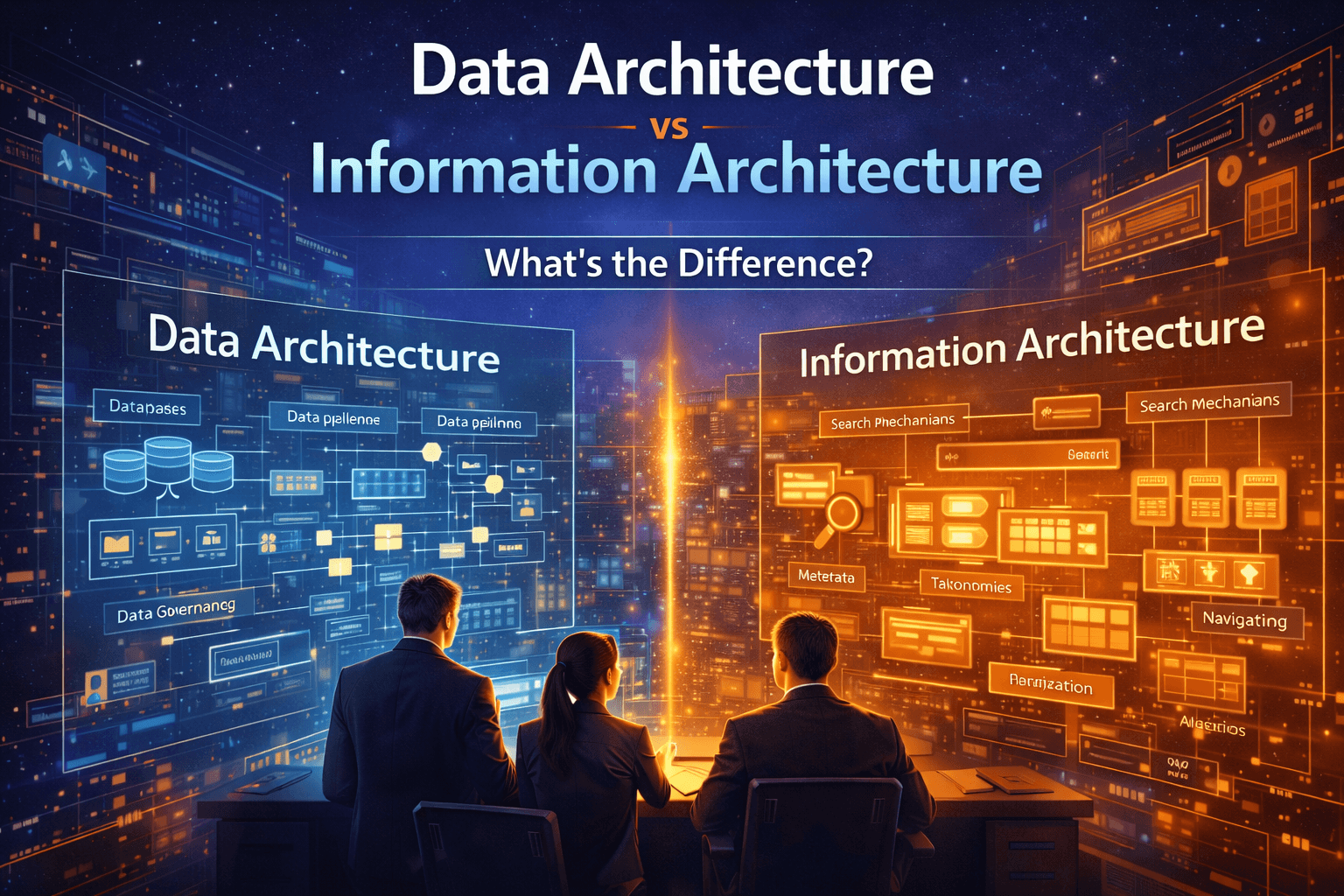
Data Architecture defines how data is structured, stored, integrated, and managed across an organization’s systems.
It focuses on technical data foundations so data remains reliable, accessible, and governed.
- Data models
- Databases and data platforms
- Data pipelines
- Data integration
- Data governance
- Data quality management
What Is Information Architecture?
Information Architecture focuses on how information is organized, structured, and presented for human use.
It is commonly associated with UX, content management, and knowledge organization.
- Content structures
- Information hierarchies
- Taxonomies
- Navigation systems
- Metadata
- Search and discovery mechanisms
Key Differences Between Data Architecture and Information Architecture
In simple terms: Data architecture manages technical data structure, while information architecture manages how information is organized and consumed by users.
- Primary focus: data systems and technical structure vs organization and usability of information
- Perspective: technical/system-oriented vs user-oriented
- Scope: databases, pipelines, platforms vs content, knowledge, information structures
- Goal: govern data across systems vs make information easy to find and use
- Stakeholders: data engineers and IT teams vs UX, content, and knowledge teams
Understand the differences between data architecture and information architecture and why modern organizations need both disciplines.
How Data Architecture and Information Architecture Work Together
These disciplines are closely connected.
Data architecture provides the technical backbone; information architecture ensures users can consume information meaningfully.
Example: data architecture manages customer database structure, information architecture defines how customer information appears in dashboards and portals.
Why Organizations Need Both
In modern digital organizations, both are essential.
- Without data architecture: fragmented data, inconsistent datasets, integration issues, unreliable analytics
- Without information architecture: poor UX, discovery issues, knowledge silos, inefficient decision-making
- Together: transform raw data into usable knowledge
The Growing Importance of Both Disciplines
With the rise of big data, AI, data platforms, knowledge systems, and digital products, organizations must design architectures that support both data processing and information usability.
- Data engineering
- Data governance
- UX design
- Knowledge management
- Coherent architecture strategy
Conclusion
Data Architecture and Information Architecture play complementary roles in modern organizations.
When combined, they turn data into meaningful, accessible, and actionable information for better decision-making.
Understand the differences between data architecture and information architecture and why modern organizations need both disciplines.
FAQ
What is Data Architecture?
Data Architecture defines how data is structured, stored, integrated, and governed across systems.
What is Information Architecture?
Information Architecture focuses on organizing, structuring, and presenting information so users can find and use it effectively.
Why are both needed?
Data architecture ensures technical reliability and integration, while information architecture ensures usability and business understanding.
Strategic links
Compare enterprise architecture platforms
Related articles
IT Cost and Supplier Risk: One Map for Money and DORA
Cost and ICT third-party risk are usually managed in separate spreadsheets. Mapping applications to suppliers and cost in one model lets you see concentration, license exposure and rationalisation candidates at once — and produce the evidence DORA-minded reviews expect.
NIS2 and Enterprise Architecture: Mapping the Systems and Dependencies Risk Management Touches
NIS2 broadens the entities covered and raises the bar on cyber risk management, supply-chain security and incident handling. Each of those expectations rests on one prior question: do you actually know your systems and how they depend on each other? An EA map is the natural place to hold that — honestly, as evidence, not as a compliance badge.
CSSF and Enterprise Architecture: One Map for ICT, Outsourcing and Resilience Documentation
Banks, PFS, investment firms and fund actors supervised by the CSSF carry recurring documentation expectations around ICT, outsourcing and operational resilience. Each rests on a prior question: can you actually show your capabilities, applications, data flows and the third parties behind them? An EA repository is the natural place to hold that — honestly, as evidence, not as a compliance badge.