


Published on March 18, 2026 | Updated on March 18, 2026 | 12 min read
Application Architecture Guide: The Ultimate Guide to Understanding Application Architecture
How to structure enterprise applications into a coherent, scalable, and governable software landscape.
Looking for an enterprise architecture software platform? Use our EA tool evaluation guide and run the EA maturity assessment.
Key takeaways
- Application architecture should reduce coupling and change risk before maximizing technical elegance.
- How to choose architecture patterns using operating model constraints.
- How to manage API and integration dependencies at enterprise scale.
Table of contents
- Introduction
- 1. What is Application Architecture?
- 2. Why Application Architecture is critical
- Business impact
- 3. Application Architecture in Enterprise Architecture
- 4. Core components of Application Architecture
- 5. Common architecture styles
- 6. Using ArchiMate to model Application Architecture
- 7. Principles of good Application Architecture
- 8. Tools for designing Application Architecture
- 9. Best practices
- 10. Common mistakes
- 11. Application Architecture and digital transformation
- Conclusion
Introduction
In today’s digital world, organizations rely heavily on software systems to run operations.
Without a clear architectural vision, application landscapes become complex, expensive, and difficult to maintain.
This guide explains what application architecture is, why it matters, how to design it properly, and how ArchiMate helps represent it in Enterprise Architecture.
1. What is Application Architecture?
Application Architecture describes the structure, organization, and interactions of applications within an organization.
It answers key questions: what applications exist, what they do, how they communicate, what data they manage, and how they support business processes.
It is the blueprint of an organization’s software ecosystem.
2. Why Application Architecture is critical
Without clear architecture, organizations commonly face the following issues.
- Application silos
- Functional duplication
- Fragile integrations
- Exponential complexity
Business impact
A strong application architecture helps organizations:
- Align IT with business strategy
- Reduce complexity
- Promote service reuse
- Improve scalability
- Support digital transformation
3. Application Architecture in Enterprise Architecture
Application architecture is one layer of Enterprise Architecture alongside Business, Data, and Technology architecture.
It acts as a bridge between business needs and technology solutions by translating capabilities into structured software systems.
4. Core components of Application Architecture
A well-designed application architecture includes several key elements.
- Applications (CRM, ERP, e-commerce, mobile, analytics)
- Application services (functional capabilities exposed by applications)
- Interfaces and APIs (APIs, message queues, event streams, data pipelines)
- Data (customers, products, transactions, documents)
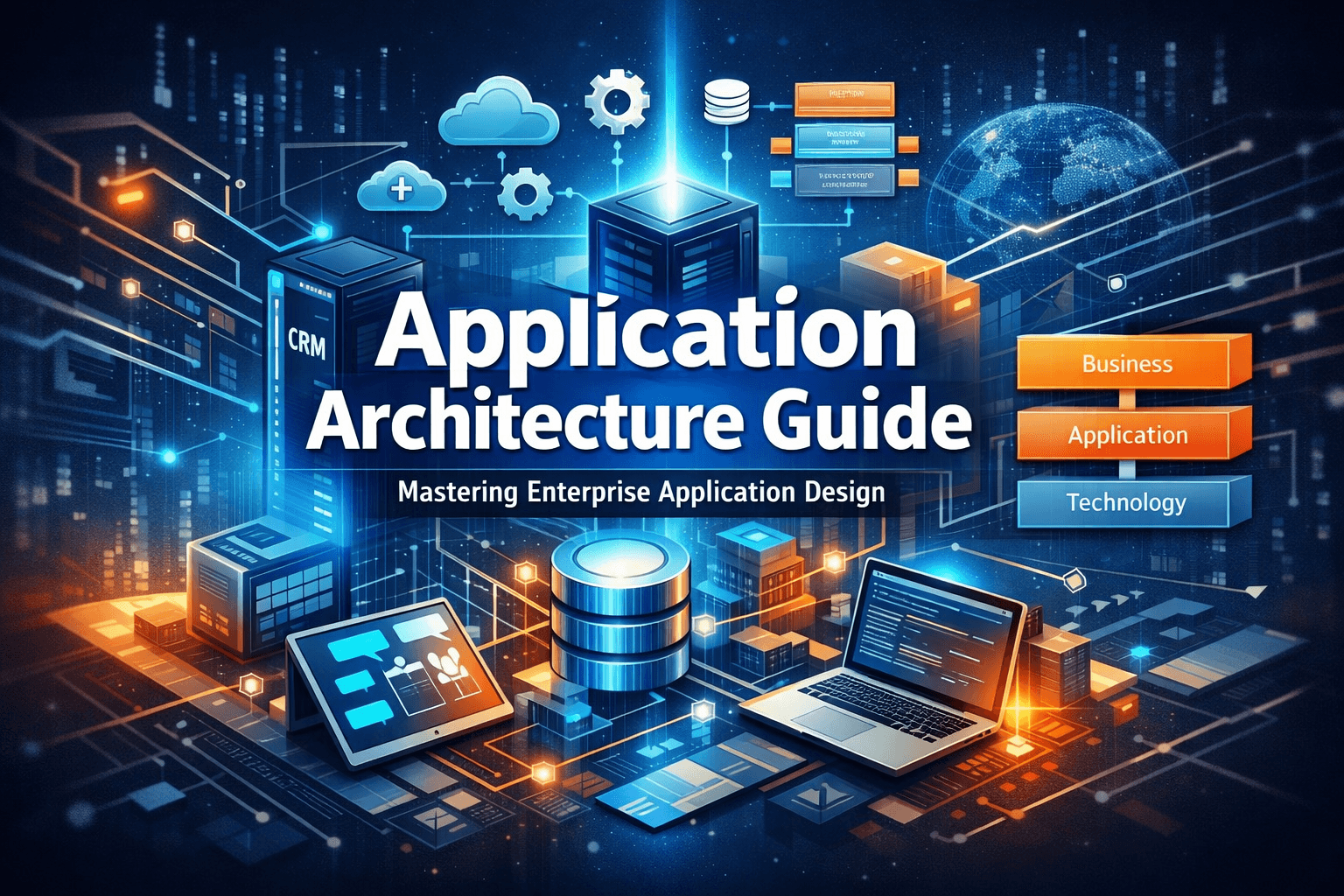
A complete guide to application architecture: principles, components, patterns, ArchiMate modeling, and digital transformation execution.
5. Common architecture styles
Several styles are used to design application landscapes.
- Monolithic architecture
- Service-Oriented Architecture (SOA)
- Microservices architecture
- Event-Driven architecture
6. Using ArchiMate to model Application Architecture
ArchiMate is a standard modeling language for Enterprise Architecture.
It helps visualize business processes, applications, services, data, and technology infrastructure.
At application level, key concepts include Application Component, Application Service, Application Interface, and Data Object.
7. Principles of good Application Architecture
Successful organizations apply a set of core principles.
- Modularity
- Loose coupling
- Reusability
- Interoperability
- Governance
8. Tools for designing Application Architecture
Common tools used to model and manage application landscapes include:
- Sparx Enterprise Architect
- Archi
- BiZZdesign Enterprise Studio
- LeanIX
9. Best practices
A pragmatic approach to build target architecture follows these steps.
- Map the current landscape
- Identify business capabilities
- Map applications to capabilities
- Identify redundancies
- Define a simplified, modular, and scalable target architecture
10. Common mistakes
Frequent anti-patterns include:
- Too many applications
- Implicit architecture
- Poor documentation
- Lack of governance
11. Application Architecture and digital transformation
In cloud, digital platform, data, and AI transformations, application architecture is central to IT strategy.
It enables modernization, cloud migration, ecosystem building, and faster innovation.
Without a strong architectural foundation, digital transformation initiatives often fail.
Conclusion
Application Architecture is a strategic foundation, not just a technical topic.
A well-designed architecture aligns IT and business, reduces complexity, accelerates innovation, controls costs, and prepares future growth.
With standards like ArchiMate, organizations can visualize, manage, and evolve their application landscapes with clarity.
A complete guide to application architecture: principles, components, patterns, ArchiMate modeling, and digital transformation execution.
FAQ
What is application architecture?
Application Architecture describes the structure, organization, and interactions of applications across an enterprise.
Why is application architecture critical?
Without it, organizations face silos, duplicated functionality, fragile integrations, and rising complexity.
How does ArchiMate help?
ArchiMate provides a standard visual language to model applications, services, interfaces, and data objects clearly.
Strategic links
Compare enterprise architecture platforms
Related articles
IT Cost and Supplier Risk: One Map for Money and DORA
Cost and ICT third-party risk are usually managed in separate spreadsheets. Mapping applications to suppliers and cost in one model lets you see concentration, license exposure and rationalisation candidates at once — and produce the evidence DORA-minded reviews expect.
NIS2 and Enterprise Architecture: Mapping the Systems and Dependencies Risk Management Touches
NIS2 broadens the entities covered and raises the bar on cyber risk management, supply-chain security and incident handling. Each of those expectations rests on one prior question: do you actually know your systems and how they depend on each other? An EA map is the natural place to hold that — honestly, as evidence, not as a compliance badge.
CSSF and Enterprise Architecture: One Map for ICT, Outsourcing and Resilience Documentation
Banks, PFS, investment firms and fund actors supervised by the CSSF carry recurring documentation expectations around ICT, outsourcing and operational resilience. Each rests on a prior question: can you actually show your capabilities, applications, data flows and the third parties behind them? An EA repository is the natural place to hold that — honestly, as evidence, not as a compliance badge.