

Published on March 18, 2026 | Updated on March 18, 2026 | 10 min read
Enterprise Architecture for Insurance: Frameworks, ACORD, and Modern Insurance Platforms
ACORD provides insurance-specific reference models that complement TOGAF and ArchiMate.
Looking for an enterprise architecture software platform? Use our EA tool evaluation guide and run the EA maturity assessment.
Key takeaways
- Insurance architecture succeeds when product agility improves without weakening risk and compliance controls.
- How to translate strategy into architecture priorities and delivery increments.
- How to align business, data, application, and technology decisions.
Table of contents
- Introduction
- Why Enterprise Architecture Is Critical for Insurance
- The ACORD Framework
- Key Components of the ACORD Architecture
- Information, Data, and Process Models
- Data Model and Process Models
- Process Models Details
- ACORD and Digital Insurance Platforms
- Digital Platform Compatibility
- ACORD and Enterprise Architecture Frameworks
- Methodology and Domain
- Additional Reference Architectures in Insurance
- Benefits of Enterprise Architecture in Insurance
- Enterprise Architecture and the Future of Insurance
- Future of Insurance Foundation
- Conclusion
Introduction
Insurance companies operate highly complex IT ecosystems that must support policy management, underwriting, claims processing, regulatory compliance, and digital customer services.
Like banks, insurers rely heavily on Enterprise Architecture (EA) to manage this complexity and modernize legacy systems.
In the insurance industry, the most widely recognized reference architecture framework is ACORD, which provides a standardized model for structuring insurance systems and processes.
This article explains how enterprise architecture works in the insurance sector and the key frameworks used by insurers.
Why Enterprise Architecture Is Critical for Insurance
Insurance organizations must manage multiple challenges simultaneously: legacy policy administration systems, regulatory and compliance requirements, large volumes of customer and risk data, complex product structures, and digital customer experience platforms.
Without enterprise architecture, insurers often face fragmented systems, duplicated business capabilities, complex integrations, and slow product innovation.
Enterprise architecture helps insurers align business strategy, data, applications, and technology to support long-term transformation.
Reference architectures provide standardized blueprints that reduce complexity and improve interoperability across the organization.
The ACORD Framework
The ACORD Reference Architecture is the most widely used architecture framework specifically designed for the insurance industry.
ACORD is a global standards organization that develops data, process, and architecture standards for insurers.
The ACORD Reference Architecture provides a complete enterprise architecture framework for insurance organizations, helping them structure their business processes, data models, and technology systems.
The framework is composed of several interconnected industry models that define how insurance operations and systems should be organized.
Its goal is to standardize operations, improve system interoperability, accelerate digital transformation, and reduce integration complexity.
Key Components of the ACORD Architecture
The ACORD framework includes several major architectural models that together form a complete enterprise architecture for insurance.
Business Capability Model
The Capability Model defines the key capabilities required by insurance organizations.
Examples include:
- underwriting
- policy administration
- claims management
- customer management
- risk and compliance
Information, Data, and Process Models
This capability model helps insurers map their business operations to technology systems.
Information Model
The Information Model provides a standardized representation of insurance data concepts.
It defines the relationships between entities such as:
- policies
- customers
- claims
- products
- risks
Data Model and Process Models
This model ensures that data is consistent across systems and applications.
Data Model
The Data Model provides a technical structure for storing and exchanging insurance data.
It supports:
- standardized data exchange
- interoperability between systems
- consistent reporting and analytics
Process Models Details
Process Models
ACORD also defines industry-standard process models that describe how insurance operations should function.
Typical insurance processes include:
- policy lifecycle management
- underwriting workflows
- claims processing
- regulatory reporting
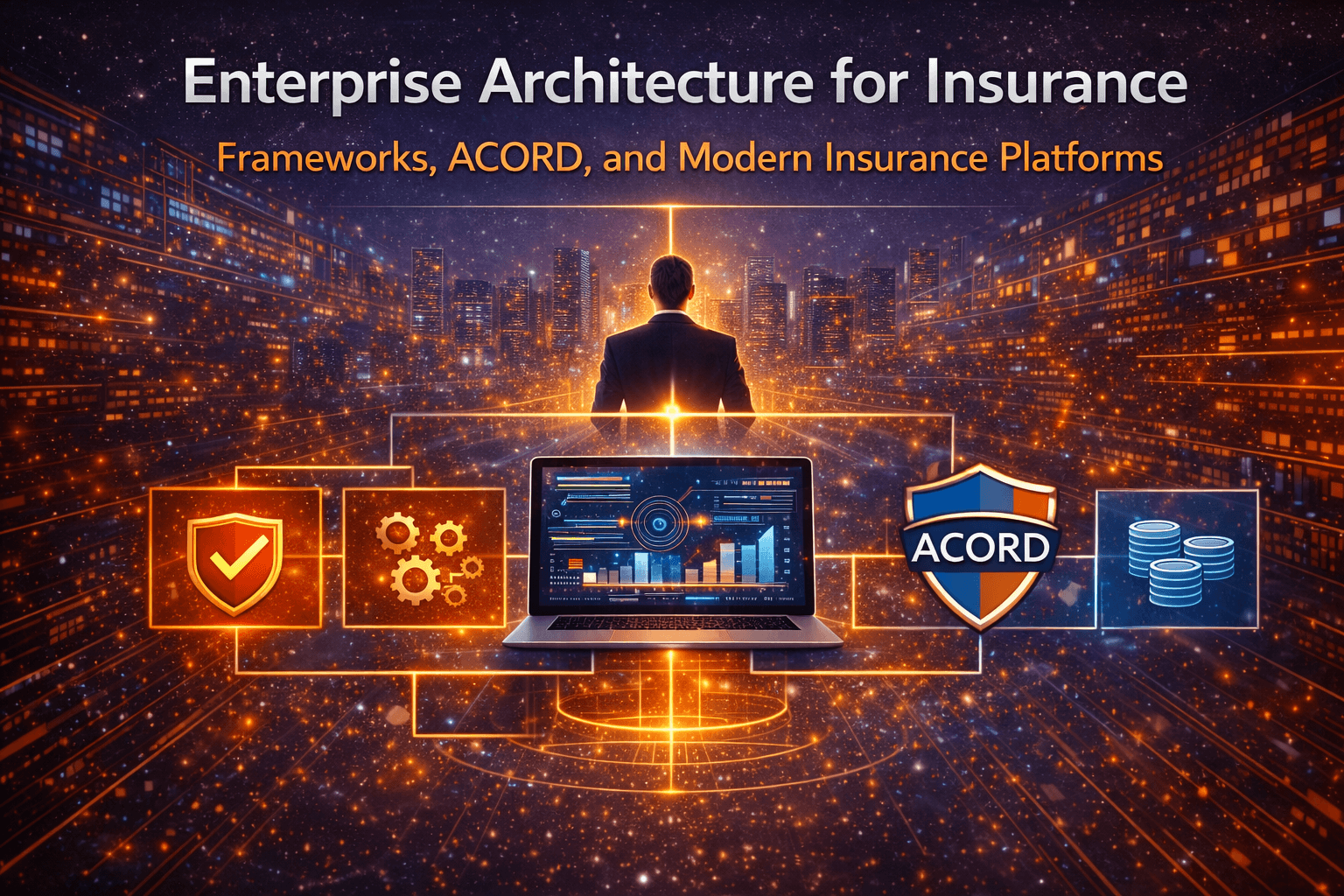
How enterprise architecture and ACORD help insurers modernize legacy systems and accelerate digital transformation.
ACORD and Digital Insurance Platforms
Modern insurers increasingly adopt API-based and microservices architectures.
The ACORD framework supports this transformation by providing standardized models for:
- services
- data structures
- message formats
- interoperability between systems
Digital Platform Compatibility
These standards allow insurers to modernize legacy systems while maintaining compatibility across their ecosystem.
ACORD and Enterprise Architecture Frameworks
The ACORD framework does not replace general enterprise architecture frameworks.
Instead, it is typically combined with frameworks such as:
- TOGAF – enterprise architecture methodology
- ArchiMate – architecture modeling language
- cloud-native architectures
- API architectures
Methodology and Domain
TOGAF defines how to develop enterprise architecture, while ACORD provides industry-specific reference models for insurance systems.
Together, they provide both methodology and domain expertise.
Additional Reference Architectures in Insurance
While ACORD is the dominant framework, insurers also use other reference architectures.
Examples include:
Industry Business Reference Architectures
Some organizations use insurance business capability maps and reference architectures to structure their transformation programs and align IT with business strategy.
Enterprise Architecture Frameworks
Insurers often rely on cross-industry EA frameworks such as:
- TOGAF
- Zachman Framework
- ArchiMate modeling standards
Benefits of Enterprise Architecture in Insurance
These frameworks provide the methodology and governance structure for enterprise architecture.
When implemented correctly, enterprise architecture provides major benefits for insurers.
Simplified IT landscapes
Reference architectures reduce system duplication and fragmentation.
Faster product innovation
Standardized architecture enables quicker launch of new insurance products.
Improved regulatory compliance
Architecture frameworks help manage complex regulatory requirements.
Better interoperability
Standard data and process models enable easier integration across systems.
Accelerated digital transformation
Modern architectures support APIs, digital platforms, and ecosystem partnerships.
Enterprise Architecture and the Future of Insurance
The insurance industry is undergoing major transformation driven by:
- Digital insurance platforms
- Insurtech startups
- Artificial intelligence
- Advanced data analytics
- Embedded insurance ecosystems
Future of Insurance Foundation
Enterprise architecture provides the foundation needed to support these innovations while maintaining operational stability.
Conclusion
Enterprise architecture is a critical capability for modern insurance organizations.
Frameworks such as ACORD provide industry-specific models that help insurers standardize operations, reduce system complexity, and accelerate digital transformation.
By combining general frameworks like TOGAF with insurance-specific frameworks like ACORD, insurers can design architectures that are flexible, scalable, and future-ready.
How enterprise architecture and ACORD help insurers modernize legacy systems and accelerate digital transformation.
FAQ
What is the main insurance-specific architecture framework?
The ACORD Reference Architecture is the most widely used insurance-specific enterprise architecture framework.
Does ACORD replace TOGAF?
No. ACORD complements TOGAF: TOGAF defines how to develop enterprise architecture, while ACORD provides insurance-specific reference models.
Why is enterprise architecture critical in insurance?
It helps insurers reduce fragmentation, standardize operations, improve interoperability, and accelerate digital transformation across legacy and modern platforms.
Strategic links
Compare enterprise architecture platforms
Related articles
IT Cost and Supplier Risk: One Map for Money and DORA
Cost and ICT third-party risk are usually managed in separate spreadsheets. Mapping applications to suppliers and cost in one model lets you see concentration, license exposure and rationalisation candidates at once — and produce the evidence DORA-minded reviews expect.
NIS2 and Enterprise Architecture: Mapping the Systems and Dependencies Risk Management Touches
NIS2 broadens the entities covered and raises the bar on cyber risk management, supply-chain security and incident handling. Each of those expectations rests on one prior question: do you actually know your systems and how they depend on each other? An EA map is the natural place to hold that — honestly, as evidence, not as a compliance badge.
CSSF and Enterprise Architecture: One Map for ICT, Outsourcing and Resilience Documentation
Banks, PFS, investment firms and fund actors supervised by the CSSF carry recurring documentation expectations around ICT, outsourcing and operational resilience. Each rests on a prior question: can you actually show your capabilities, applications, data flows and the third parties behind them? An EA repository is the natural place to hold that — honestly, as evidence, not as a compliance badge.