


Published on March 14, 2026 | Updated on March 14, 2026 | 12 min read
Architecture Governance Model That Actually Works
How to scale technology decisions while preserving architecture integrity and delivery speed.
Looking for an enterprise architecture software platform? Use our EA tool evaluation guide and run the EA maturity assessment.
Key takeaways
- Governance creates leverage when it shortens decision cycles while improving risk-quality trade-offs.
- How to design governance that accelerates delivery instead of blocking it.
- How to define decision rights and exception workflows that teams can use.
Why most architecture governance fails
In many transformations, governance is introduced to align decisions but ends up producing delay and bureaucracy.
The most common failure modes are late reviews, unclear ownership, heavyweight process, and weak outcome measurement.
- Reviews happen after critical implementation choices are already made
- Teams bypass governance because processes are too heavy
- Decision rights are ambiguous across architects and business owners
- Approvals are tracked, but decision quality and value are not
The governance model that actually works
A practical model combines three pillars: clear roles, lightweight checkpoints, and measurable decision quality.
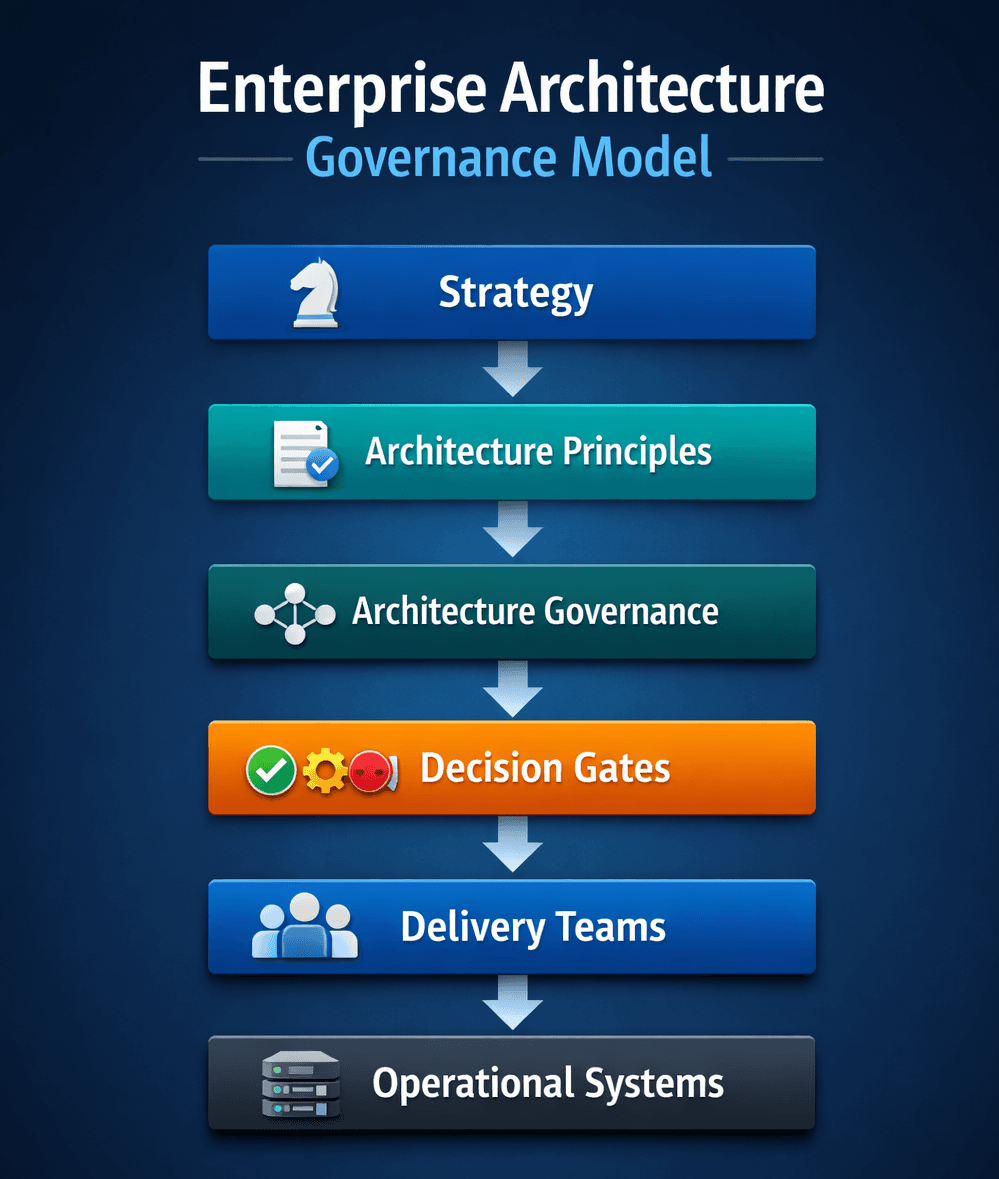
The governance flow should stay simple and visible: strategy, architecture principles, governance, decision gates, delivery teams, operational systems.
Pillar 1: clear roles and decision ownership
Explicit role boundaries prevent overlap and improve accountability, especially in federated organizations.
Keep the ARB focused on high-impact cross-domain decisions and delegate routine choices to domains and teams.
- Chief Enterprise Architect: principles, standards, and strategic alignment
- Architecture Review Board: major cross-domain decisions and optimization recommendations
- Domain Architects: domain-level architecture governance
- Solution Architects: implementation design accountability
- SMEs: specialized risk input without veto rights
- EA Program Manager: workflow, metrics, and reporting
- Business owners: priorities and justified exception approval
Pillar 2: lightweight architecture checkpoints
Governance must be embedded in delivery lifecycle stages, not added as a late-stage control function.
A four-gate model is usually enough to catch risk early while maintaining delivery speed.
- Gate 0 (Intent): strategic fit and constraints before design
- Gate 1 (Design Review): integration, data, security, scalability, platform alignment
- Gate 2 (Compliance Check): implementation deviations, emerging risk, operational readiness
- Gate 3 (Post-Implementation): value delivered, decision quality, debt impact
- Use time-bound waivers with business justification to avoid governance debt
A practical governance model with roles, checkpoints, and measurable decision quality.
Pillar 3: measure decision quality
Move from activity metrics to outcome metrics and review them quarterly.
This makes governance a measurable strategic asset rather than a compliance ritual.
- Architecture compliance rate (target 80-90%)
- Decision lead time (target under 5 business days)
- Technology duplication index
- Technical debt ratio (target under 25%)
- Rework rate after architecture decisions
- Value realization and risk reduction indicators
- Adoption rate of EA artifacts
Governance principles that increase speed
Governance should protect decision quality while keeping delivery momentum.
- Govern decisions, not documentation volume
- Intervene early when changes are cheaper
- Delegate aggressively and centralize only high-impact topics
- Use reference architectures to reduce review friction
- Capture decisions in ADRs for transparency and reuse
Implementation roadmap
Start with a pragmatic pilot, then scale after proving value on a limited scope.
- Assess current governance process and gaps
- Define roles and decision rights clearly
- Introduce the four checkpoints into delivery workflows
- Implement KPI tracking and quarterly reviews
- Run communication and training for adoption
- Reassess the model annually, especially with AI-related change
Conclusion
Architecture governance should be a framework for better decisions at scale, not a delivery barrier.
With clear roles, lightweight gates, and measurable quality, organizations can scale technology decisions without losing architectural integrity.
A practical governance model with roles, checkpoints, and measurable decision quality.
FAQ
What is enterprise architecture governance?
It is the decision model that ensures technology choices support business strategy, control risk, and preserve architecture integrity.
Why do governance models often fail in practice?
Most fail because reviews happen too late, ownership is unclear, bureaucracy is too heavy, and outcomes are not measured.
How do we avoid governance bureaucracy?
Use lightweight decision gates integrated into delivery, delegate routine decisions, and focus governance on high-impact choices.
Which KPIs prove governance value?
Track architecture compliance rate, decision lead time, duplication index, technical debt ratio, rework rate, and value realization.
Can governance be both fast and controlled?
Yes. A risk-based model with clear roles and transparent Architecture Decision Records can accelerate delivery while keeping control.
Strategic links
Compare enterprise architecture platforms
Related articles
IT Cost and Supplier Risk: One Map for Money and DORA
Cost and ICT third-party risk are usually managed in separate spreadsheets. Mapping applications to suppliers and cost in one model lets you see concentration, license exposure and rationalisation candidates at once — and produce the evidence DORA-minded reviews expect.
NIS2 and Enterprise Architecture: Mapping the Systems and Dependencies Risk Management Touches
NIS2 broadens the entities covered and raises the bar on cyber risk management, supply-chain security and incident handling. Each of those expectations rests on one prior question: do you actually know your systems and how they depend on each other? An EA map is the natural place to hold that — honestly, as evidence, not as a compliance badge.
CSSF and Enterprise Architecture: One Map for ICT, Outsourcing and Resilience Documentation
Banks, PFS, investment firms and fund actors supervised by the CSSF carry recurring documentation expectations around ICT, outsourcing and operational resilience. Each rests on a prior question: can you actually show your capabilities, applications, data flows and the third parties behind them? An EA repository is the natural place to hold that — honestly, as evidence, not as a compliance badge.