

Published on March 18, 2026 | Updated on March 18, 2026 | 12 min read
What is Data Architecture?
How to transform raw data into trusted insights, decisions, and business value.
Key takeaways
- Strong data architecture starts with ownership and semantic consistency before platform optimization.
- How to compare platforms on decision outcomes, not feature volume.
- How to reduce adoption risk with a short but rigorous pilot.
Table of contents
- 1. Introduction: Why Data Architecture matters
- 2. Data Architecture in Enterprise Architecture
- 3. What Data Architecture is
- 4. Core components of Data Architecture
- 5. The role of the Data Platform
- 6. Data Architecture in TOGAF Phase C
- 7. Conceptual, Logical, and Physical levels
- 8. Modern data architecture patterns
- 9. The role of the Data Architect
- 10. Ultimate objective
1. Introduction: Why Data Architecture matters
In modern enterprises, data is one of the most strategic assets. Decisions, AI, digital products, and process optimization all depend on data.
Without structure, organizations quickly face data silos, inconsistent reporting, poor quality, limited accessibility, and compliance risks.
Data Architecture is the blueprint that defines how data is collected, stored, integrated, governed, and used across the organization.
- Roads -> Data pipelines
- Buildings -> Data storage systems
- Rules & zoning -> Data governance
- Citizens -> Applications and users
- City planning -> Enterprise Architecture
2. Data Architecture in Enterprise Architecture
Enterprise Architecture aligns business strategy with IT systems. In TOGAF, enterprise architecture is structured in four domains: Business, Data, Application, and Technology.
Business defines what the company wants to do, Data defines what information is required, Applications define how processes are implemented, and Technology provides the infrastructure.
Data Architecture sits at the center as the enterprise information backbone.
3. What Data Architecture is
Data Architecture is the design and governance of the organization's data ecosystem.
It defines where data comes from, how it flows, where it is stored, how it is accessed, and how it is governed.
- Data is consistent
- Data is trusted
- Data is accessible
- Data is secure
- Data supports business decisions
4. Core components of Data Architecture
A professional enterprise data architecture includes the following layers.
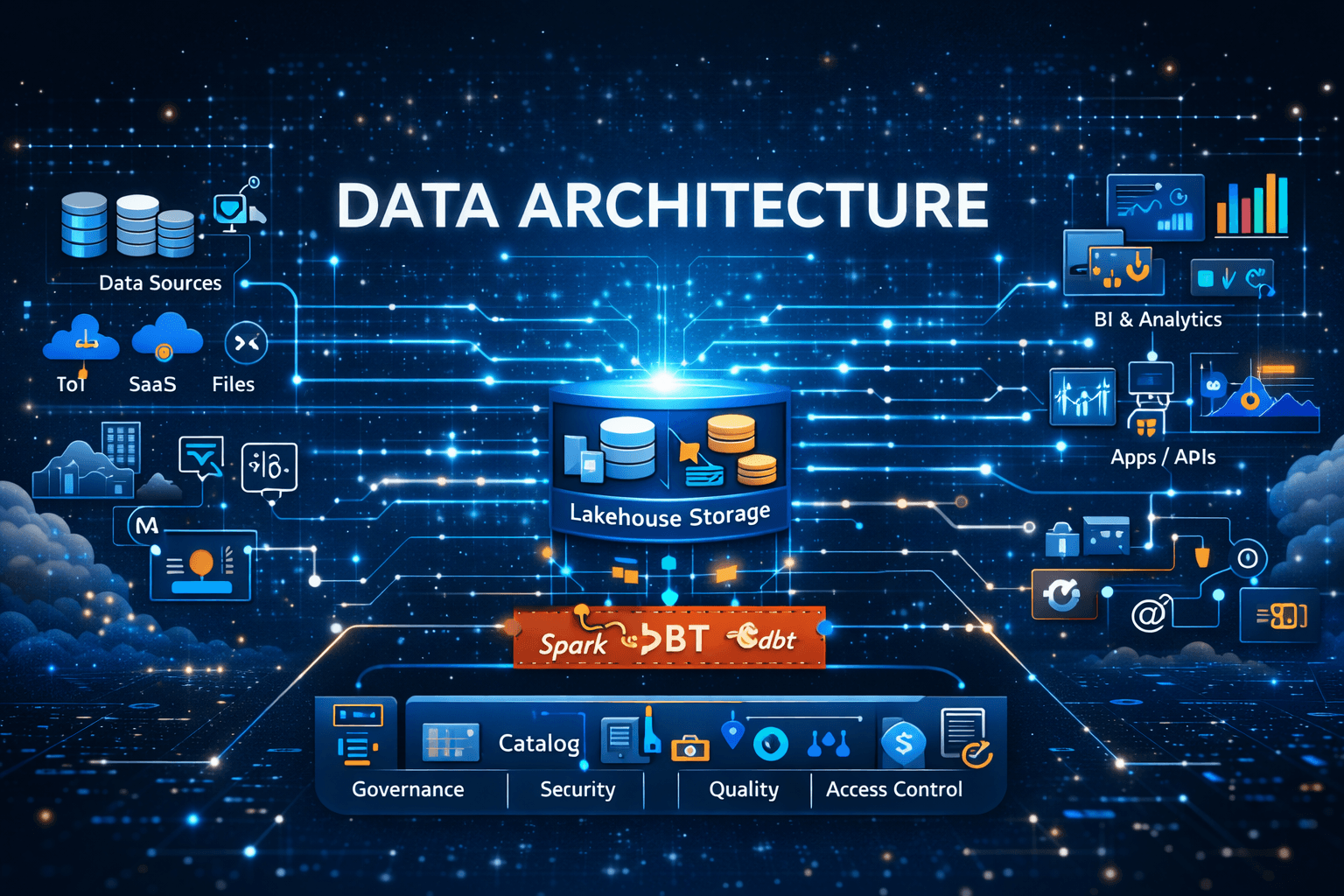
- Data sources (ERP, CRM, APIs, IoT, files, logs, external data)
- Data ingestion (batch ETL and streaming pipelines)
- Data storage (warehouse, lake, lakehouse, operational databases)
- Data processing (ETL, ELT, cleaning, enrichment, aggregation)
- Data governance (quality, security, compliance, traceability, access control)
- Data consumption (BI, AI/ML, data science, applications, APIs)
A complete enterprise architect guide to Data Architecture, from fundamentals to modern patterns and TOGAF Phase C.
5. The role of the Data Platform
Data Architecture is the blueprint. Data Platform is the building.
The platform operationalizes ingestion, storage, processing, governance, and consumption capabilities.
6. Data Architecture in TOGAF Phase C
In TOGAF ADM, Data Architecture is defined in Phase C, within Information Systems Architecture, alongside Application Architecture.
This phase defines data entities, relationships, data flows, lifecycle, and the data architecture roadmap.
- Data principles
- Conceptual data model
- Logical data model
- Data architecture roadmap
7. Conceptual, Logical, and Physical levels
Conceptual model: business view of key entities (Customer, Order, Product, Invoice).
Logical model: detailed relationships and attributes.
Physical model: implementation choices and technologies (Snowflake, S3, Delta Lake, PostgreSQL).
8. Modern data architecture patterns
Modern enterprises use several architectural patterns depending on scale, governance model, and analytics needs.
- Data Warehouse: traditional analytics architecture
- Data Lake: large-scale raw data storage
- Lakehouse: hybrid model combining lake and warehouse strengths
- Data Mesh: decentralized domain ownership, data as product, self-service, federated governance
9. The role of the Data Architect
The Data Architect designs and governs the data ecosystem, bridging business strategy and technical implementation.
- Define data standards
- Design data models
- Guarantee data quality
- Align business and technical needs
- Define the data roadmap
10. Ultimate objective
The ultimate objective is to turn data into business value.
A mature data architecture enables trusted analytics, AI, faster decisions, compliance, and operational efficiency.
Without Data Architecture, data becomes noise. With Data Architecture, data becomes intelligence.
A complete enterprise architect guide to Data Architecture, from fundamentals to modern patterns and TOGAF Phase C.
FAQ
What is Data Architecture in simple terms?
Data Architecture is the blueprint that defines how data is collected, stored, integrated, governed, and used across the enterprise.
How is Data Architecture different from a Data Platform?
Data Architecture is the design and governance model. The Data Platform is the technical implementation of that model.
Where does Data Architecture fit in TOGAF?
In TOGAF ADM, Data Architecture is addressed in Phase C within Information Systems Architecture, alongside Application Architecture.
Strategic links
Compare enterprise architecture platforms
Related articles
From Strategy to Execution: How Enterprise Architecture Drives Business Agility
How EA turns strategic intent into coordinated, measurable execution across the enterprise.
Capability mapping step by step
A practical step-by-step guide to move from capability maps to actionable transformation decisions.
Alternatives to HOPEX: How to Choose an Enterprise Architecture Platform (Without Regretting It Later)
The right alternative depends less on feature parity and more on the architecture operating model you want to run.