

Published on March 17, 2026 | Updated on March 17, 2026 | 9 min read
Business Architecture vs Enterprise Architecture: What’s the Difference?
Business architecture defines what the business must do, enterprise architecture defines how the enterprise supports it.
Key takeaways
- The two disciplines should be synchronized: business architecture frames value, EA orchestrates execution.
- How to translate strategy into architecture priorities and delivery increments.
- How to align business, data, application, and technology decisions.
What is Enterprise Architecture?
Enterprise Architecture (EA) provides a holistic view of the organization across business, applications, data, and technology.
Its primary goal is to align IT systems and technology investments with business strategy.
- Business architecture - capabilities, value streams, operating models
- Application architecture - systems and software landscape
- Data architecture - information models and data governance
- Technology architecture - infrastructure, cloud, and platforms
What is Business Architecture?
Business Architecture focuses on how the business operates.
It structures the organization through business capabilities, value streams, operating models, business processes, and organizational structures.
Its purpose is to connect business strategy to execution.
Key differences between Business Architecture and Enterprise Architecture
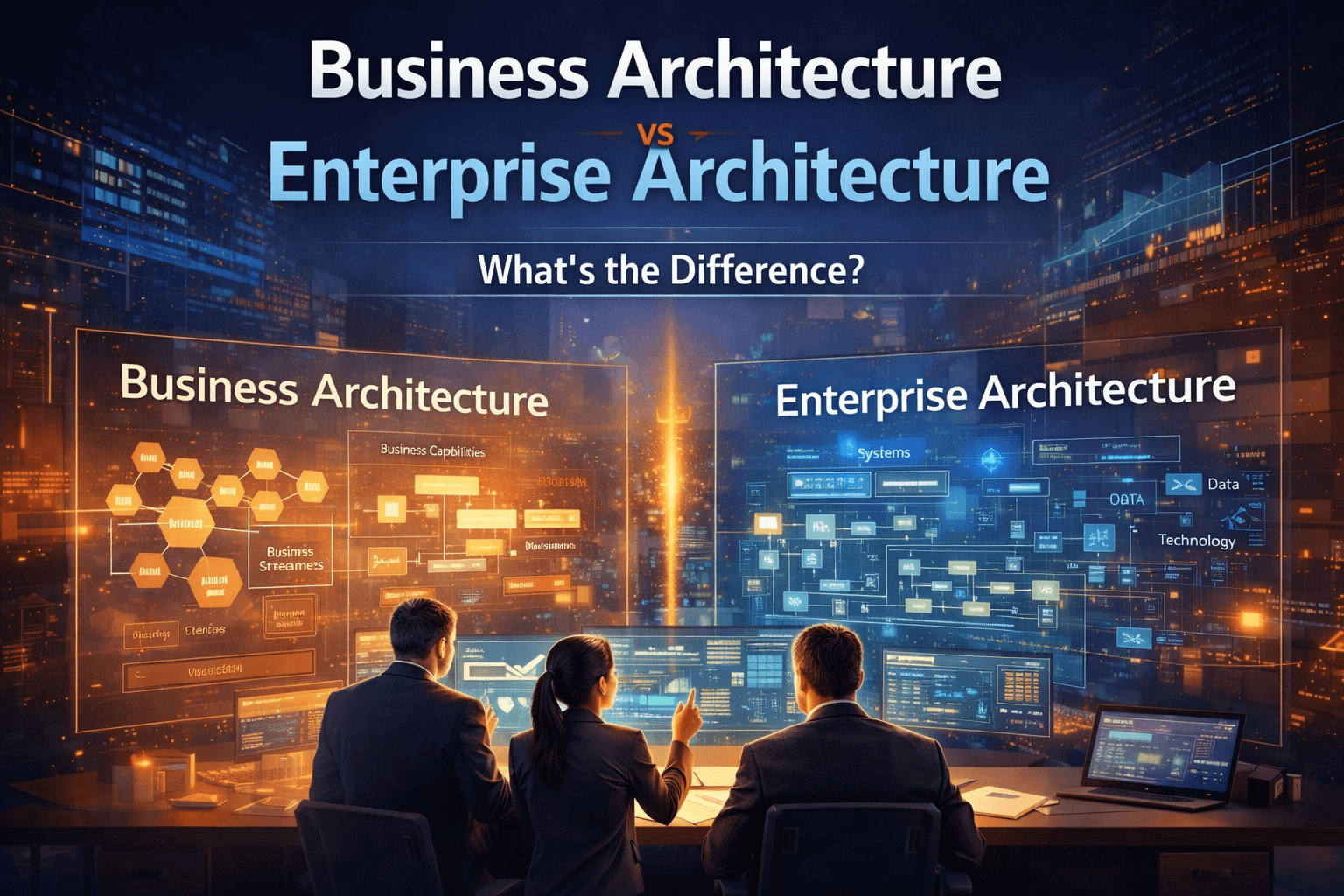
In short, Business Architecture defines what the business needs to do, while Enterprise Architecture defines how the enterprise supports it.
- Primary focus: Business strategy and operating model vs enterprise-wide architecture including technology
- Scope: Business capabilities and organization vs business, applications, data, and technology
- Goal: Translate strategy into business structure vs align IT and technology with business strategy
- Stakeholders: Executives and operations vs CIOs, IT leaders, architects
- Perspective: Business-first vs enterprise-wide
Understand the core differences between business architecture and enterprise architecture and how both disciplines work together.
How Business Architecture fits inside Enterprise Architecture
In many frameworks, Business Architecture is a subset and foundation of Enterprise Architecture.
A common chain is: Strategy -> Business capabilities -> Applications -> Technology.
Without Business Architecture, Enterprise Architecture risks becoming technology-driven rather than strategy-driven.
Why organizations need both
Modern organizations face increasing complexity from digital transformation, cloud migration, AI adoption, platform ecosystems, and M&A.
- Business Architecture to clarify strategy and operating models
- Enterprise Architecture to design supporting systems and technology
- Align strategy and technology
- Prioritize investments
- Reduce IT complexity
- Improve transformation outcomes
A simple way to think about it
A useful analogy is city planning.
- Business architecture defines what the city needs: hospitals, schools, transport, residential areas
- Enterprise architecture defines how the city is built: roads, infrastructure, networks, zoning
Conclusion
Business Architecture and Enterprise Architecture are closely related but serve different purposes.
Used together, they bridge strategy and execution and ensure transformation initiatives deliver real business value.
Understand the core differences between business architecture and enterprise architecture and how both disciplines work together.
FAQ
What is Enterprise Architecture?
Enterprise Architecture is a holistic discipline that aligns business, applications, data, and technology with strategic goals.
What is Business Architecture?
Business Architecture focuses on business capabilities, value streams, operating models, and strategic execution.
Do organizations need both?
Yes. Business Architecture clarifies strategic intent and operating priorities, while Enterprise Architecture aligns systems and technology to deliver them.
Strategic links
Compare enterprise architecture platforms
Related articles
From Strategy to Execution: How Enterprise Architecture Drives Business Agility
How EA turns strategic intent into coordinated, measurable execution across the enterprise.
Capability mapping step by step
A practical step-by-step guide to move from capability maps to actionable transformation decisions.
Alternatives to HOPEX: How to Choose an Enterprise Architecture Platform (Without Regretting It Later)
The right alternative depends less on feature parity and more on the architecture operating model you want to run.