

Published on March 30, 2026 | Updated on March 14, 2026 | 14 min read
From Strategy to Execution: How Enterprise Architecture Drives Business Agility
How EA turns strategic intent into coordinated, measurable execution across the enterprise.
Key takeaways
- Why the strategy-execution gap persists across complex organizations.
- How enterprise architecture connects strategy, investments, projects, and operating assets.
- Practical levers to improve business agility and execution quality.
Table of contents
- Context and challenge
- The perils of the strategy-execution gap
- Enterprise architecture as a strategic enabler
- Core domains: building blocks of alignment
- Portfolio management: from insight to action
- Project portfolio and operational assets
- Navigating the future: EA in an AI-driven world
- Implementing EA: a roadmap for success
- Conclusion
Context and challenge
In today’s digital economy, organizations face a persistent challenge: turning strategy into execution. Leaders craft visionary strategies—pivoting to AI-driven innovation, customer-centric models, or sustainable operations—only to watch them falter in implementation. Fragmented initiatives, siloed decisions, and escalating complexity erode value, with studies revealing that 70 percent of transformations fail. Yet, amidst this turbulence, Enterprise Architecture (EA) emerges as the strategic linchpin, transforming abstract ambitions into orchestrated execution.
EA isn't merely an IT framework; it's a holistic discipline that aligns business strategy with technology, investments, and operations. By providing a dynamic blueprint, EA enables organizations to navigate volatility, optimize resources, and accelerate outcomes. In fact, enterprises in the top quartile of product and operating model maturity have 60 percent greater total returns to shareholders than bottom-half companies and 16 percent higher operating margins. This article delves into how EA bridges strategy to execution, drawing on proven frameworks and real-world insights to equip leaders with actionable guidance.
The perils of the strategy-execution gap
The disconnect between strategy and execution manifests in myriad ways, often with quantifiable costs.
Without intervention, these issues compound: McKinsey research indicates that the average success rate for transformations remains persistently low at around 30%. EA counters this by imposing structure, fostering collaboration, and ensuring every decision ladders up to strategic imperatives.
- Misaligned Projects: Initiatives launched reactively, without tying back to core objectives, leading to wasted efforts.
- Investment Inefficiencies: Budgets funneled into legacy tech, with 70% of IT budgets going toward maintenance rather than innovation.
- Siloed Operations: Departments operating in isolation, resulting in duplicated capabilities and data inconsistencies.
- Agility Deficits: Inability to respond to market shifts, such as AI adoption or regulatory changes.
Enterprise architecture as a strategic enabler
At its essence, EA serves as the organization's "nervous system"—a living blueprint that translates vision into viable structures. It encompasses the interplay of people, processes, data, and technology, evolving from static diagrams to dynamic, AI-augmented models.
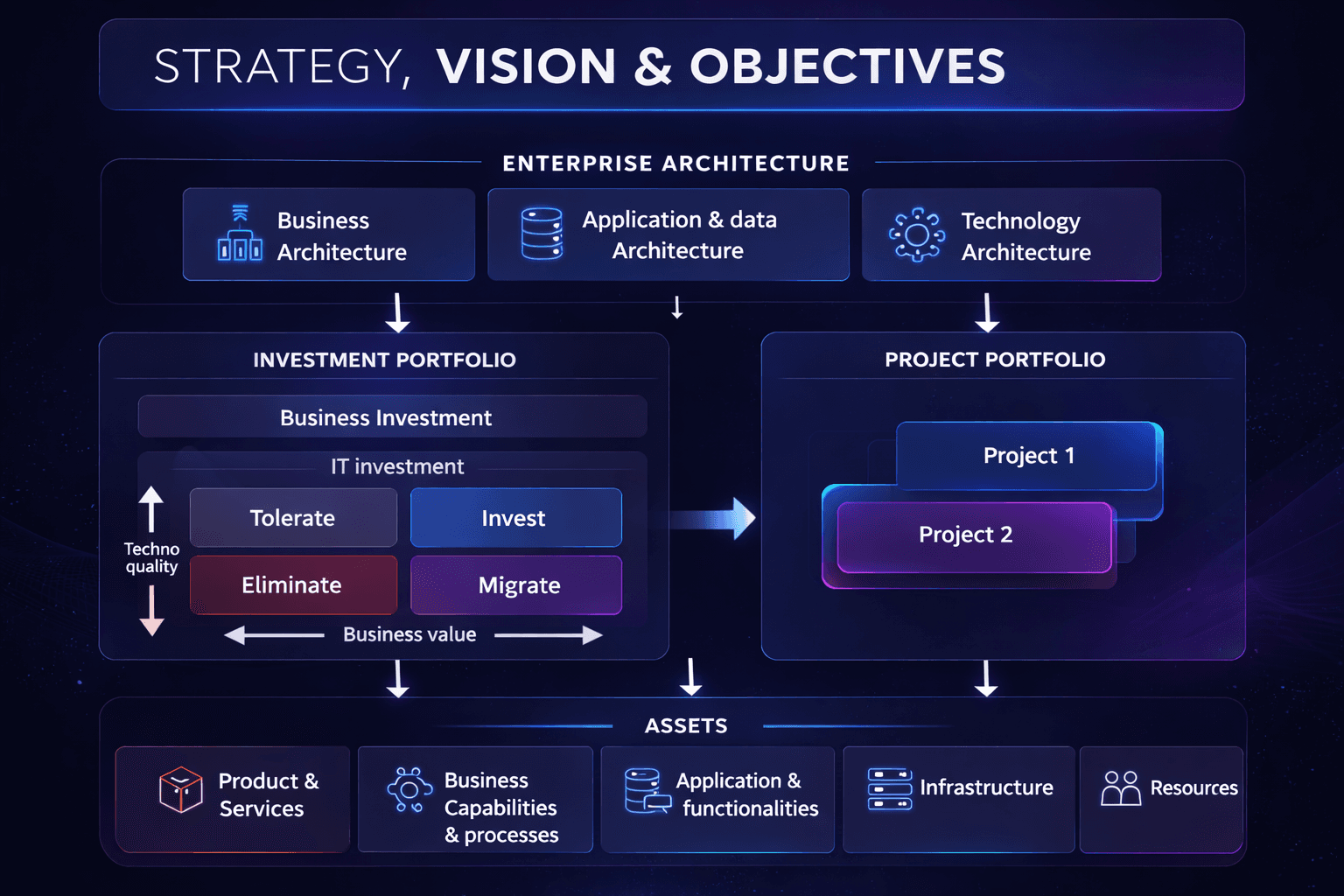
The framework connects strategy, investments, projects, and operational assets across the enterprise.
EA's framework flows top-down:
- Enhanced Alignment: EA ensures business and IT strategies converge.
- Cost Optimization: Mature practices can reduce costs by addressing technical debt.
- Innovation Acceleration: Data-driven organizations can better capture generative AI value.
- Risk Mitigation: By visualizing relationships and gaps, EA supports robust governance.
- Strategy, Vision & Objectives
- Enterprise Architecture (Business, Application & Data, Technology)
- Investment Portfolio
- Project Portfolio
- Assets (Products & Services, Business Capabilities & Processes, Applications & Functionalities, Infrastructure, Resources)
Core domains: building blocks of alignment
Business Architecture: maps how the organization delivers value through capabilities, processes, products, and structures.
Application and Data Architecture: rationalizes applications, data models, and integrations to eliminate silos.
Technology Architecture: encompasses infrastructure, cloud, networks, and standards to future-proof the stack.
Enterprise architecture aligns strategy, investments, projects, and operations to improve execution quality.
Portfolio management: from insight to action
EA translates architecture into decisions via portfolios.
Using a matrix evaluating business value against technical quality, leaders can categorize assets for clear action.
- Invest: High-value, high-quality—scale for growth.
- Migrate: High-value, low-quality—modernize to cloud or AI platforms.
- Tolerate: Low-value, acceptable quality—maintain minimally.
- Eliminate: Low-value, poor quality—retire to free resources.
Project portfolio and operational assets
Projects operationalize investments, such as CRM implementations or data migrations. EA ensures they align, prevents silos, and measures ROI against objectives.
At the base, EA materializes in assets and turns strategy into measurable KPIs like reduced time-to-market.
- Products & Services: revenue drivers, enhanced by EA-aligned innovation.
- Business Capabilities & Processes: streamlined for efficiency.
- Applications & Functionalities: agile, integrated tools.
- Infrastructure: scalable, secure foundations.
- Resources: optimized talent and budgets.
Implementing EA: a roadmap for success
EA skills are among the fastest-growing IT demands, which reinforces the urgency of structured adoption.
- Assess Maturity: Use Gartner's IT Score to benchmark across activities.
- Secure Buy-In: Engage C-suite with ROI projections.
- Adopt Frameworks: Leverage TOGAF or ArchiMate, integrated with tools like LeanIX.
- Iterate with AI: Incorporate gen AI for dynamic modeling.
- Measure and Adapt: Track metrics such as alignment scores and cost savings.
Conclusion
In an era where strategy without execution is futile, and execution without strategy is aimless, Enterprise Architecture stands as the indispensable catalyst for sustained growth.
By mastering EA, organizations not only close the strategy-execution gap but also accelerate agility, innovation, and performance.
Whether you're embarking on digital transformation or optimizing existing assets, investing in EA today creates the blueprint for tomorrow's success.
Ready to bridge your strategy-execution divide? Contact our experts for a tailored EA assessment, or share your experiences in the comments.
Enterprise architecture aligns strategy, investments, projects, and operations to improve execution quality.
FAQ
Why is the strategy-execution gap still so common?
Because strategy is often not translated into capability priorities, portfolio decisions, and governed execution loops.
Is enterprise architecture only an IT concern?
No. Enterprise architecture aligns business strategy, technology choices, investments, and operations across the enterprise.
How does the investment matrix help executives decide faster?
It combines business value and technical quality to classify assets into Invest, Migrate, Tolerate, and Eliminate, making trade-offs explicit.
Can enterprise architecture support AI-driven transformation?
Yes. EA creates the data, application, and technology structure required for scalable AI adoption and governance.
What should leaders track to prove strategy-to-execution progress?
Track transformation decision lead time, dependency risk trends, capability maturity, and value realization from portfolio initiatives.
Strategic links
Compare enterprise architecture platforms
Related articles
Capability mapping step by step
A practical step-by-step guide to move from capability maps to actionable transformation decisions.
Alternatives to HOPEX: How to Choose an Enterprise Architecture Platform (Without Regretting It Later)
The right alternative depends less on feature parity and more on the architecture operating model you want to run.
Enterprise Architecture for the Public Sector: Frameworks, Digital Government, and the Case of Luxembourg
TOGAF, FEAF, Zachman, and national reference architectures help public institutions modernize at scale.