

Published on March 15, 2026 | Updated on March 15, 2026 | 9 min read
Enterprise Architect Role and Responsibilities: Understanding the Architecture Ecosystem
The Enterprise Architect owns the global architecture vision while specialized architects deliver domain and project execution.
Key takeaways
- Use this role as a decision integrator between strategy, risk, and execution, not as a documentation owner.
- How to structure a target technology architecture around business risk and resilience.
- How to avoid cloud and platform sprawl through clear standards and ownership.
The Enterprise Architect: The Global Architecture Role
The Enterprise Architect is responsible for designing and governing the overall architecture of the organization.
This includes aligning business strategy, business capabilities, data and information, applications, technology platforms, and security principles.
Enterprise architects operate at strategic level so technology investments support long-term business goals.
- Defining architecture principles
- Establishing technology standards
- Designing target enterprise architectures
- Guiding transformation roadmaps
- Ensuring alignment between business and IT
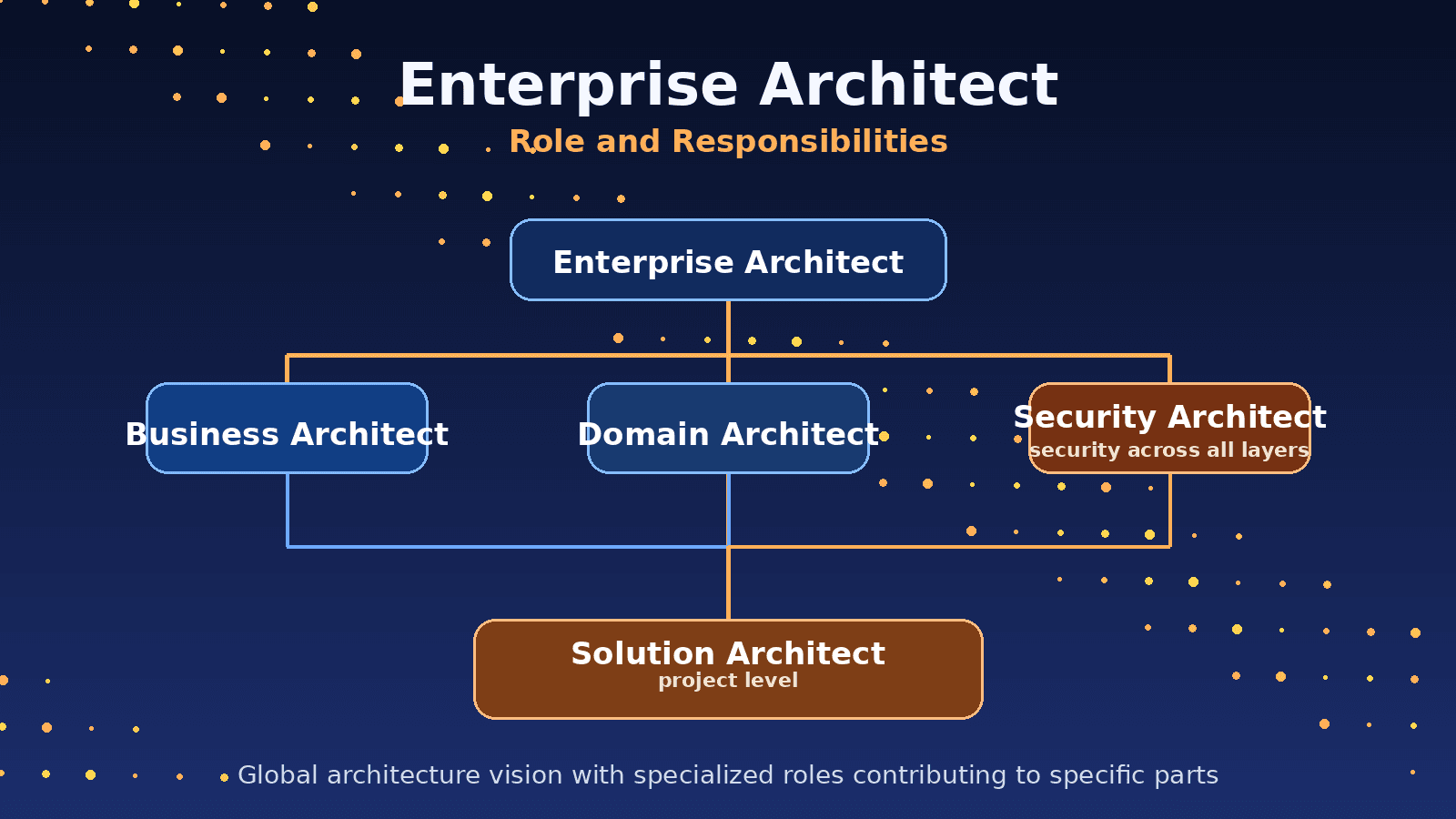
Architecture Is a Team Effort
Enterprise architecture is distributed across specialized architect roles in modern organizations.
Specialized roles cover specific architecture areas while the Enterprise Architect ensures cross-role coherence.
Business Architect
The Business Architect focuses on business-side architecture.
They model business capabilities, value streams, operating models, organizational structures, and business processes.
They translate strategy into operational capabilities and work closely with enterprise architects.
Domain Architect
Domain Architects specialize in specific architecture domains and define principles, standards, and models in those domains.
- Data Architecture
- Application Architecture
- Integration Architecture
- Infrastructure Architecture
- Security Architecture
Understand the strategic role of the Enterprise Architect and how it works with Business, Domain, Solution, and Security Architects.
Solution Architect
Solution Architects work at project or product level and design specific solutions based on enterprise architecture standards.
- Designing system architecture
- Defining integrations
- Selecting technologies
- Ensuring implementation feasibility
Security Architect
Security Architects protect systems, data, and infrastructure through architecture patterns, standards, and policies.
They work with enterprise architects to embed security across all architecture layers.
- Designing security architectures
- Defining security standards and policies
- Preventing threats and vulnerabilities
- Ensuring compliance with regulations
- Implementing secure architecture patterns
How These Roles Fit Together
Enterprise architecture governance typically follows a layered collaborative model.
- Enterprise Architect -> defines global architecture vision
- Business Architect -> models capabilities and strategy
- Domain Architects -> define standards for technical areas
- Solution Architects -> design project-level implementations
- Security Architect -> ensures security across all layers
Why the Enterprise Architect Is Critical
Without strong enterprise architecture leadership, organizations often face:
- Fragmented IT landscapes
- Duplicated systems
- Inconsistent technology standards
- Integration challenges
- Increasing technology costs
Conclusion
The Enterprise Architect is the strategic architecture leadership role in an organization.
While Business, Domain, Solution, and Security Architects focus on specific areas, the Enterprise Architect ensures all efforts converge toward one coherent enterprise vision.
Understand the strategic role of the Enterprise Architect and how it works with Business, Domain, Solution, and Security Architects.
FAQ
What does an Enterprise Architect do?
The Enterprise Architect defines and governs the overall enterprise architecture, ensuring alignment between strategy, business capabilities, systems, data, and technology.
How is an Enterprise Architect different from a Solution Architect?
The Enterprise Architect works at strategic organization level, while the Solution Architect designs architecture for a specific project or product.
Why is the Enterprise Architect role critical?
Without this role, organizations often face fragmented IT landscapes, duplicated systems, inconsistent standards, and rising integration costs.
Strategic links
Compare enterprise architecture platforms
Related articles
From Strategy to Execution: How Enterprise Architecture Drives Business Agility
How EA turns strategic intent into coordinated, measurable execution across the enterprise.
Capability mapping step by step
A practical step-by-step guide to move from capability maps to actionable transformation decisions.
Alternatives to HOPEX: How to Choose an Enterprise Architecture Platform (Without Regretting It Later)
The right alternative depends less on feature parity and more on the architecture operating model you want to run.