


Published on March 28, 2026 | Updated on March 14, 2026 | 14 min read
Capability mapping step by step
A practical step-by-step guide to move from capability maps to actionable transformation decisions.
Key takeaways
- Capability mapping becomes strategic when it directly drives investment and sequencing decisions.
- How to translate strategy into architecture priorities and delivery increments.
- How to align business, data, application, and technology decisions.
Table of contents
- Why capability mapping matters
- What is a business capability?
- Step 1: start with the right objective
- Step 2: define scope
- Step 3: identify Level 1 capabilities
- Step 4: decompose into Level 2 and Level 3
- Step 5 and 6: validate and define
- Step 7 and 8: ownership and heatmapping
- Step 9 and 10: connect and operationalize
- Common mistakes to avoid
- Conclusion
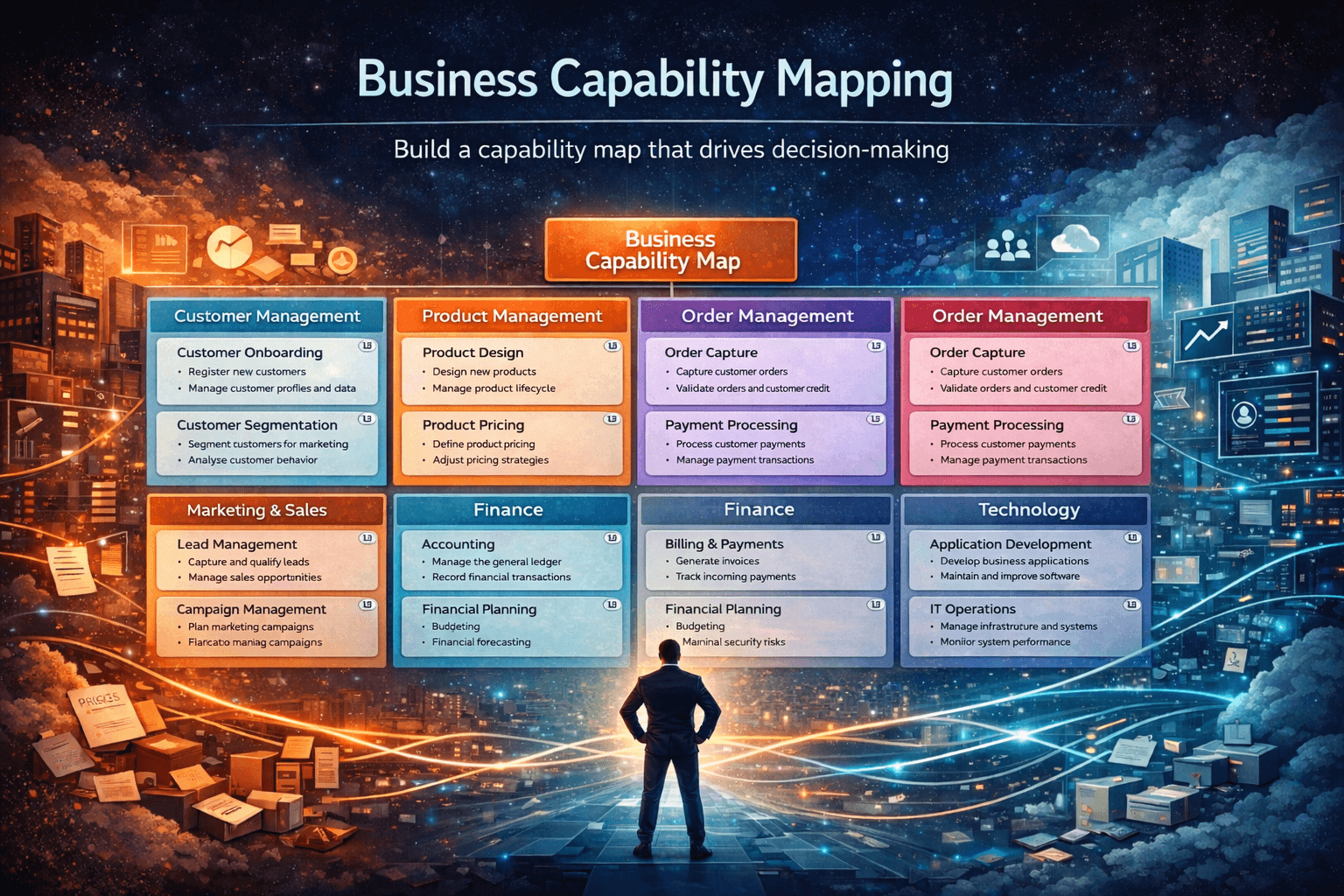
Why capability mapping matters
Most organizations do not lack strategy; they lack a shared, stable view of what the business must be able to do.
Capability mapping provides that view by describing the enterprise through business abilities rather than org charts, projects, or systems.
Done well, it connects strategy to execution and improves transformation decision quality.
What is a business capability?
A business capability is something the enterprise does or must be able to do, expressed in a stable and outcome-oriented way.
Capabilities are not departments, process steps, applications, projects, or job titles.
They describe the business from a what perspective, not a how perspective.
- Examples: customer onboarding, order management, product pricing, financial reporting, workforce planning
- Non-examples: Sales Department, Approve invoice in SAP
Step 1: start with the right objective
Before mapping, define the decision the map is meant to support.
Without a clear use case, capability mapping becomes abstract and difficult to operationalize.
- Transformation program support
- Enterprise architecture baseline
- Business/IT portfolio alignment
- AI and automation opportunity mapping
- Application landscape simplification
- M&A integration planning
- Operating model prioritization
Step 2: define scope
Do not map the full enterprise in deep detail on day one.
Start with a clear perimeter and use Level 1 and Level 2 first.
- Enterprise high-level scope
- Single business domain
- Region or value stream
- Transformation perimeter
- Examples: Sales, Supply Chain, Finance, HR, Digital Commerce
Step 3: identify Level 1 capabilities
Level 1 capabilities are major business building blocks and should remain broad and stable.
- Strategy and Planning
- Product Management
- Marketing
- Sales
- Customer Service
- Supply Chain Management
- Finance
- Human Resources
- Risk and Compliance
- Technology Management
How to build a business capability map that truly supports enterprise decision-making.
Step 4: decompose into Level 2 and Level 3
Decomposition is where capability mapping becomes actionable.
A good decomposition isolates distinct business abilities within each parent capability.
- Use nouns and stable business language
- Avoid process sequencing and system names
- Keep sibling capabilities at similar granularity
- Do not mix capabilities with roles/functions
Step 5 and 6: validate and define
Capability maps must be validated with business stakeholders, not created in an architecture silo.
Each capability should have a clear definition to reduce ambiguity and improve reuse.
- Validation checks: value creation fit, missing abilities, clarity, decomposition consistency
- Definition fields: name, description, business outcome, scope, inclusions, exclusions
Step 7 and 8: ownership and heatmapping
A capability map becomes a governance tool when ownership and maturity are visible.
Heatmaps make prioritization objective by exposing strategic and operational weak points.
- Ownership types: business owner, architecture owner, platform owner, data owner
- Heatmap dimensions: strategic importance, maturity, performance, investment, automation, risk, technical debt, data quality
Step 9 and 10: connect and operationalize
The map becomes enterprise architecture backbone when linked to applications, processes, data, teams, risks, and initiatives.
Its value appears only when it is used repeatedly in real decision forums.
- Use for portfolio prioritization and investment planning
- Use for application rationalization and operating model redesign
- Use for target architecture and post-merger integration
- Use for AI opportunity mapping and roadmap sequencing
Common mistakes to avoid
A capability map has no value if it stays in slideware and does not support decisions.
- Confusing capabilities with processes
- Confusing capabilities with org units
- Going too deep too early
- Making the map too technical
- Building without stakeholder validation
- Not operationalizing the map in governance
Conclusion
Capability mapping is one of the most practical EA tools because it creates a stable language for change.
Projects, systems, and structures evolve, but core business abilities are more stable.
Step by step, capability mapping helps organizations shift from fragmented transformation to intentional design.
How to build a business capability map that truly supports enterprise decision-making.
FAQ
What is a business capability in enterprise architecture?
A business capability is what the organization must be able to do, expressed as a stable business ability rather than a process, system, or org unit.
How detailed should a capability map be at the start?
Start with Level 1 and Level 2 capabilities, then go deeper only where strategic decisions require additional granularity.
Who should validate a capability map?
Business stakeholders must validate the map with architects to ensure it reflects how value is created and where ownership is clear.
Why use heatmaps on capability maps?
Heatmaps expose strategic importance, maturity, risk, and investment gaps so leaders can prioritize transformation objectively.
How do capability maps become operational?
Link capabilities to applications, data, teams, and initiatives, then use the map in portfolio and investment decision forums.
Strategic links
Compare enterprise architecture platforms
Related articles
From Strategy to Execution: How Enterprise Architecture Drives Business Agility
How EA turns strategic intent into coordinated, measurable execution across the enterprise.
Alternatives to HOPEX: How to Choose an Enterprise Architecture Platform (Without Regretting It Later)
The right alternative depends less on feature parity and more on the architecture operating model you want to run.
Enterprise Architecture for the Public Sector: Frameworks, Digital Government, and the Case of Luxembourg
TOGAF, FEAF, Zachman, and national reference architectures help public institutions modernize at scale.