


Published on March 24, 2026 | Updated on March 24, 2026 | 11 min read
Architecture Review Board Template: The Ultimate Guide to Enterprise Architecture Governance
Standardize architecture decisions, accelerate governance, and improve traceability with a structured ARB template.
Key takeaways
- A strong ARB template improves decision evidence quality and prevents recurring exception debt.
- How to design governance that accelerates delivery instead of blocking it.
- How to define decision rights and exception workflows that teams can use.
Introduction
In digital transformation programs, the critical moment is when a solution must be validated before build or deployment.
This is exactly the role of the Architecture Review Board (ARB).
An ARB template provides a structured way to evaluate proposed architectures against shared standards.
What is an Architecture Review Board (ARB)?
An ARB is a technical and architectural governance committee responsible for validating major architecture decisions.
Its objective is to ensure proposed solutions align with IT strategy, follow standards, are scalable and maintainable, reduce technical debt, and integrate with the existing ecosystem.
In short, the ARB protects enterprise architecture coherence.
Why an ARB template is essential
Without a template, reviews quickly become subjective, inconsistent, difficult to compare, and time-consuming.
- Standardization of submissions
- Faster decision-making
- Decision traceability
- Alignment with TOGAF and ArchiMate
Role of ARB in TOGAF
TOGAF ADM includes Architecture Vision, Business Architecture, Information Systems Architecture, Technology Architecture, and Implementation Governance.
The ARB primarily operates in Phase G (Implementation Governance).
At this stage, the board checks target architecture compliance, controls deviations, and approves or rejects solutions.
A complete guide to ARB governance with a practical Architecture Review Board Template aligned with TOGAF and ArchiMate.
Why use ArchiMate in ARB reviews
Architecture reviews are more effective when architecture is visualized clearly.
ArchiMate represents business, application, and technology layers.
- Application Landscape View
- Technology View
- Capability View
Essential sections of an ARB template
A professional ARB template should include at minimum the following sections.
- General information
- Business context and problem statement
- Architecture objectives
- Current architecture (As-Is)
- Target architecture (To-Be)
- Alignment with architecture standards
- Risk analysis
- Impact on the information system
- Decisions required from the board
- Implementation roadmap
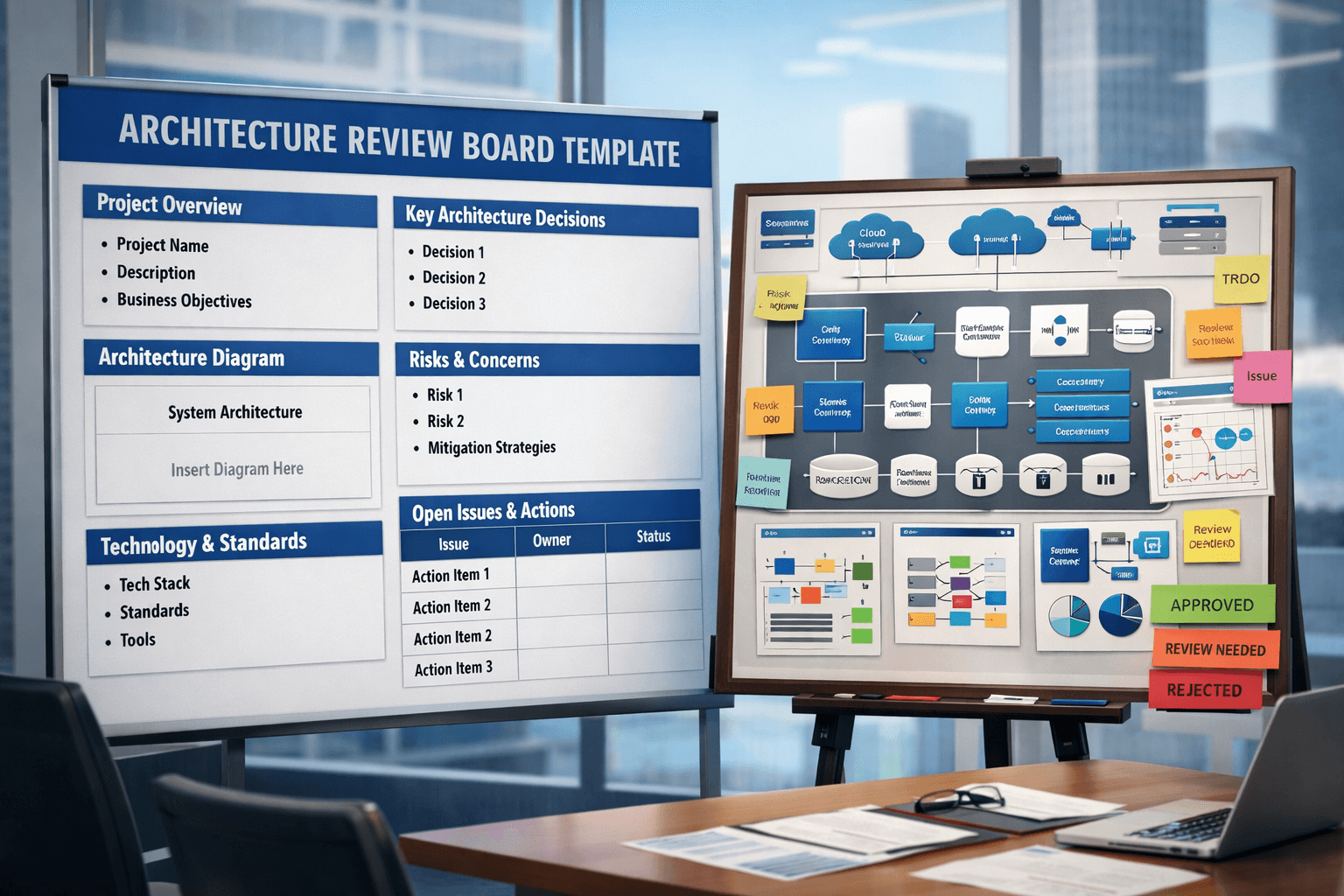
Reusable Architecture Review Board Template
You can use this simplified structure immediately for reviews.
- Project overview
- Business context
- Architecture overview
- As-Is architecture
- Target architecture
- Architecture principles alignment
- Security considerations
- Risks and mitigations
- Implementation roadmap
- ARB decision
Best practices for an effective ARB
Even the best template fails without solid governance discipline.
- Keep reviews short (30 to 60 minutes)
- Share documents at least 48 hours in advance
- Use clear and simple diagrams
- Focus the board on structural decisions
Common mistakes
Frequent governance failures include:
- Overly bureaucratic ARB processes
- Overly technical boards with missing business representation
- Lack of architecture standards
Conclusion
An Architecture Review Board Template is essential to control enterprise architecture, reduce technical debt, and align IT with business.
Combined with TOGAF and ArchiMate, it turns architecture reviews into a clear, fast, and scalable governance process.
Good architecture is not only designed, it is governed.
A complete guide to ARB governance with a practical Architecture Review Board Template aligned with TOGAF and ArchiMate.
FAQ
What is an Architecture Review Board (ARB)?
An ARB is an architecture governance committee that validates major IT and solution architecture decisions before implementation.
Why use an ARB template?
A template standardizes submissions, speeds up decisions, improves comparability, and ensures full traceability of architecture choices.
Where does ARB fit in TOGAF?
ARB governance is mainly connected to TOGAF ADM Phase G (Implementation Governance), where conformity to target architecture is controlled.
Strategic links
Compare enterprise architecture platforms
Related articles
From Strategy to Execution: How Enterprise Architecture Drives Business Agility
How EA turns strategic intent into coordinated, measurable execution across the enterprise.
Capability mapping step by step
A practical step-by-step guide to move from capability maps to actionable transformation decisions.
Alternatives to HOPEX: How to Choose an Enterprise Architecture Platform (Without Regretting It Later)
The right alternative depends less on feature parity and more on the architecture operating model you want to run.