

Published on March 28, 2026 | Updated on March 14, 2026 | 12 min read
Alternatives to HOPEX: How to Choose an Enterprise Architecture Platform (Without Regretting It Later)
The right alternative depends less on feature parity and more on the architecture operating model you want to run.
Key takeaways
- A HOPEX alternative must prove transition feasibility and measurable governance gains in real scenarios.
- How to compare platforms on decision outcomes, not feature volume.
- How to reduce adoption risk with a short but rigorous pilot.
Table of contents
- Alternatives to HOPEX: context and strategic question
- The first mistake: replacing a tool instead of reframing the need
- 1. Governance-centric architecture model
- 2. Transformation-centric architecture model
- 3. Data-driven architecture model
- The real criteria for choosing an alternative
- How major alternatives differ in practice
- The tool is not the hardest part of the change
- Final thought
Alternatives to HOPEX: context and strategic question
Choosing an Enterprise Architecture tool is rarely just a tooling decision.
It is a decision about how architecture will actually be practiced in the organization.
For many large enterprises, HOPEX by MEGA has long been one of the reference platforms. It offers a very broad coverage across enterprise architecture, business architecture, application portfolio management, risk management, and governance.
But over the last few years, many organizations have started to reassess their EA tooling strategy.
Not because HOPEX is weak, but because the way organizations practice architecture is changing.
Architecture is becoming more product-driven, data-driven, collaborative, and connected to delivery teams.
And that evolution changes what organizations expect from an EA platform.
So the real question is not simply "what tool replaces HOPEX?"
The real question is: what architecture practice are you trying to support?
The first mistake: replacing a tool instead of reframing the need
Many EA teams start the evaluation process with a tool comparison: HOPEX vs LeanIX, HOPEX vs Ardoq, HOPEX vs Bizzdesign.
That is usually the wrong starting point.
Before evaluating alternatives, you need to answer a more fundamental question: what role should architecture tooling play in the organization?
In practice, organizations typically fall into three categories.
1. Governance-centric architecture model
This is the traditional EA model.
Architecture is focused on standards, governance, compliance, review boards, and documentation.
In this model, the tool acts as a central architecture repository.
HOPEX was largely designed for this type of practice.
Replacing it with a lighter tool may actually reduce governance capability.
2. Transformation-centric architecture model
Here the focus is not documentation but change management.
Architecture supports transformation roadmaps, capability-based planning, investment prioritization, and portfolio decisions.
In this model, the value of the tool is decision support.
Visualization and analytics matter more than strict modeling completeness.
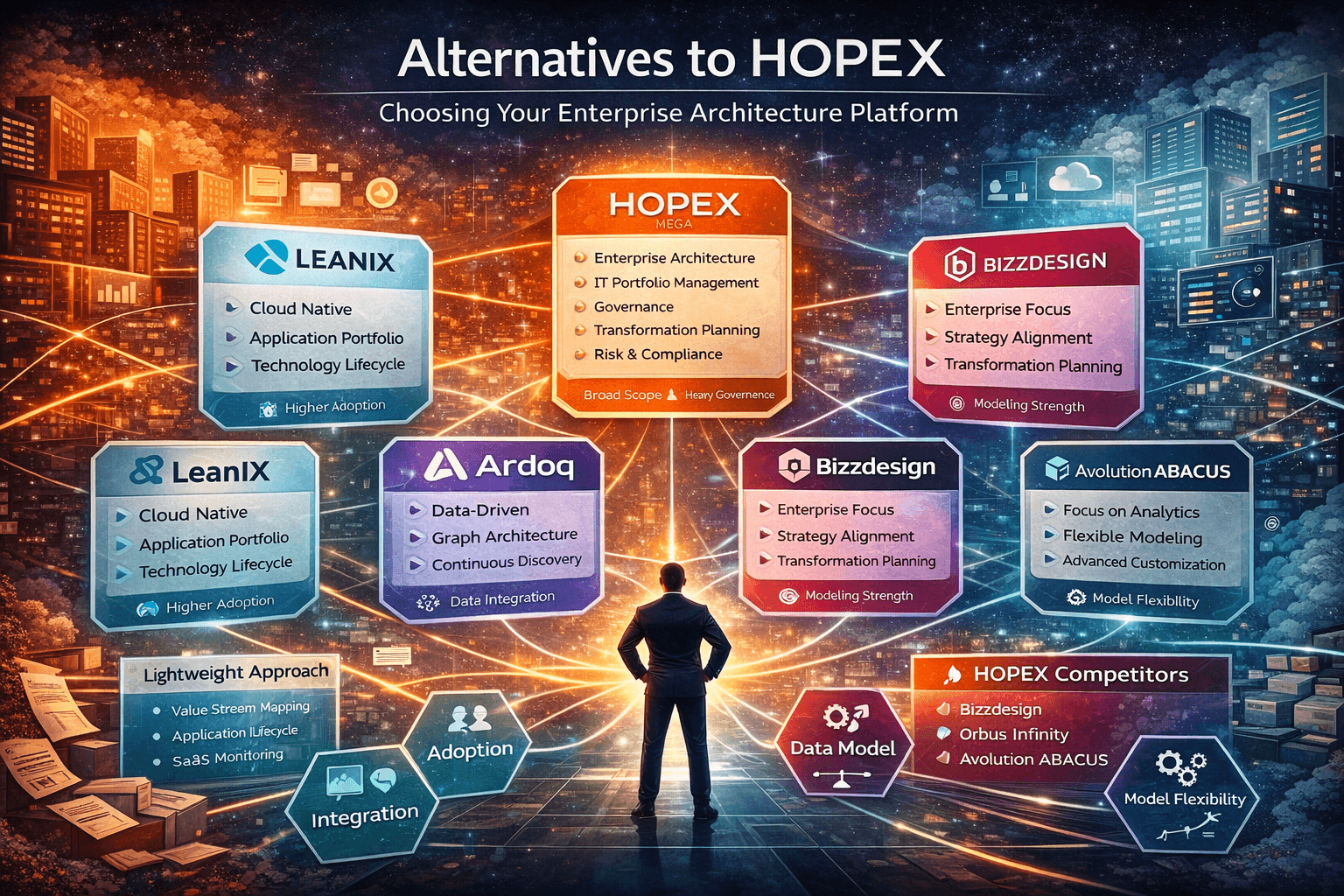
A practical framework to evaluate HOPEX alternatives based on architecture practice, adoption, and delivery integration.
3. Data-driven architecture model
More modern organizations are shifting toward data-driven architecture management.
Architecture is not manually documented.
Instead, the platform ingests data from CMDBs, cloud platforms, DevOps pipelines, code repositories, and SaaS inventories.
The architecture repository becomes a continuously updated data model of the IT landscape.
This is where some modern tools differ significantly from traditional EA suites.
The real criteria for choosing an alternative
Once the architectural practice is clear, the evaluation becomes much easier.
In real projects, several criteria consistently drive the decision.
- Adoption by non-architects: can product teams, domain architects, and managers actually use the platform?
- Data collection model: does the platform support automated discovery, integration with existing systems, and API-driven ingestion?
- Capability mapping and strategic views: are maps, heatmaps, application mapping, and transformation roadmaps maintainable in practice?
- Application portfolio management support: can teams quickly answer risk, redundancy, lifecycle, and capability support questions?
- Integration with the delivery ecosystem: Jira, ServiceNow, GitHub, cloud platforms, and CI/CD tools.
- Metamodel flexibility: deep customization vs governance overhead trade-off.
How major alternatives differ in practice
When organizations move away from HOPEX, several platforms frequently appear in evaluations, each with a different philosophy.
- LeanIX: strong on application portfolio management and technology lifecycle management, with effective visualization, easy onboarding, and strong IT ecosystem integration.
- Ardoq: data-driven and graph-based, strong for dependency mapping, data relationships, and continuous architecture discovery.
- Bizzdesign: closer to traditional EA suites, with strong modeling capabilities, transformation planning, and strategy alignment.
- Avolution ABACUS: known for very flexible modeling and advanced analytics, often chosen for deep customization and complex models.
The tool is not the hardest part of the change
One of the biggest lessons from EA tooling transformations is this: the tool is rarely the hardest part.
The hardest part is redefining who contributes to the architecture repository, how architecture data is maintained, and how architecture supports decisions.
If the architecture practice remains unchanged, replacing the tool will rarely change the outcome.
Final thought
Organizations often search for the best EA tool.
But in practice, the best tool is the one that fits how architecture is actually practiced in the organization.
A platform that perfectly supports a governance-heavy architecture team may fail in a product-driven organization.
And a lightweight platform that works well in a digital company may struggle in a highly regulated environment.
Choosing an alternative to HOPEX is therefore not just a product comparison.
It is a reflection of how the organization wants to practice architecture in the future.
A practical framework to evaluate HOPEX alternatives based on architecture practice, adoption, and delivery integration.
FAQ
What is the most common mistake when replacing HOPEX?
Teams often compare tools first instead of clarifying which architecture practice the platform must support.
How do we know if our architecture model is governance-centric or transformation-centric?
Look at where value is expected: compliance and standards control, or roadmap and portfolio decision support.
Why is non-architect adoption a critical criterion?
If product teams, managers, and domain stakeholders cannot use the platform, the repository becomes isolated and loses decision value.
What should be measured during an alternative evaluation?
Measure decision lead time, data maintenance effort, integration depth, and adoption across architecture and delivery roles.
Can changing tool alone fix architecture performance?
Usually no. The hardest part is changing contribution model, data maintenance model, and decision workflows.
Strategic links
Compare enterprise architecture platforms
Related articles
From Strategy to Execution: How Enterprise Architecture Drives Business Agility
How EA turns strategic intent into coordinated, measurable execution across the enterprise.
Capability mapping step by step
A practical step-by-step guide to move from capability maps to actionable transformation decisions.
Enterprise Architecture for the Public Sector: Frameworks, Digital Government, and the Case of Luxembourg
TOGAF, FEAF, Zachman, and national reference architectures help public institutions modernize at scale.