

Published on March 16, 2026 | Updated on March 14, 2026 | 11 min read
Enterprise Architecture Roadmap: From Strategy to Execution
An EA roadmap connects business capabilities, transformation initiatives, technology evolution, and investment decisions.
Key takeaways
- A roadmap is credible only when it sequences dependencies, funding gates, and capability outcomes together.
- How to translate strategy into architecture priorities and delivery increments.
- How to align business, data, application, and technology decisions.
Table of contents
- Introduction
- What Is an Enterprise Architecture Roadmap?
- Roadmap Focus
- Capability-Based Planning
- Capability Assessment
- Capability Gaps
- From Capability Gaps to Transformation Initiatives
- The Link Between EA Roadmaps and Portfolio Management
- Portfolio Alignment
- EA Roadmaps and Demand Management
- Demand Governance
- Typical Structure of an EA Roadmap
- Short-term (0–12 months)
- Mid-term (1–3 years)
- Long-term (3–5 years)
- Roadmap Balance
- Visualizing the EA Roadmap
- Multi-Layer Impact
- The Role of the Enterprise Architect
- Strategic Reference
- Best Practices for Building an EA Roadmap
- Start with business capabilities
- Integrate with portfolio governance
- Maintain a rolling roadmap
- Keep the roadmap understandable
- Conclusion
Introduction
An Enterprise Architecture (EA) roadmap is one of the most critical tools used by enterprise architects to translate business strategy into a structured transformation plan.
While architecture models describe the current and target state of the enterprise, the roadmap defines how the organization will move from one to the other.
A well-designed EA roadmap connects business capabilities, transformation initiatives, technology evolution, and investment decisions.
It becomes the bridge between strategy and execution.
What Is an Enterprise Architecture Roadmap?
An Enterprise Architecture roadmap is a structured plan that outlines how an organization will evolve its architecture over time.
It typically describes:
- the current architecture state
- the target architecture
- the transformation initiatives required
- the timeline and sequencing of changes
Roadmap Focus
Rather than focusing only on technology projects, a mature EA roadmap focuses on business capabilities and value creation.
This is where capability-based planning becomes central.
Capability-Based Planning
Capability-Based Planning (CBP) is one of the most widely used approaches for building enterprise architecture roadmaps.
Instead of starting with systems or projects, the planning process begins with business capabilities.
Capabilities represent what the organization must be able to do in order to execute its strategy.
Examples include:
- customer onboarding
- digital payments
- risk management
- product configuration
- regulatory reporting
Capability Assessment
Each capability can then be assessed in terms of:
- maturity
- performance
- supporting applications
- supporting data
- technology platforms
Capability Gaps
This allows architects to identify capability gaps between the current state and the target state.
These gaps become the foundation of the transformation roadmap.
From Capability Gaps to Transformation Initiatives
Once capability gaps are identified, the enterprise architect translates them into architecture initiatives.
For example:
Capability Gap Initiative
Customer onboarding Manual processes Digital onboarding platform
Risk analysis Fragmented data Enterprise data platform
Product configuration Legacy systems Product lifecycle platform
These initiatives represent architecture-driven transformation programs.
They are not simply IT projects — they are capability investments aligned with business strategy.
The Link Between EA Roadmaps and Portfolio Management
Enterprise architecture roadmaps must be closely connected to investment portfolio management.
In mature organizations, architecture roadmaps influence which initiatives are funded.
The EA function helps answer key questions such as:
- Which initiatives deliver the most strategic value?
- Which projects contribute to the target architecture?
- Which investments reduce technical debt?
- Which capabilities should be prioritized?
Portfolio Alignment
This alignment ensures that investment decisions support the long-term architecture vision.
Without this link, organizations often fund projects that increase architectural fragmentation.
EA Roadmaps and Demand Management
Another critical element is demand management.
Demand management processes capture new initiatives proposed by business units.
Enterprise architecture plays a key role in evaluating these demands.
Architects typically assess whether a new initiative:
- supports strategic capabilities
- aligns with the target architecture
- duplicates existing solutions
- introduces architectural risk
Demand Governance
When integrated with EA governance, demand management ensures that new initiatives reinforce the architecture roadmap rather than undermine it.
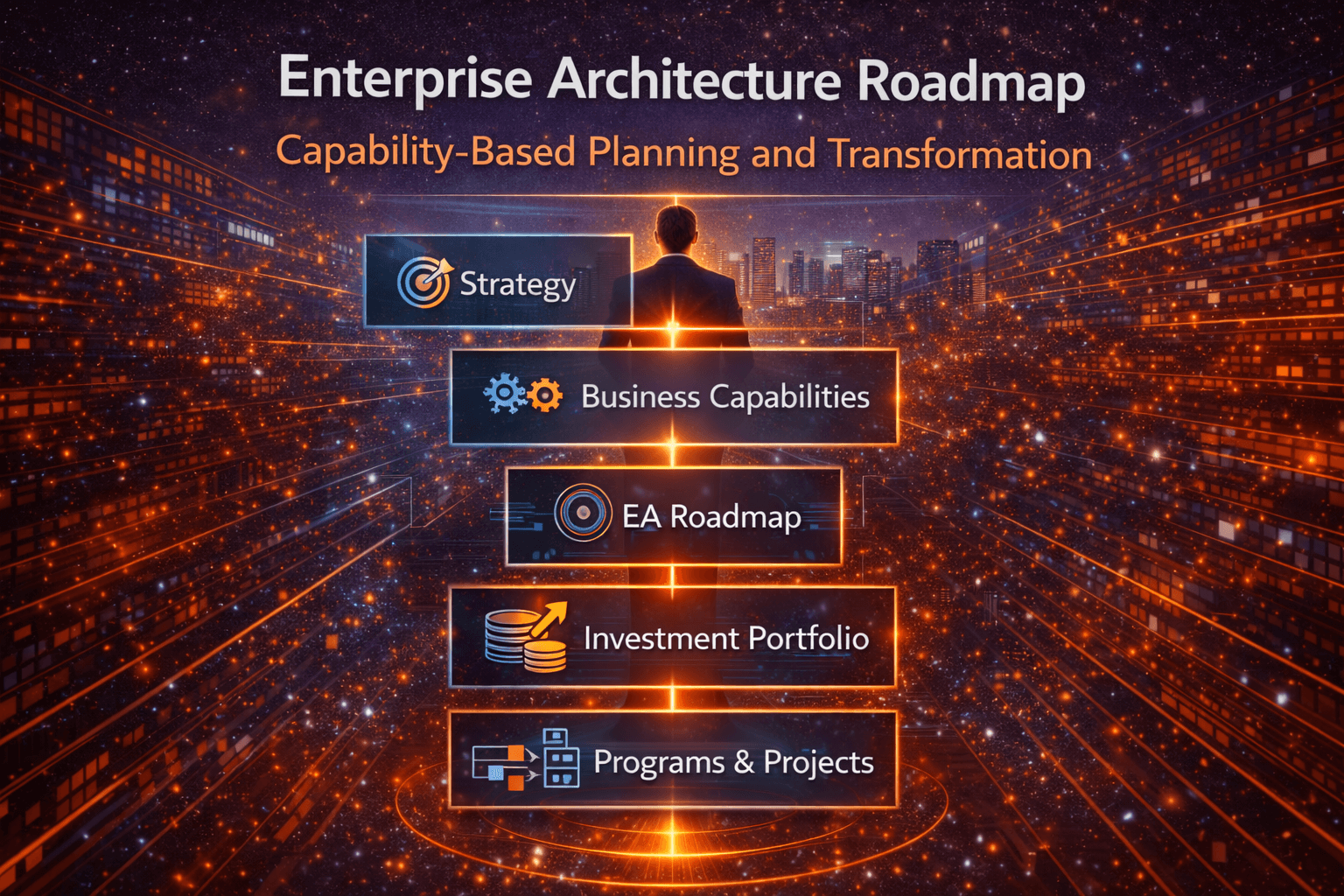
How enterprise architects use capability-based planning, portfolio management, and demand management to execute strategy.
Typical Structure of an EA Roadmap
Enterprise architecture roadmaps are usually structured across several time horizons.
Short-term (0–12 months)
Focus on:
- quick wins
- regulatory initiatives
- urgent technology upgrades
Mid-term (1–3 years)
Focus on:
- major capability transformation
- system modernization
- data platform evolution
Long-term (3–5 years)
Focus on:
- strategic architecture targets
- platform consolidation
- ecosystem integration
Roadmap Balance
This layered roadmap helps organizations balance immediate needs and long-term transformation.
Visualizing the EA Roadmap
Most EA roadmaps are visualized using multi-layer architecture views.
Typical layers include:
- Business capabilities
- Applications
- Data platforms
- Technology platforms
Multi-Layer Impact
This makes it possible to see how transformation initiatives impact multiple architecture layers simultaneously.
For example, a digital banking initiative may affect:
- customer management capabilities
- mobile applications
- API platforms
- identity management systems
The Role of the Enterprise Architect
The enterprise architect plays a central role in maintaining the roadmap.
Their responsibilities include:
- aligning architecture with business strategy
- identifying capability gaps
- prioritizing transformation initiatives
- supporting investment decisions
- governing architectural consistency
Strategic Reference
In many organizations, the EA roadmap becomes the strategic reference for digital transformation programs.
Best Practices for Building an EA Roadmap
Experienced enterprise architects follow several best practices.
Start with business capabilities
Roadmaps should focus on business value, not only technology upgrades.
Integrate with portfolio governance
Architecture roadmaps must influence investment decisions.
Maintain a rolling roadmap
Roadmaps should evolve continuously as strategy and market conditions change.
Keep the roadmap understandable
Roadmaps should be clear enough for executives and business leaders.
Conclusion
An Enterprise Architecture roadmap is the key instrument that allows organizations to move from strategic intent to practical execution.
By combining capability-based planning, portfolio management, and demand management, enterprise architects can guide transformation initiatives in a coherent and sustainable way.
When used effectively, the EA roadmap becomes the strategic compass for enterprise transformation, ensuring that investments, projects, and technology evolution all support the organization’s long-term vision.
How enterprise architects use capability-based planning, portfolio management, and demand management to execute strategy.
FAQ
What is an Enterprise Architecture roadmap?
An EA roadmap is a structured plan that explains how the organization will move from current architecture to target architecture over time.
Why is capability-based planning important in roadmap design?
Because it starts from business capabilities and capability gaps, ensuring transformation initiatives are directly tied to strategy and value creation.
How does an EA roadmap support investment decisions?
It links architecture priorities with portfolio governance so funding decisions support target architecture and long-term strategic outcomes.
Strategic links
Compare enterprise architecture platforms
Related articles
From Strategy to Execution: How Enterprise Architecture Drives Business Agility
How EA turns strategic intent into coordinated, measurable execution across the enterprise.
Capability mapping step by step
A practical step-by-step guide to move from capability maps to actionable transformation decisions.
Alternatives to HOPEX: How to Choose an Enterprise Architecture Platform (Without Regretting It Later)
The right alternative depends less on feature parity and more on the architecture operating model you want to run.